This week I attended one of the National Emergency Briefing screenings near me. While I wasn’t a fan of the Celebrity Gogglebox presentation style, with Chris Packham on the sofa seeing what Jennifer Saunders and others thought about the climate emergency, it did give me enough of an idea about the individual presentations to want to follow them up, and there is a really good website to do so here.

The two points which struck me particularly were the following:

  1. Professor Tim Lenton warning about what would happen if the weakening Atlantic Meridional Overturning Circulation (AMOC) hit a tipping point which, in some models, “shows that London would be -20°C in three frozen months of the year, and Edinburgh would be -30°C in five and a half frozen months of the year. And yet the summers will still be hotter than today because it’s a 2°C warmer world.”
  2. Professor Hayley Fowler warning of the risks of mega floods: “These storms can produce two thirds of a year’s rainfall in just a couple of days. Over London, that would mean about 35cm of rainfall falling over a large area. A flood of this scale will be a national crisis. Recovery would take years.” She also warned that by 2050 1 in 4 properties – 8 million in England – will be at risk of flooding.

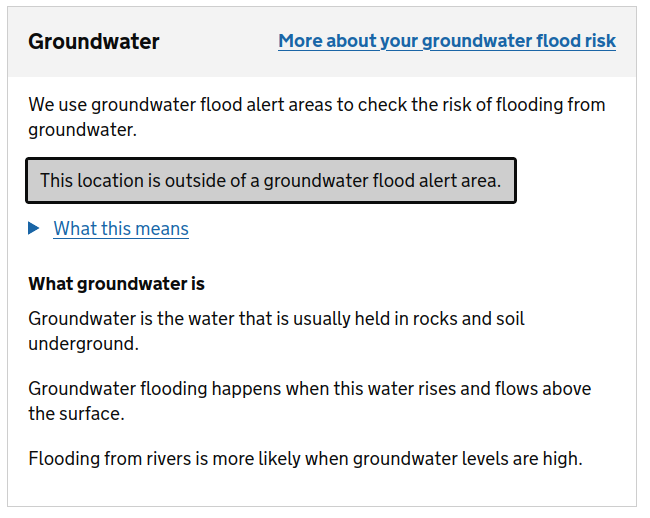
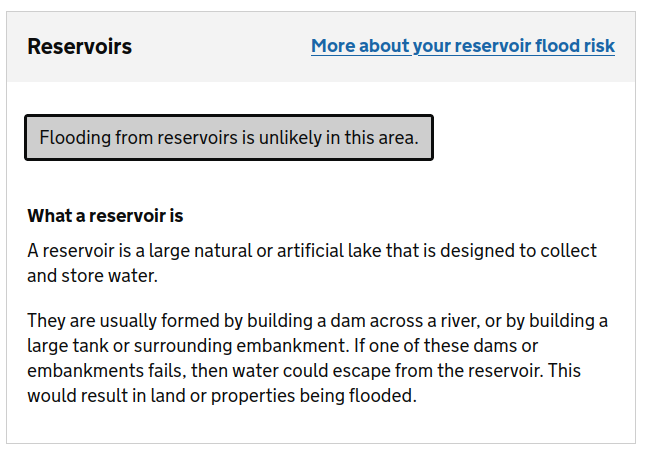
And since flooding often follows a heatwave such as the one we are currently experiencing, I thought I would look at the risk of long-term flooding in a bit more detail, which is when I came across the government’s check the long term flood risk for an area in England website. When you put in your postcode, it assesses your flood risk under four different categories:
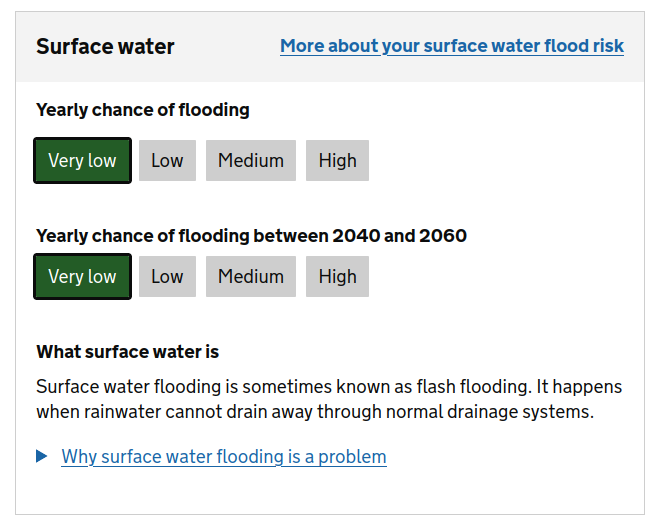
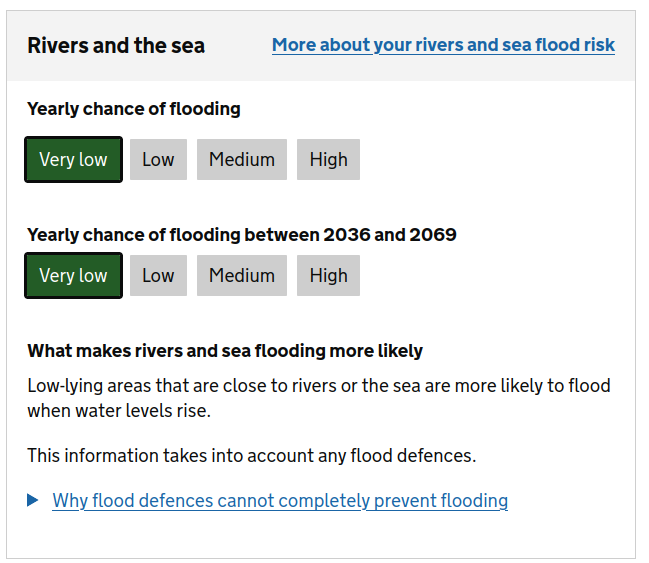
It then explains how they measure the risk and the kinds of things which tend to affect it. All in all a good resource, and the modelling behind it is what the 1 in 4 properties at risk of flooding by 2050 is based on.

In July 2021, several European countries were affected by severe floods. The floods started in the United Kingdom as flash floods causing some property damage. Later floods affected several river basins across Europe including Austria, Belgium, Croatia, Germany, Italy, Luxembourg, the Netherlands, Romania and Switzerland. At least 243 people died in the floods, including 196 in Germany, 39 in Belgium, two in Romania, one in Italy and one in Austria. It was thought that some of the affected regions may not have seen rainfall of this magnitude in the last 1,000 years.

A study using climate simulations on a grid of 2.2km squares published in June 2021 had come to the following conclusion:

Intense rainstorms are expected to be more frequent due to global warming, because warmer air can hold more moisture. Here, using very detailed climate simulations (with a 2.2 km grid), we show that the storms producing intense rain across Europe might move slower with climate change, increasing the duration of local exposure to these extremes. Our results suggest such slow-moving storms may be 14× more frequent across land by the end of the century. Currently, almost-stationary intense rainstorms are uncommon in Europe and happen rarely over parts of the Mediterranean Sea, but in future are expected to occur across the continent, including in the north. The main reason seems to be a reduced temperature difference between the poles and tropics, which weakens upper-level winds in the autumn, when these short-duration rainfall extremes most occur. This slower storm movement acts to increase rainfall amounts accumulated locally, enhancing the risk of flash floods across Europe beyond what was previously expected.

As Professor Fowler says:

Our infrastructure was built for a climate that no longer exists. Raised reservoirs, drainage, housing and transport were designed many years ago when extreme rainfall was rare and less severe. As rainfall intensifies, risks such as dam overtopping and cascading failures rise.

The government also produces monthly reports on rainfall, soil moisture deficit, river flows, groundwater levels and reservoir levels. This includes a wonderful map of the year’s rainfall:
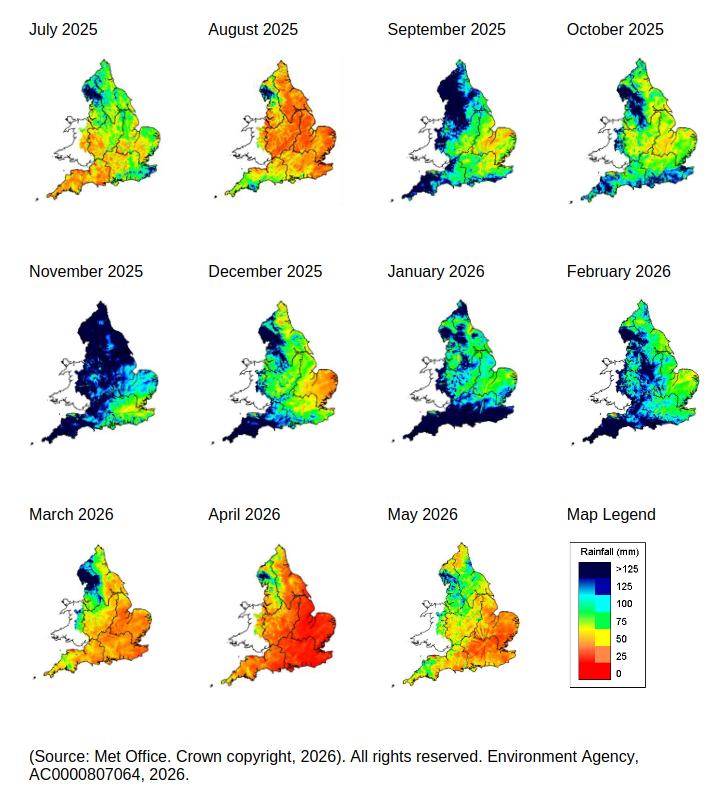
What struck me was that the report looked at exactly the same things (river levels, groundwater levels and reservoirs) but, because they were concerned with low levels of rainfall, did not even mention flood risk. The rainfall scale only goes up to >125mm rainfall within a month as a maximum, which looks hilarious when compared with the 271.5mm of rainfall over 48 hours in parts of Belgium in 2021.

There have been no new reservoirs built in the UK since 1992, just another one of the gifts of water privatisation discussed previously. The government announced last year that it had “seized control of the planning process” to build two reservoirs due to be complete in 2036 in the Cambridgeshire Fens and 2040 near Sleaford in Lincolnshire respectively.

Professor Fowler says the probability of dam overtopping is increasing. So how’s the review of reservoir safety going?

In 2019, there was a failure of a dam at Toddbrook Reservoir in the Peak District. The operation to pump water out of the reservoir to safeguard Whaley Bridge seems to have been dominated by concerns about the fish. The independent review commissioned into the incident identified the rather alarming fact that:

“…the reservoir and its Owner can be compliant with the legislation without the reservoir necessarily being safe.”

Among the report’s recommendations were the following:

  • There is a systematic review of how the current Reservoirs Act, and the associated Regulations and Guidance, are implemented. This should consider the roles and responsibilities of qualified engineers, whether compliance with the Act is sufficient to ensure safety, and how safety is formally assured.
  • The potential of an Inspecting Engineer issuing a Certificate of Safe to Operate be explored. This should include a review of practice in other safety critical infrastructure sectors. It should also consider liability implications and whether some form of qualifying statement may be needed to accompany the certificate.
  • The statutory maximum period between inspections is reviewed to determine if it is still appropriate in every case in the light of the ageing reservoir stock.

In his follow up report looking at the reservoir system in general in 2021, Professor David Balmforth made this extraordinary statement:

This raises the question of what is meant by “safe”. In other infrastructure sectors and with reservoirs in other countries, safety is assured by managing risk, and by reducing that risk so far as is reasonably practicable – the terms “reasonable” and “practicable” being well understood in practice and in law. For a reservoir, risk is defined as a combination of the likely failure of the dam (or other reservoir structure) and the impact that an uncontrolled release of water would have on the area downstream, particularly the likely loss of life. I have therefore recommended that in future the assurance of reservoir safety should be managed on the basis of risk, and that the amount of effort (and cost) associated with that process should be in proportion to that risk. In this way the public can be assured that the hazard posed by reservoirs is being managed in an objective and transparent way.

It would appear that reservoir management is playing catch up on the whole concept of risk management.

What has followed is a policy paper from the Environment Agency on the launch of a reservoir safety reform programme. However the public consultation on the proposed reforms has already been delayed until later this year. And the page about the consultation process does not suggest anyone is in any hurry.

A no entry sign over an image of a reverse-centaur where the robot is in control

As I discussed in How Not To Be A Reverse-Centaur (Cory Doctorow defines a reverse-centaur as “a machine that is assisted by a human being, who is expected to work at the machine’s pace”) our actuarial education system needs to change. This has been true for some time, but the development of AI systems has both demonstrated why more clearly and accelerated the timeframes over which action is needed. As I said in December last year:

A large part of the education of the future will need to be about equipping us all to understand what we now have access to and when and how to access it. We will all have different things we are interested in, or end up involved with and needing to be educated about. It will be up to each of us to decide which things are worth the difficulty of learning, but to make those decisions we will need education that can support the development of judgement.

For education institutions, the question will be what is not worth the difficulty of learning? Credentialising based on now relatively meaningless assessment methods will not cut it. This is where the confrontation with employers and politicians is likely to come. Essential skills and their related knowledge will be better developed and assessed via more open-ended project work and online assessment of it to check understanding. These will need to become the norm, with written examinations becoming less and less prevalent. Not because of fear of cheating and plagiarism, but because an outcome which can be replicated that easily by AI is not worth assessing in the first place.

Suppose you were to ask someone who had never seen our academic system that, in order to assess whether someone else we wanted them to employ in their organisation would do a good job for them, we would:

  1. Award marks for what has been written in answer to academic questions about what the students can remember unaided about the content of their lecture courses and reading lists with a biro on a pad of paper perched precariously on a tiny wooden table surrounded by hundreds of other similar scribblers, for a set period of time as minders wandered the floors like Victorian factory owners.
  2. These marks would be based on marking criteria they would never see.
  3. We would then get together in a secret huddle for a couple of months to mark all these scripts, check them and “moderate” them to check they were in line with the previous years’ exercises.
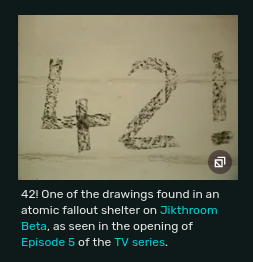
  4. Then out would come the answer (like the Answer of 42 to the Ultimate Question of Life, the Universe and Everything in Douglas Adams’ The Hitchhikers Guide To The Galaxy).

Source: https://hitchhikers.fandom.com/wiki/42

Imagine another world where the kinds of things employers routinely do when trying to decide whether to take on someone as a new member of their organisation are routinely part of their assessments at university, eg:

  • Watch them operating in groups working on a task.
  • Ask them to describe how they would go about tackling a particular problem.
  • Get them to show they understand the implications of a piece of work they have carried out and can explain what assumptions it is based on and can justify them.

With assessments of performance which are not opaque academic exercises but descriptions of performance made as the tasks are being carried out evidenced by video if necessary. In other words, transparent enough to whoever might want to work with these students next to eliminate the gap between their credentials and and their actual actionable skills, knowledge and experience.

Assessing in this way will be highly demanding, for both the students and the assessors, but it means the final assessment is done with the student present and, with careful probing from the assessors, who will obviously need to have done a close reading of the project work beforehand, confidence will be high about the abilities demonstrated by the process. And it removes the need for all the time currently spent on the Victorian factory owner process – imagine what could be done if the whole of May, June and July wasn’t spent marking scripts!

A move like this will significantly change what is taught. There will be no point presenting lots of information in ways which make retention easier for students (the so-called bookwork” questions currently in most exams). This makes sense when you think about how much of the content of your courses is accessible to you now, even on a vocational course like actuarial science, as opposed to skills developed. Instead the focus will be more on conversations with students for the purpose of developing their understanding of a meaty topic and the problems to be solved within it. Explorations of these will form the projects students will be spending most of their time working on. Checking understanding and making sure students are working within frameworks they understand and can talk about will be the main teaching activity, with opportunities to practise these throughout the year. In other words, showing the ability to apply what they have understood and demonstrate the ability to reflect, make judgements and show higher levels of understanding as a result. An ability they can then apply to new problems and situations.

And notice something else about how these alternative credentials are generated? They are all social activities: from operating in groups, to presenting a piece of work to a group of assessors. Even the project work is developed through group sessions alongside individual work. If you want to develop people who can spot the gaps between models and reality you need to do it in groups, where people can test their perspectives against each other.

Compare this to the current solitary exam preparation, peppered with “revision” lectures, exam sitting and exam marking processes which comprise the predominant activities in universities between March and July each year. We are currently being funneled into an ever more solitary professional practice around LLMs. It has become quite accepted for people to do all of their thinking on a subject closeted with perhaps one, two or three LLMs but no other people and then share their analysis with an expectation that other people should read the output. Developing the skills to do these analyses will obviously be necessary, but they will never be the most important skills people learn.

Treating each other like walking databases is never going to make you new friends or influence people. However the skills you develop via an alternative more social education will.

There are examples of this approach already happening, with employers involved in the design of assessments in some cases and universities using the flexibility they have to restructure and redesign courses. But the dominant assessment system of formal exams is keeping much of this activity at the margins at the moment.

If it were to become the dominant assessment, it would also mean that larger areas of the curriculum could be examined, as the focus would not be on retention of large bodies of content but the ability to use the content to solve problems. So, perhaps, after a first year levelling up students’ ability and experience of mathematics and statistics, year 2 would have an actuarial statistics module (currently CS1/CS2) and an actuarial mathematics module (currently CM1/CM2), both dissertation based and vivaed. Then in the third year they would tackle an economics module and a business modules (currently CB1 and CB3). Perhaps in the final year of a four year MAct they would tackle a modelling and communication module (CP2/CP3) and either CP1 actuarial practice module would be offered or a professional skills module.

This would be more of a driving test style of assessment, with students working with supervisors on the comments from assessors on the original dissertations and presentations until they were up to the required standard. Students unable to make the standard after an additional year would be offered a move to a non-accredited course. The current funding model for higher education will need to change: loading students with £10,000 more debt every time they add to the nation’s skills bank with another year wrestling with these difficult skills to master was never a clever strategy, but this structure would make it even clearer how self defeating it is. If economists are accepting that the labour market no longer allocates resources effectively and are considering either a universal basic income or universal basic services, then logically university funding should follow suit.

The implications for the actuarial profession will be even more challenging. I question whether the Institute and Faculty of Actuaries will continue to consider it worth the effort and expense of reconfiguring their entire approach to exam setting, syllabus maintenance, marking, online proctoring, etc for subjects routinely taught throughout the university system for a a variety of purposes, ie the current core principles subjects of mathematics, statistics and business studies.

Whether they retain their own capacity to assess the core practice subjects is a more open question (CP1 Actuarial Practice, I imagine, will be seen as sufficiently specialist to keep in house, with perhaps a few universities, as now, accredited to run courses which can earn this qualification, however CP2 Modelling and CP3 Communications are not nearly as specialised now as they seemed when they were first introduced). I would also move the new core economics module recommended by the IFoA Economics Review Group I chaired in 2022 to replace the current CB2 module into the core practice section, as it would be more of a critical thinking module about the economic ideas necessary to underpin good actuarial work than the technical how-to subjects in core principles.

The specialist stage of the SP and SA subjects and the whole continuing education and additional certification options I would confidently expect the profession to retain, review and adapt as needed to reflect new challenges in members’ working lives. However, if CP1 is all that is needed post graduation to get to Chartered Actuary and CP1, two SP subjects and a SA subject gets you to Fellow, then suddenly time to qualification becomes much more predictable for students and their employers alike.

The risks to employers of taking on students would therefore be reduced, but also the rewards to taking them on will be much more transparent. The students we will be developing will have collapsed the gap between their credentials and their actual actionable skills, knowledge and experience. They will have:

  • Great team working skills;
  • Very highly developed presentation skills, both in writing and speech;
  • Strong IT skills and comfort working with data; and
  • Clarity about why they are in an organisation and a drive to use their skills to solve problems.

They will also have developed the four capabilities set out in Carlo Iacono’s Teach Judgement, Not Prompts:

  1. Epistemic rigour. They will be more likely to spot when a system or model is over-confident given the evidence, after an intense experience of interrogating models and evaluating evidence in their courses.
  2. Synthesis. They will be able to integrate different perspectives into an overall understanding, through dissertation development, defending a position, understanding weaknesses in a position and adjusting accordingly.
  3. Judgement. They will have been asked to make many judgements in their work and had to defend them in discussions with their supervisors and fellow students. Unconvincing opinions, not backed by evidence, will not pass muster.
  4. Cognitive sovereignty. Students will have to take their own stand on their work, after all of the challenge and argument. Independence of thought is the hard-earned outcome here.

And then they will have a fighting chance of being centaurs in the world awaiting them, masters of the technology and opportunities available, rather than the reverse-centaurs that our education system is currently, and inadvertently, preparing them to be.

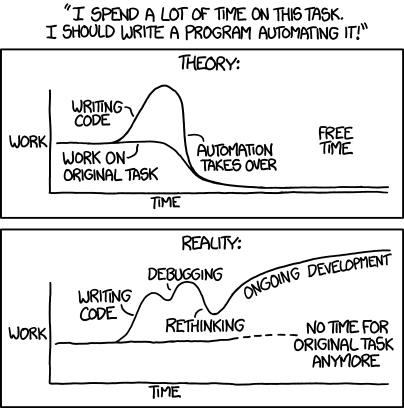
Source: https://xkcd.com/249/ This work is licensed under a Creative Commons Attribution-NonCommercial 2.5 License

It all started for me in May 2017, with the challenge from Daniel and Richard Susskind in their book “The Future of the Professions”, which set out two possible futures for the professions. Either:

  • They carry on much as they have since the mid 19th century, but with the use of technology to streamline and optimise the way they work; or
  • Increasingly capable machines will displace the work of current professionals.

Their research suggested that, while these two futures would exist in parallel for some time, in the long run the second future would dominate. The actuarial profession was going to be particularly vulnerable. As the Susskinds wrote:

Accountants and consultants, for example, are particularly effective at encroaching on the business of lawyers and actuaries.

I stood in the Institute and Faculty of Actuaries Council elections that month, on a platform saying that we needed to urgently respond to this challenge. I didn’t get elected.

However, at the University of Leicester we pursued a curriculum transformation programme in response to this challenge aimed at developing actuaries of the future who had:

  • Highly developed presentation skills, both in writing and in speech
  • Great team working skills
  • Strong IT skills – comfortable with working with data
  • Clarity about why they are there and the desire to use their skills to solve problems

The 2017 post also talked about emerging trends which had hardly started at all yet:

  • The end of reserved roles for actuaries
  • Different ways of communicating advice
  • Online self-help for users of actuarial advice
  • The advance of roboactuaries and their assistants

A paper called 2036: An actuarial odyssey with AI written for the Society of Actuaries in July 2016 by Dodzi Attimu and Bryon Robidoux discussed the possibilities for robo actuaries and robo actuarial analysts.

They estimated that robo actuarial analysts would be with us in 5-10 years and would provide:

A system that has limited cognitive abilities but can undertake specialized activities, e.g. perform the heavy lifting in model building (once the specification/configuration is created), perform portfolio optimization, generate reports including narratives (e.g. memos) based on data analysis, etc.

Whereas a robo actuary was more like 15-20 years away and which they also helpfully described:

We mean a software system that can more or less autonomously perform the following activities: develop products, set assumptions, build models based on product and general risk specifications, develop and recommend investment and hedging strategies, generate memos to senior management, etc.

Then, in 2018, there was the whole Bullshit Jobs argument posed by the late David Graeber, discussing Keynes’ prediction in 1930 that:

In quite a few years – in our own lifetimes I mean – we may be able to perform all the operations of agriculture, mining, and manufacture with a quarter of the human effort to which we have been accustomed.

Graeber, in Bullshit Jobs, pointed out that this never happened, despite pretty much all of the technological developments and income increases which Keynes predicted. He suggested that the future which the Susskinds were predicting is already happening in terms of needing fewer people to fill the meaningful roles within organisations but that, rather than employing fewer people, we are either creating “bullshit” jobs which even the people doing them can see no point to or bullshitizing existing roles for which the meaningful need has passed. It was as if the organisations themselves have attempted to maintain the outward appearance of the same structures by disguising the hollowing out of so many of their functions with simulated business.

Why? One of the reasons he thought the situation had been allowed to develop was that noone believed that capitalism could produce such an outcome. Graeber gave the example of the creation of Obamacare, where Barack Obama “bucked the preferences of the electorate and insisted on maintaining a private, for-profit health insurance system in America” in order to protect jobs in health insurance.

Then we had the pandemic, and the painful return to work which found that people were not necessarily keen to return to populating those office empires, preferring to work remotely. Some of the attempts by the captains of industry to get them back were a little desperate.

Now nine or ten years on from the initial challenge, we are deluged in articles about how AI is impacting different areas of actuarial work, whether it is already replacing graduate roles and what actuarial students need to do to make themselves employable. And now the blinkers also seem to have come off about capitalism not producing the need for fewer jobs.

Ian Pay of the ICAEW’s quote from last year was just one example:

Historically, accountancy firms have typically had a pyramid structure – wide base, heavy graduate recruitment. Firms are now starting to talk about a ‘diamond model’ with a wide middle tier of management because, ultimately, AI is not sophisticated enough yet to make those judgment calls.

But hang on a moment. Now there is something called an “AI boomerang”. Sam Altman of Open AI and Dario Amodei of Anthropic have both been backtracking on their predictions of job lay offs due to AI. As the Gold and Geopolitics Substack puts it:

Two-thirds of the companies that ran AI-driven layoffs last year are now rehiring. One in three spent more on the rehiring than they saved on the original cuts. Robert Half calls them “AI boomerangs” – which is the name a consultant invents when there’s a market in unwinding what the last consultant sold you.

The last few years of AI-generated headlines (in both senses of the phrase) have been quite the rollercoaster.

I do not want to add to the deluge, as currently you would need a LLM summarising reports for you 24/7 just to keep up with it as it is.

And there are good reasons for not rushing to judgement on this. It is only six weeks ago that the Bank of England’s Head of Financial Stability warned that global stock markets are overvalued. As she said:

The thing that really keeps me awake at night is the likelihood of a number of risks crystallising at the same time – a major macroeconomic shock, confidence in private credit goes, AI and other risky valuations readjust – what happens in that environment and are we prepared for it?

Since then, the economics of the major AI players has only got more bonkers. In this environment, there is considerable uncertainty about what students should be learning to prepare them for the world they will need to rebuild from the rubble of the current one.

Daniel Susskind reckons a “no regret” strategy for education would focus on the basics, which he describes as literacy, numeracy and critical thinking, and the critical use of AI. Carlo Iacono talks about the work which will always be hard to automate as follows:

The work that depends on reading a room. The work that relies on institutional memory. The work where the important fact is not in the document. The work where the answer is political, ethical or relational as much as technical. The work where being right is not enough, because someone has to be accountable for the consequences.

But you have to get into the organisation first before you can develop much of this. I remain reasonably comfortable with our prescription from 2017 in terms of broadly what the curriculum should be trying to achieve. Curriculum changes take time and, tempting though it is to pile into syllabus changes aimed at incorporating the latest cutting edge technological developments, the likelihood is that you will be arriving at the wrong fire. As a social media post this week put it:

The danger is that, as Agentic AI in particular looks so much like the predictions of 2016, we declare it the new messiah and bet everything on this being the future. I certainly think that 2036 will look very different to now, but I am not convinced that we have the shape of it yet. This may just be another bullshit alternative, waiting for the next crisis to mutate into something else.

What we can say with certainty is that the future for early professionals is as uncertain as any of us can remember. And, in my view, the best way to support our young people starting their professional lives (or whatever is going to replace professional lives) is to make the value they add much clearer to anyone who might want to work with them in the future.

Future education systems are going to need to help their graduates demonstrate their value in ways they haven’t historically needed to. AI has not brought new problems, it has accelerated existing ones. And the gap between actual actionable skills, knowledge and experience and the credentials which are supposed to represent them is the key one I believe as far as those graduates are concerned.

Because currently the companies who might want to take them on have to guess what they can do to a large extent. What does a 1st mean? A 2.1? Do the differences matter to their employer? Should they interrogate the details of student courses? How would they incorporate that into a manageable recruitment process? Some people see a future of AI generated applications by the thousand per student doing battle with AI powered triage systems operated by potential employers.

This is already an issue in academia. The conclusions of one academic paper on submissions to one major academic journal were stark:

Submission volume has risen 42% since the late 2022 release of ChatGPT, while writing quality has declined. The rise in AI-generated writing accounts for nearly all of these trends.

On the other hand, researchers complain about the increasing use of AI peer review to try and cope with these increased volumes, and some have tried to game the LLMs they believe they are dealing with.

I think we can do better than this in actuarial teaching and learning.

And this will be the subject of my next post.

Source: https://xkcd.com/1319 This work is licensed under a Creative Commons Attribution-NonCommercial 2.5 License

I didn’t understand statistics until I started taking actuarial exams that required me to master particular statistical techniques, decide which ones were appropriate to the problem I was looking at, apply them accordingly and be able to interpret what the results did and didn’t tell me. An A at GCE O level in maths, and A at GCE A level in both maths and further maths and a maths degree from Oxford did not give me those abilities.

I didn’t understand economics until I started putting together modules which could be taught on both BSc and MSc courses and then teaching them. My economics module on the way to qualifying as an actuary, based very heavily on Economics by Begg, Fischer and Dornbusch, did not give me that understanding.

There is a pattern here: the most impactful experiences we have are frequently at a bit of a distance from the credentials we present to the world. Your education is not a paragraph on your CV, it is your lived experience, sometimes assisted by, sometimes actively hindered by and often pursued completely independently of the educational institutions you have had a relationship with during your life.

Daniel Susskind has marched into this often fraught relationship between credentials and actual actionable skills, knowledge and experience in the last lecture of his Gresham College series on The Future of Work, called Education – And Its Limits. His analysis is a very clear expression of the problems that will be created if AI systems prove to be half as capable and long-lasting as people from OpenAI and Anthropic are telling us they will be.

Susskind argues that trying to future-proof students through education was a hopeless task and that working on the assumption of unresolvable uncertainty was the better way forward. He suggests a “no regret” strategy for education would focus on the basics, which he describes as literacy, numeracy and critical thinking, and the critical use of AI. Others in the audience suggested some other “basics”: communication skills for instance.

The other strand of Susskind’s basics was critical use of AI. And his challenge to the audience was whether we can teach AI without losing the basics in the process.

After a bit about the need to make continuing education in later life more accessible, he looked at his list from a previous lecture (which I briefly touched on here) of problems for a post AI future:

  1. Distribution (replacing wages);
  2. Contribution (how do you “pull your weight”);
  3. Power (domination by Big Tech on economics, politics, liberty, social justice and democracy); and
  4. Meaning (fulfilment in life).

And this is why I continue to watch Susskind’s output, because he is the unusual combination of an extremely orthodox economist (see his book Growth: A Reckoning for proof of this) and someone who has been wrestling with the challenges of more capable systems to our way of doing things for over 10 years. What Susskind gives you is a peek at how the actual economists advising our governments would deal with things if OpenAI and Anthropic are proved right. It is as if you had someone who both thought, as Ben Bernanke, Chair of the Federal Reserve, did in October 2007, that “the banking system is healthy” and also that the banking collapse was going to happen anyway.

Because what he reveals is that, if Anthropic are right, orthodox economists have really got no policy prescriptions worthy of the name.

On 1. Distribution: Susskind acknowledges that, if the labour market could not redistribute wealth effectively any more, then a bigger state would be needed to do so (but he was at pains to emphasise that this would not be the 20th century central planning type of state).

On 2. Contribution: Susskind thinks that perhaps we should allow people to make non-economic contributions! As if all of the activity in society which economists routinely ignore really wasn’t already happening!

On 3. Power: Susskind says the political power of Big Tech with regard to liberty, social justice and democracy is a problem. We have anti-trust legislation that can deal with Big Tech’s economic power, but not its political power. I don’t know what kind of political power he thinks Big Tech would have without the economic power that has been granted it by a steady erosion of that anti-trust legislation over recent years.

On 4. Meaning: he has little to say other than something about us currently having policies for work but not for leisure.

And in all of this, there is the implicit underlying assumption of a stable future environment for all of this tech to operate within.

For me it brought to mind something a friend of mine who was in a tent with Cory Doctorow at the How The Light Gets In festival at Hay-on-Wye last week. “He has a theory of change” he said.

He really does, including about how to break the economic power of the Big Tech companies. You all need to read Enshittification for the full account, but my review of the book here is a sneaky peek.

Susskind really really does not have a theory of change. Which tells me that the economics profession does not have one either.

However I continue to watch him as I find he goads me into thinking what some better answers might be to the questions he asks. And perhaps also a better question than whether we can teach AI without losing the basics in the process. I think a better question would be what do we need to learn when the future is uncertain.

First of all, let’s remind ourselves of the problem. If noone cares how your advice was constructed, but your client can get advice that ticks the compliance box more cheaply and quickly from an AI system, while the experienced professional still has some role in managing the process, it may increasingly be a struggle to justify the cost of the junior colleague. So the future education system is going to need to help that future junior colleague demonstrate their value in ways they haven’t historically needed to. AI has not brought new problems, it has accelerated existing ones. And the gap between actual actionable skills, knowledge and experience and the credentials which are supposed to represent them is currently the key one as far as that future junior colleague is concerned.

The temptation is to rush into syllabus changes towards what currently looks like the cutting edge activity. I agree with Susskind here that this would be a mistake. He cites the example of Michael Gove, amongst many other education ministers at the time, mandating the teaching of coding in 2014. Now we find that the new AI systems (despite the problems highlighted by Hannah Fry, Kyle Kingsbury and others I talked about here) are most suited to writing code and Anthropic claim that Claude is now writing 80% of its own code. Programmers are saying that, on the famous XKCD cartoon above, they are now living on the theory curve.

But both higher education institutions and the professions who still want to be in the game of developing the next generation of professionals can do a lot more both to reduce the gap between credentials and actual actionable skills, knowledge and experience and to make it clearer to employers that they have done so. That will be the subject of my next post.