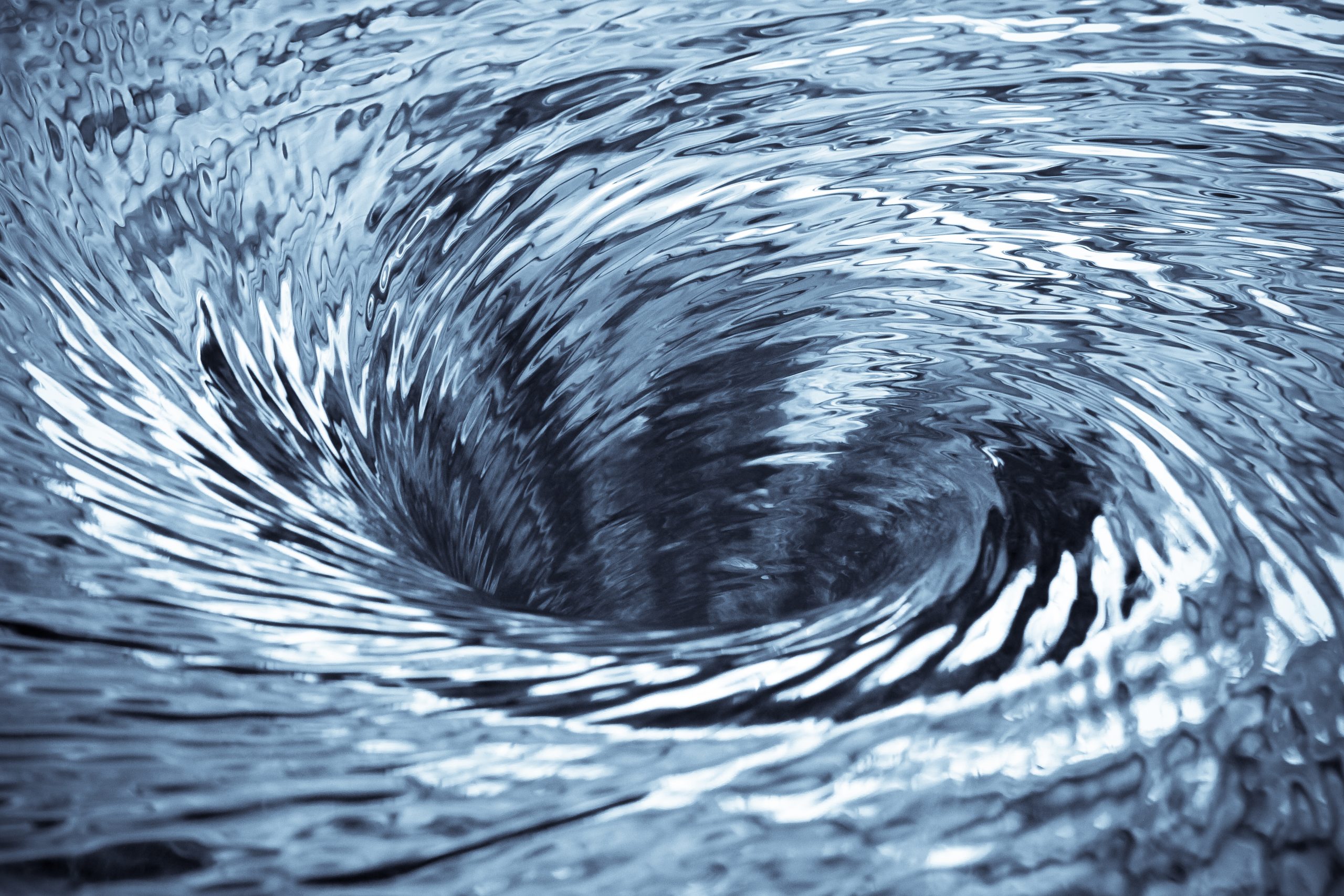
The Charybdis is a swirling water feature in the temperate house at Savill Garden. It was designed by Giles Rayner in 2006. https://funandgames.org/web/wp-content/uploads/2020/09/The-Charybdis_Savill-Gardens_9257-2-scaled.jpg– you may have recently seen the original in The Odyssey
Last week I mentioned that I thought this blog, for the rest of the year at least, would be about what we resist, what we create and what we could nurture in the face of a terrifying future. This week I thought I should start to put a bit of flesh on that particular carcass.
One source for my thinking on this is Alex Steffen. I recently attended one of his Personal Climate Strategy: The Basics webinars. He is particularly good on the importance of continually updating your world view in the face of climate discontinuity and increasing evidence of societal brittleness, and how professions can often be a barrier to doing this:
The greatest danger in any work that asks you to think systemically about the future is getting locked into the worldview that made sense to you when you first began, that you built your successful career on.
We all have limited time and energy. Building up an insightful mental model of how the world works takes a lot of both. The pay-off is in the profit and sense of purpose gained from one’s expertise. It is very common, when you’re highly rewarded for a given set of working insights, to commit more to those insights as your career unfolds, to begin even to defend those insights from challenging new perspectives (ones you fear might devalue your intellectual stock in trade). This “sunk-cost expertise” can easily become a set of shackles.
The article then goes on to explain the process of triangulation, by which professionals can “deflate pressure (from the public, regulators or activist stakeholders) to change more quickly and shore up the power of management and experts who would otherwise be forced to admit that they don’t really know what they’re doing”. If someone starts by saying that they support what you are suggesting, then responds with a bunch of short-term easy actions and claims that these are the start of a journey towards what you are suggesting, you are probably being triangulated.
The biological idea that first made me think this might be possible is called allostasis. It is not a complicated concept. It simply describes the way living organisms survive by continually adapting to the changing world around them.
As we all know, nothing alive exists in a stable environment. Every living thing must continually respond and adapt to changing circumstances. Human beings are no exception. Our brains and bodies are constantly anticipating change and adjusting to it. Most of that work happens without us ever noticing. Allostasis happens all the time, and most of us do not notice. But the fact is that this continual adaptation has a cost.
Murphy points out that, at a time of continual change like ours, that cost is high. And the adaptation required is much higher for people who cannot just throw money at their problems. He then goes on to say:
That changes how we think about political economy. Politics then becomes the process by which societies decide how those costs of adaptation are distributed, whilst economics becomes the study of how institutions either increase or reduce them. Accounting becomes the means by which we identify who ultimately bears the cost of adaptation and health becomes one of the principal ways in which we observe its effects.
I think there is a lot to this approach, which would also provide a structure to identify and critique the triangulation process set out by Steffen. Murphy only mentions education once in this piece:
Education should recognise that human beings learn differently, rather than assuming that everyone should conform to a single model.
I would go a lot further than that, because I think education is the key to helping individuals with their own adaptation strategies as well as in developing the political understanding to see how the costs of adaptation are currently distributed and how to change that within a democratic system. This seems to be an extension of what I have been writing recently about how not to be a reverse-centaur for instance.
The implications for this in health, education and our institutions are considerable in my view and growing all the time. So that is what I am going to be writing about for a while.
Two events recently have made me think about the last 55 years in a different way. The first was the last Birmingham Science Fiction Group meeting, which we had dedicated to a 55 year anniversary celebration for the group (the 50th anniversary having been pandemicked). We had a cake, illustrated by David Hardy’s Stratus Hotel, and we showed a film of interviews from members across the years, again featuring some of David Hardy‘s artwork, with stories about guest speakers from Asimov to Frank Herbert to Iain Banks to Jack Cohen and very frank recollections from our current honorary president, Alastair Reynolds. If you want to see the film, you need to join the Group, which you can easily do by emailing us at contact@brumsfgroup.org.uk. Seeing some of the original organisers talking about some of these meetings like they had just happened made me reflect on how we often attribute significance to things after the event and tend to downplay things happening around us now. Things are both never as good or important as they used to be and, of course, as we prove to ourselves over and over again, they also are.
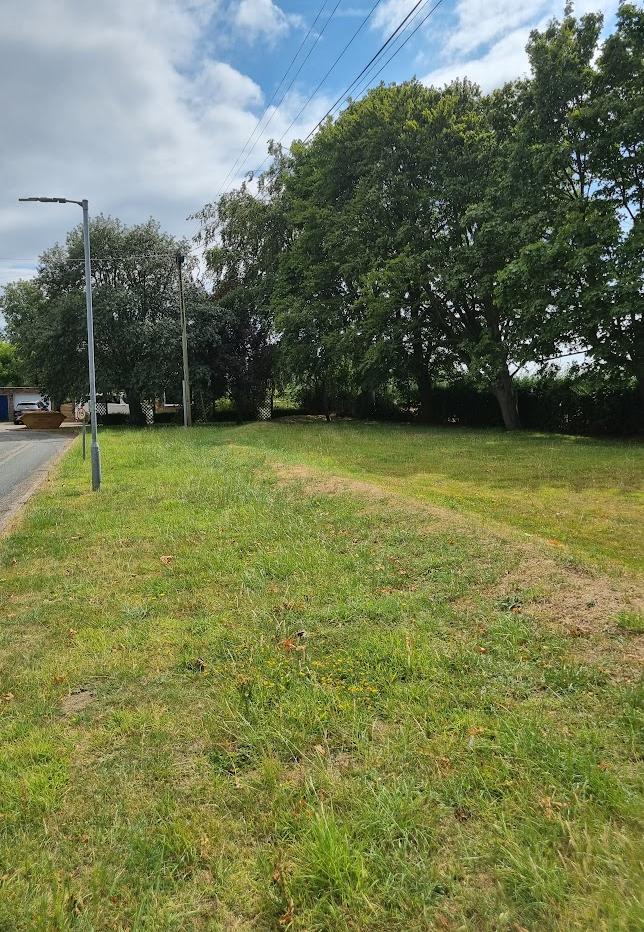
The other event was a visit with my brother and his wife to where we used to live, in the officers’ married quarters of an RAF station in Yorkshire, 55 years ago, when I was eight. Just standing on this patch of grass, with a field of wheat still growing the other side of the fence (to the right), I got a very strong sense of another way of getting from there to here. Obviously there was the one I had taken, with countless house moves, school moves, marriages, careers, children, holidays, illnesses and death and grief and so much joy and laughter in the very fortunate and privileged life I have lived.
But what if I had just stood here and the 55 years had just sped past me instead. My Liverpool football kit would have been a bit tight, with the number seven sewn on the back by my Mum (actually that might have been the following year, when the full magnificence of Kevin Keegan had become apparent). Or, much more spookily, if the eight-year-old just found themselves on the same patch of grass 55 years later in a Wells’ The Time Machine kind of way. It all suddenly felt just as possible and plausible, as if the 55 year old football-and-everything-else pitch was still there within touching distance somehow.
The thing is, I could understand the world of 1971, once I had been reminded of a few things no doubt. A world of cash (just decimalised so no shillings and old pence), phones fixed to houses and telephone boxes, smaller cars filled with leaded petrol, three channels on the black and white TV. I had just driven up there in a car with bodywork comprising mostly plastics, with no spare tyre and no wallet. Just a device known as a mobile which can not only make calls, but send and receive text messages, carry out all my financial transactions and navigate me to my brother’s house. My eight-year-old self would recognise very little about this world beyond the patch of grass he stood on and the field beyond the fence where he had parachuted his mother’s childhood teddy bear.
And this is the terrifying thing about life: we are all that eight-year-old facing the incomprehensible future, and so much of what we spend our time doing is trying to deal with that fear and lack of understanding with often meaningless structures and practices and customs to ward off the sense of being totally out of control. Trump is scary because he appears to have taken a lot of the guard rails off the path we are on, with little sense that he understands what he is doing. AI is scary because it is putting its foot on the accelerator before we have a clear idea of where we are going. Climate change is scary because we no longer look like we are headed where we thought we were.
And we try and stick some grit in the wheels to slow down the disruption to our own little bit of the world, whether to our sense of ourselves, or to how we think life should be lived. And sure we need to question whether we need to change things which are working perfectly well, but often the driver for resisting change is fear of what we don’t know is coming and finding familiar things irresistibly reassuring.
And when we realise that it is not just us with our, certainly in my case, fairly small and unimportant lives (although obviously very important to us!), but also the people who seem to be shaping the world around us that feel these insecurities and uncertainties, the possibility of working together to make it easier to adapt to the very weird future that is coming suddenly doesn’t seem so outlandish after all.
I think this – what we resist, what we create and what we could nurture in the face of this terrifying future – is what I am going to be writing about for the rest of this year, as we all rattle on down the road in the back of someone’s van.
Lobby journalists often fall back on “a week is a long time in politics” whenever there is more than one thing going on. It’s like what the rest of us mean when we say we’re quite busy at work. It is unclear how the phrase was originally coined, but it is usually attributed to Harold Wilson during one of his sterling crises in 1964. He could not remember ever having said it himself.
I am here this week to say it’s all tosh anyway, because the place where a week can be a really long time sometimes is football.
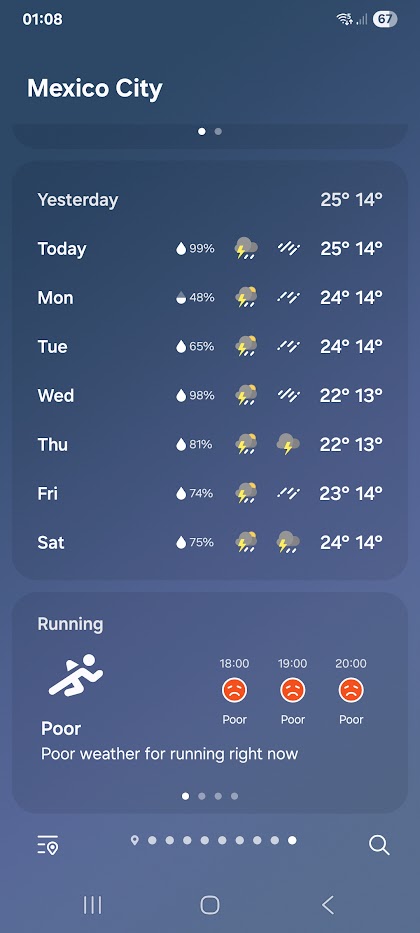
The World Cup week started at 2am on Monday morning. It should have been 1am, but the lightning storms and North American monsoon had led to a delay in kick off time to 7pm local time and the local weather forecast rather unfortunately designated Mexico City as having “poor weather for running right now”.
I anticipated that it was going to be an operatic night, win or lose, so at 1am I decided to take a walk through Sutton Coldfield to take the temperature of my neighbourhood. I was Charles Dickens’ uncommercial traveller in my mind, who documented several nights of night walks, starting around 12.30am. He described:
The restlessness of a great city, and the way in which it tumbles and tosses before it can get to sleep, formed one of the first entertainments offered to the contemplation of us houseless people. It lasted about two hours. We lost a great deal of companionship when the late public-houses turned their lamps out, and when the potmen thrust the last brawling drunkards into the street; but stray vehicles and stray people were left us, after that.
By contrast Sutton was very quiet. The first pub I came to, the Horse and Jockey, was closed and dark. Lights behind curtains and blinds were dotted around the streets, but everyone seemed to be keeping their own company. The Distillery had gone full event night, with bouncers posted on the door, but I walked past the Wetherspoons just as the staff were locking the front door there. Otherwise the only communal places still lit up and active were the pool bar and the Sher Punjabi Bar and Grill, whose Facebook page encouraged you to “feast like a lion”. Compared to the London of the 1860s, where pubs open until 2.30am seemed commonplace, Sutton Coldfield was, on the whole, tucked up in bed with the sound turned down.
I returned home to take my seat for the opera. It started with the national anthems. I have never seen a team and home crowd singing a national anthem more terrifyingly. “Mexicans, at the Cry of War” it translates as, written in 1853 to refer to various Mexican victories in battle in defence of their homeland. This was soon after the Mexican-American War between 1846 and 1848, following the United States’ annexation of Texas from Mexico, a war which resulted in Mexico being forced to sell its northern territories of New Mexico and most of California.
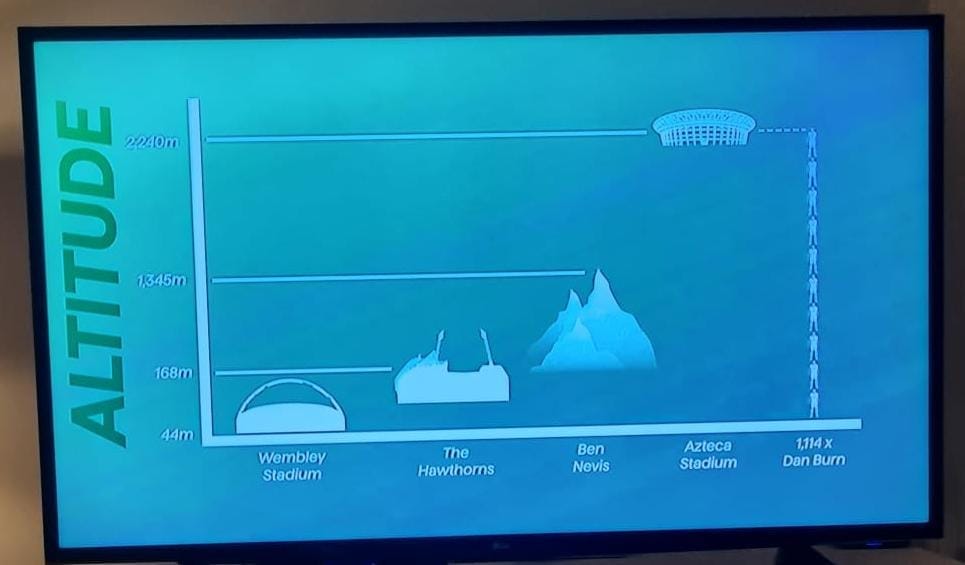
The venue was the Azteca stadium, the largest stadium in Latin America, built in 1966 when the 60 years of hurt began. It is 7,352 feet above sea level. ITV had this hilarious graphic:
The 20% reduction in oxygen partial pressure at that attitude means you have to work harder to breathe. This is something that can be adapted to in time. The Mexican team had played every game except one (Guadalajara at 5000 feet) in Mexico City.
England had last played in the Azteca in a World Cup 40 years earlier when Maradona scored with his hand (he called it “the hand of God”) for one of his two goals (the other was one of the most brilliant individual goals ever seen) to defeat England in the quarter finals. They had never beaten Mexico there. Indeed Mexico had only ever lost there twice before, in 2013 and 2001.
I won’t document the actual match in much detail, as there are many match reports around and you don’t come here for the sports reporting. But in summary:
Quietened the crowd for 20 mins by breaking up any flow to the game – first hydration break – 2 goals in quick succession from Bellingham followed equally quickly by one back from Quinones – half time, when the Azteca produced its own light show including flashing all the lights off in a very unsettling way – Quansah sent off and down to 10 men for most of 2nd half – Gordon won a penalty which Kane scored then Kane gave away a penalty which Jimenez scored – then Tuchel at the hydration break assessed the state of his 10 men at 7000 feet and changed the entire team to one which could man barricades and they threw themselves bodily in front of any attempt at a shot for over half an hour – 3-2 phew!
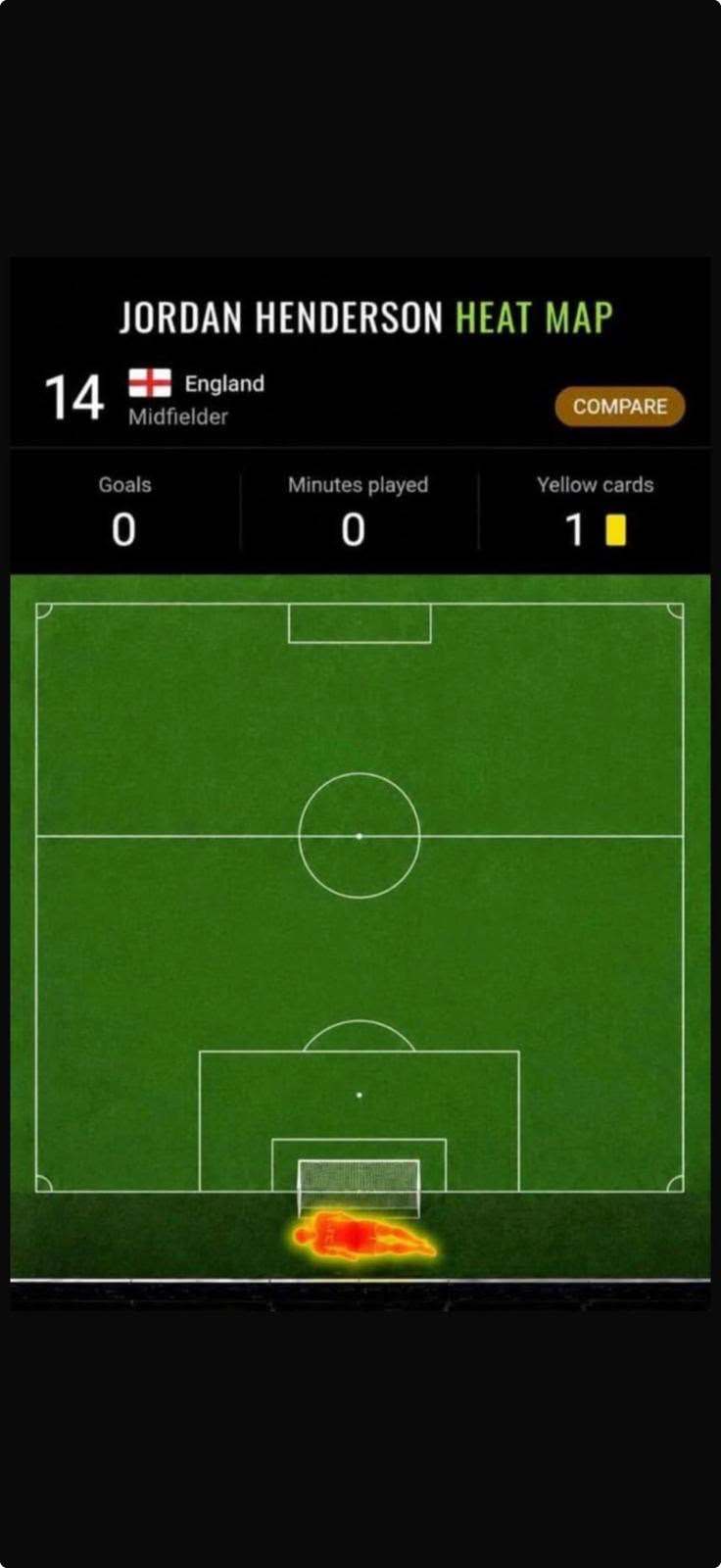
Jordan Henderson managed to get yellow carded and injured without even coming on the pitch. It was that kind of night.
Source: ET Heisenberg on X
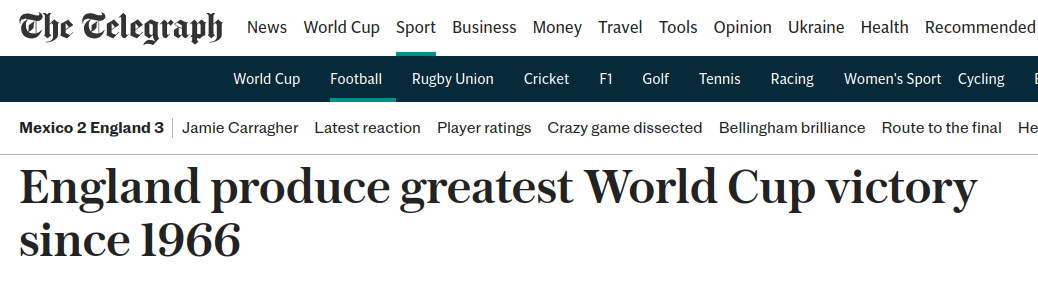
The mythologising of the match began almost immediately. Sky Sports described it as “one of their greatest knockout results”. The BBC report said:
On a night of sheer sporting theatre, with the game delayed by an hour because of severe storms, Thomas Tuchel’s side even survived Jarell Quansah’s red card early in the second half to record one of their finest wins in recent years.
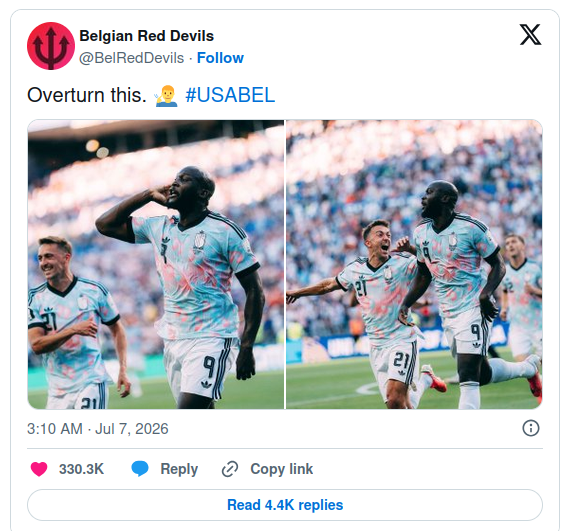
The week continued. Spain knocked out Portugal and Ronaldo in stoppage time, which seemed appropriate after Portugal’s win over Croatia being so controversial the crowd rained plastic water bottles down on them. Even more appropriate was Belgium’s 4-1 win over the United States, who fielded Folarin Balogun after his red card suspension was itself suspended following a conversation between US President Donald Trump and FIFA President Gianni Infantino, with the Belgian forward Romelu Lukaku doing a Trump Dad dance at the end and the team posting this on X:
Argentina struggled past Egypt controversially too, with Egypt having a goal disallowed and their FA calling for an investigation of the entire team of referees and VAR team over “blatant errors and insisting on not reviewing some of the footage that we believe are in favour of the Egyptian national team”.
This was not the first country to lose its shit over an early exit. The South Korean President has instructed their Ministry of Culture, Sports and Tourism to conduct a thorough investigation into the team’s early exit, citing the amount of public money invested in the team’s World Cup campaign.
The week continued. Neither Switzerland nor Colombia were able to shoot straight, but Switzerland went through on penalties.
So, as part of this hard-hitting report, a good friend of mine suggested I look into the incidence of people having their boots trodden on, which we agreed to call Bootgate. To be honest, unless it was one of the many things happening to Jordan Henderson I had not really been paying attention, and after an extensive investigation I can confirm that I can find no evidence for my friend’s claim. However one reason, if it were true, might be that everyone’s boots seem to be DayGlo pink this year.
On to the quarter finals. France looked dazzling beating Morocco, with Mbappe now almost unplayable at times. Spain, as clever as they were in the European Championships but much more incisive now with the 19 year old Yamal, eased past a severely injury-depleted Belgium, who even lost their legendary goalkeeper Courtois before the end.
And England? Well huge amounts of drama but not a great game of football. The Norwegian fans’ Oops-Upside-Your-Head routine roused their team fitfully. Both teams had goals ruled out and England a penalty too. In the end Bellingham wanted to win more than anyone else on the pitch and carved out two goals from sheer bloody-minded willpower.
One thing I didn’t pick up until the following morning’s coverage was the controversy over England’s first goal. The Norwegians claimed their goalkeeper’s clearance hit the camera cables suspended over the pitch and changed direction before it landed, and there should therefore have been a drop ball. This is when I discovered that FIFA had installed snickometer technology, of the type that tells whether batsman have hit the ball before it hit their pads and therefore whether they are lbw or not, in every match ball. And it didn’t snick! If we win, I predict this will be talked about as long as England’s third goal in the 1966 final.
And then, exactly one week from the start of England’s game in the Azteca, Argentina kicked off against Switzerland in the final quarter final. Argentina scored an early goal against Switzerland and then did very little after that, with Switzerland looking like the most likely team to win until Embolo managed to get a second yellow card for falling over his own feet and was sent off, at which point Argentina stirred themselves to two extra time goals to win it. Meanwhile Tuchel was saying his team were lucky to get through and that he was unhappy with the performance. To which Bellingham, clearly feeling unappreciated, retorted that:
“Maybe he doesn’t know what it’s like to play in those conditions against Erling Haaland, Martin Odegaard, Antonio Nusa and Alexander Sorloth.”
Harry Kane stepped in like a good captain to both defend his manager and indulge in a bit of Good Cop-Bad Cop psychology:
“He’s trying to drag it out of us and we know ourselves we have another level we can reach.”
So that was a week in football. What did politics achieve in that time? Well Trump ended a war and then restarted it. Nigel Farage resigned as an MP and then immediately stood for a by-election in the same constituency, with only Count Binface for company. All of Labour’s MPs have now ruled themselves out of challenging Andy Burnham for the PM role. Compared to the football it feels like Groundhog Day in politics.
Next week in football may turn out to be just as long!
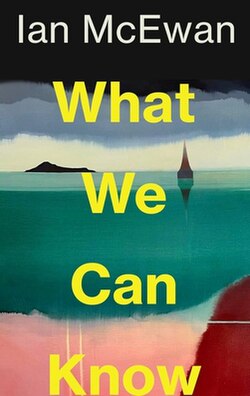
What We Can Know by Ian McEwan is a difficult book to categorise. Some might call it “cli-fi”, as it sets itself in a future significantly altered by human actions and the landscape’s response to those. The Sunday Times appears to think that it might have created a new genre entirely. I think it is best seen as an Oxford novel, even if many of Oxford’s landmarks are submerged for large parts of it. Radiohead even gets a mention. As the petty snobberies and clandestine affairs of academics play out on the much-changed landscape of 2119, earnest academics Tom Metcalfe and Rose Church explore the petty snobberies and clandestine affairs of 2014 and the quest for the long-lost poem from that year. “A Corona for Vivien” certainly feels like a poem which belongs in a past of barn conversions and dinner parties.
For these academics, The Derangement – which is how they refer to the developing crisis mindset between 2015 and 2030 – is just a backdrop to what they regard as the important drama of their lives. It is followed by the first of several climate wars in 2036 involving nuclear weapons, ironically causing a cooling before the Inundation of 2042 causes the deaths of 200 million, with the UK’s population halving and life needing to be eked out on a cluster of small radioactive islands.
I set this out because the book, while occasionally referring to the eeriness of things, carries on with the work obsessions and love lives of its characters pretty much regardless. If What We Can Know is to be believed, academia carries on much as before, with lectures and seminars and essay marking, despite all of this. For humanities departments currently under the cosh despite the absence so far of a nuclear war, this may seem unlikely.
My grumpiness about all this may be partly due to the fact that I am writing this during a series of record breaking heatwaves and unbudgeable heat domes, but I feel like I have had to make more accommodations to the climate – cancellation of plans, a whole new routine at home with the single aim of keeping the thermometer from moving up any further – than McEwan’s characters seem to be doing in their post-not-quite-apocalyptic lives. Whereas one visit to the swimming pool last month was reduced to bobbing about in water along with a couple of dozen others in a manner reminiscent of the wet bulb event at the start of Kim Stanley Robinson’s The Ministry for the Future, McEwan’s only concession to a future world that can still apparently support an academic entirely focused on a 105 year old poem which has never been seen since, seems to be that journeys anywhere are now more difficult and dangerous.
And yet Tom then travels to Snowdonia (where the Bodleian is now housed) fairly easily. And he and Rose then travel to the flooded valleys of the Cotswolds to attempt to retrieve the poem. The only difficult journey described is once they get on to the target island and have to navigate through thick vegetation without satnav (GPS is no more) or even rudimentary hiking skills between the two of them. At one point we are told the internet is on the way out and at another that there is a National Artificial Intelligence which remembers everything you have ever told it.
This book seems as complicit in the “crisis of realism in fiction” as McEwan, via Rose, accuses everything else written between 2015 and 2030 of being. However it is an entertaining Oxford novel, with tense conversations in parked cars and breathtaking egomaniacs everywhere you look.
What we can’t know is what Tom and Rose will make of it in 100 years’ time.
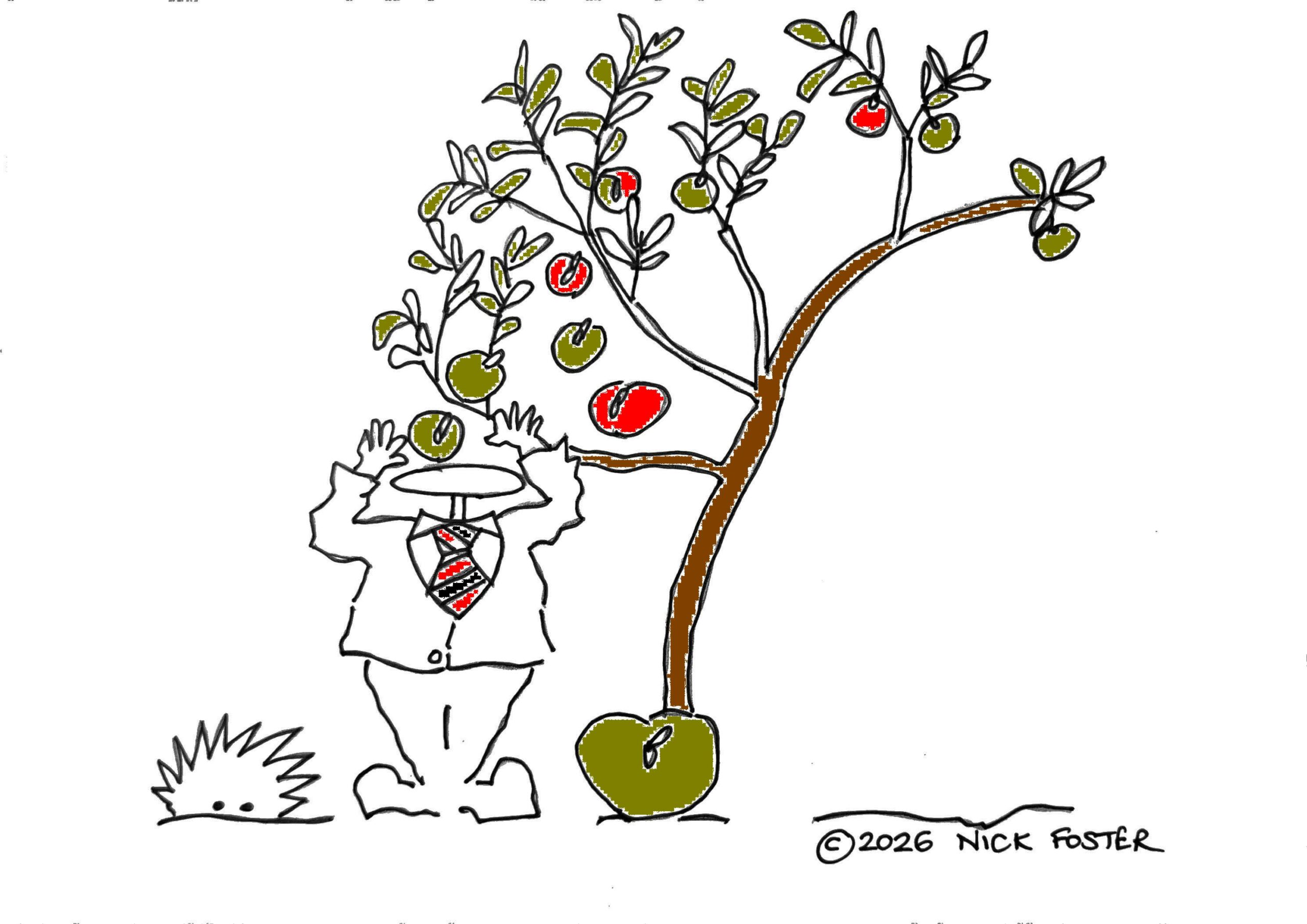
Isaac Newton may or may not have been nutted by an apple. His friend William Stukeley, whose memoir of Newton was the source of the story, states it as follows (spelling and punctuation from Stukeley’s manuscript at the Royal Society):
“why should that apple always descend perpendicularly to the ground,” thought he to him self: occasion’d by the fall of an apple, as he sat in a comtemplative mood: “why should it not go sideways, or upwards? but constantly to the earths centre? assuredly, the reason is, that the earth draws it. there must be a drawing power in matter. & the sum of the drawing power in the matter of the earth must be in the earths center, not in any side of the earth. therefore dos this apple fall perpendicularly, or toward the center. if matter thus draws matter; it must be in proportion of its quantity. therefore the apple draws the earth, as well as the earth draws the apple.”
However there may be stronger grounds for believing that Newton nutted English mathematics and, as a result, the actuarial profession.
I thought all this to myself, occasion’d by participation in the Actuarial Teachers and Researchers Conference (ATRC) this week. It was great. There were lots of interesting talks, and people were very engaged and respectful in how they discussed them. There was a lot of expertise in the room about both education and actuarial practice and theory. It felt like it was a room that could take on difficult topics and make progress in tackling them.
There were several calls for the need to change assessment, one of them by me, whether due to large student cohorts and the difficulties of engaging them, or the ease with which AI can duplicate examination solutions or because the credentials provided by those assessments seem increasingly irrelevant to the actual actionable skills, knowledge and experience required to operate successfully as an actuary. And there was an equally robust response from the Institute and Faculty of Actuaries (IFoA) to the effect that assessments would not be changing significantly in the latest changes due to come in by 2029.
My favourite presentation was by Angus Macdonald, about his recent short paper on Newton, Leibniz and Actuarial Science. It conjectures that the argument between Leibniz and Newton over who invented calculus resulted in the stagnation of mathematics in English universities and meant that actuaries needing to gain respectability for their advice were forced to create a professional body (in company with architects, accountants and engineers) rather than rely on universities to develop actuarial thinking as happened in continental Europe. This stagnation (Macdonald quoted G.H.Hardy, talking about the Cambridge mathematics exams, saying that they had “. . . effectively ruined serious mathematics in England for a hundred years”) was felt across the whole Anglosphere, with attempts to create institutions with equal status to the traditional universities leading to the establishment of business schools in the USA in the late 19th and early 20th centuries.
This explained a lot for me. The suspicion of our actuarial courses amongst some of our mathematics colleagues at times at Leicester. The occasionally uneasy relationship between the IFoA and the accredited universities where students can gain exemptions from their exams. The horror from some at the very idea that an actuary might qualify as a result of university courses, like they can in the Netherlands, for instance. ATRC seemed the appropriate place to explore these ideas.
Angus Macdonald considers that the Newtonian and Leibnizian branches have nearly rejoined, but I feel that our actuarial education system still suffers from the long shadow cast by these two 17th century gentlemen and their personal enmity. The ferocity with which some within the profession opposed what they saw as a threat to the popularity of the fellowship qualification posed by the new chartered actuary designation was hard to explain when the number of practising certificates issued for chief actuaries, pension scheme actuaries, etc was only around 1,100 (out of over 17,000 fellows), but if the whole profession originated from a highly developed form of status anxiety compared to academics, it becomes much easier to understand. As they say, the apple doesn’t fall far from the tree.
Now, nearly 180 years on from this “unstoppable” “rush to respectabilize” (according to Jeremy Paxman) I think it is legitimate to ask:
Why does the IFoA still insist on detailed accreditation of individual university courses on basic mathematics, statistics and business economics? Do they not trust them to teach them right? Do they think that there is something better about learning these universal subjects via a bespoke course created by a tiny professional body with 34,000 members globally?
Why are they so concerned about what assessment methods the universities use? Do they consider that they have more educational expertise on this than some of the leading universities in the world?
I have written previously about the changes in assessment I think are necessary and floated some ideas about where actuarial education might sit to accommodate these. My view was that the IFoA, faced with the need to innovate at all levels of its education system at a time of great uncertainty, might wish to get out of the foundational mathematics and business education tuition of the core principles subjects and leave this to the university system, in a truly Leibnizian way.
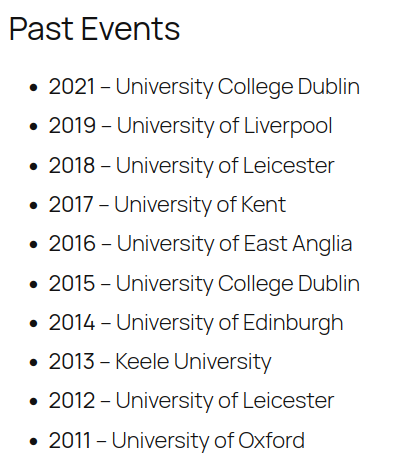
In actuarial science, the list of UK universities offering accredited courses has not changed for some time, and it is a small group within the university system. These courses must be seen as vulnerable. I don’t think it is a coincidence that it is so hard to persuade one of this tiny band to run the ATRC. This week’s was the first since 2021 and the list of past hosts is not very long:
The IFoA needs to ask itself what it would do if there were some high profile closures of actuarial courses and whether perhaps it might be time to protect the core mathematical education arrangements for actuaries through a broad brush accreditation of a wider range of courses, rather than the very detailed accreditation process it currently carries out on core principles subjects.
I also doubt that it has the capacity on its own to significantly restructure its assessments beyond the objective based assessments it has developed to work within its proctored environment.
The core practice and specialist subjects leading to fellowship are the areas where actuaries have, rightly, the strongest views about content and assessment structures. It surely makes sense that the expertise within the profession and the university system are pooled in a joint endeavour rather than risking both failing independently.
In contrast to Newton, who had quite a temper, Leibniz was famously parodied by Voltaire in his Dr Pangloss character in Candide who believed that “All is for the best in this best of all possible worlds.”
Let’s not be too Panglossian about the current state of actuarial education.