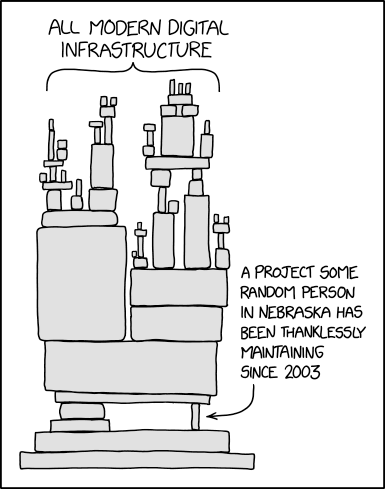
Source: https://xkcd.com/2347 This work is licensed under a Creative Commons Attribution-NonCommercial 2.5 License

Last week I suggested that the period of disruption we have entered would be likely to impact the relationship between society and its institutions and professions, and likened those institutions and professions to the models behind the models we normally focus on. I suggested that this has serious implications for actuarial education, amongst much else.

This week I want to expand a little on what I meant by that.

First, the impact of AI. My view of AI is that I don’t believe most of the claims coming out of OpenAI and Anthropic when noone else gets to see the data and they clearly have a vested interest in playing up the capabilities of their systems. And I certainly don’t believe the fantasy economics the Magnificent 7 are currently indulging in is sustainable (see Ed Zitron’s Hater’s Guide to Circular Financing for more on this). But I do believe that there is a lot of political power with an increasingly out of control stake in it continuing, which makes the quote often attributed to Keynes (“Markets can remain irrational longer than you can remain solvent”, although it may have been A. Garry Shilling in 1999) even more relevant here.

However, what cannot be denied is that the existence of AI is accelerating conversations which we should have been having a long time ago. Last month, MIT issued a report called AI and Education, which turns out to be more a philosophical musing about what we should be trying to achieve in universities, and what expectations we should have of both staff and students. It’s not a long report, but for the time poor amongst you there are two passages from this that I’d like to highlight here.

First, on the expectations we should have of students:

Leaning into learning means creating a new “social contract” between teachers and students. All of us who teach at MIT will need to be prepared to help students understand both that the process of education is necessarily a productive struggle, and that the most important product of their education is not a GPA or a diploma but themselves: their personal growth and intellectual maturity and the development of their own imagination, insight, and judgment.

Instilling these attitudes needs to become a central task for every educator, so that our students know not only what they should learn, but also how they should learn and why learning matters. We need to help them develop metacognitive abilities to think about thinking, to engage in reflective practices, and to enhance their sense of personal agency. This will require both dedication and fresh preparation on the part of instructors.

Remember that social contract idea, because it will be coming up again.

Second, on what kinds of assessments we need to move to in anything we still want to be able to refer to as education:

Rather than simply “AI-proof” current methods of assessment, instructors need to revisit what they really want students to know and devise assessments that foster, or even include, the kind of productive struggle that builds durable understanding and mastery.

We urge instructors to consider forms of assessment that are less vulnerable to AI, and more valuable for learning, such as oral exams, semester portfolios, and out-of-class assignments paired with in-class conversations. This likely means resources such as TAs and class time will become more central to evaluation.

and this:

To match the shift towards assessment methods that aren’t vulnerable to AI, instructors need to increase the role of experiential and project-based learning. To encourage this kind of creative teaching, MIT should support the development of teaching skills and practices for all instructors, and recognize contributions in this domain.

As someone who has already spent some time advocating just such a move in higher education, I feel quite vindicated. But back to that social contract point. I am in a WhatsApp group called Actuarial Change in Education (A C E), where we have been discussing this point for a while, but couldn’t agree what to call it. Culture was one proposal, but I think we all agreed on the MIT point that it should be aiming to ensure:

our students know not only what they should learn, but also how they should learn and why learning matters

And then, like buses, a third take on this point came from, of all people, Seth Godin in Two schools of thought about school:

One kind of school is about culture, compliance and community. We indoctrinate kids, for better or worse, in what it means to be in this world we’ve built, and how to do it together. We teach them how to be kids, how to be citizens and hopefully, how to be adults.

And the other kind of school is about the content. All the ‘R’s. The software that goes with the operating system we taught in the other school.

The first paragraph is what MIT and my WhatsApp group are referring to. It is the bit which has been assumed we shared in common for too long, but is the most important bit. A shared culture or social contract would allow us to meet and discuss things within a shared set of assumptions about how we can get agreement and take action. It is what has been holding back COPs and peace talks and politics more generally for my whole lifetime. It is also how we decide what we put in the second paragraph, which is necessarily stuff which will be being tweaked constantly and be much more short-term in focus..

The second paragraph is what the Institute and Faculty of Actuaries respond with when you ask them about education (I am only picking on them as this is the one I am most familiar with). Curriculum. Syllabus items. Suggested number of hours study. Past papers to practise for the traditional written exam.

Seth Godin calls this software. It is content. It is largely ephemeral, as the needs of the model we operate in and the tools we are given to do so change all the time. Little of it will survive a decade let alone a career. It does not encourage looking up and wondering if there is a better way. It is full of short-term deadlines and urgency and immediacy. Which tends to get confused with importance.

But the software will never surprise you or deal with situations noone has ever met before. If it is not in the underlying model, it will not turn up in the software. The important education is in the operating system. That is what needs to be reformed.

As I said, there is a WhatsApp group discussing such questions regularly. We are a small group currently, but would welcome new members interested in these questions. If you are, then respond to me in the comments section below or via a LinkedIn message if you are reading it there.

A little more information about A C E is set out below:

What is A C E?

Actuarial Change in Education. A place to discuss where change is needed in how actuarial students learn and the changing landscape they are preparing themselves for. A place to argue about how we teach, and how we get students to care about why they are in education and question the assumptions underlying it. A place to share thoughts and ideas you have had or seen about education, actuarial or otherwise. A place to collaborate with others equally concerned about the future of actuarial education. A place to plan and deliver communications with the wider actuarial community.

What are A C E’s aims?

To have an impact on actuarial education by providing a place for developing actionable ideas about education more generally and how they can be applied to actuarial studies in particular. The hope is that these will then be a useful resource for when the need for alternatives gains a wider acceptance.

Who can join A C E?

Anyone interested in the development of actuarial students.
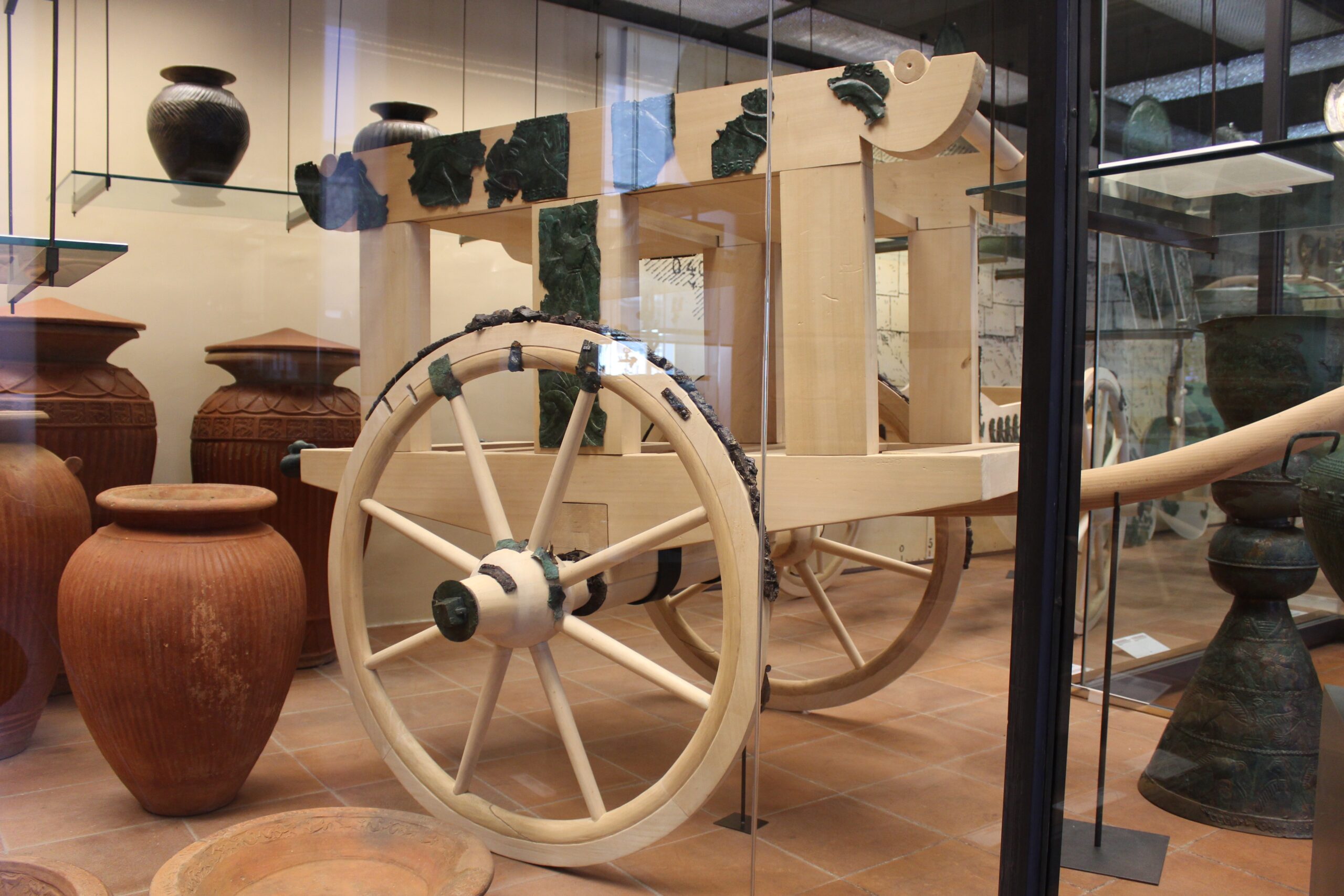
Copper parts of a vehicle have been mounted on a much larger wooden structure in an exhibit at the Vatican Museums
My photograph of an exhibit at the Vatican Museums

Worldbuilding in science fiction has certain rules, or so I thought. And the first of these according to some sources at least seems to be consistency. According to the Quirkworthy website:

The basic message is very simple: your world must be internally consistent. Doesn’t matter if it’s science fiction or fantasy, and it makes no odds if it’s a novel, game, or opera. At all times, your world must be consistent to itself.

So when Jeff Noon and Steve Beard came to the Birmingham Science Fiction Group a couple of years ago, I pricked up my ears when one of them (Jeff I think) said that the first book of the Ludwich Chronicles, Gogmagog, which they were discussing, was not consistent. They were following Cady Meade’s viewpoint which journeyed 60 miles along the river Nysis inside a ghost and the focus was to set a particular mood. It was built from the bottom up.

This idea appealed to me then, and has, in my view, become a more and more important idea recently. We all build our views of the world from the bottom up based on our own experiences and they are frequently inconsistent with those of other people. The problem comes when we stop accepting that and treat our models as, in some way, top down and universal.

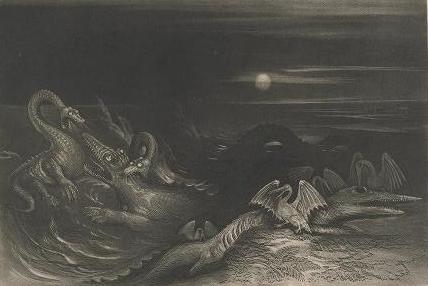
I had a great example of this a few years ago in the Vatican Museums. Some bits of bronze they reckoned to be parts of a cart buried in an Etruscan tomb had been discovered and were then displayed on an entirely speculative wooden model of a cart (to be fair to them, the Monteleone chariot dated to around 530 BC, was a rather more complete find and the wooden model looks like it was modelled on that). The trouble is, once you have seen the pieces on the cart, it is difficult to think of them in any other way. Rather like some of those early dinosaur reconstructions and possibly unhelpful in a field as fast-moving as archaeology.

Source: The book of the great sea-dragons, Ichthyosauri and Plesiosauri, [gedolim taninim] gedolim taninim, of Moses. Extinct monsters of the ancient earth. With thirty plates, copied from skeletons in the author’s collection of fossil organic remains, (deposited in the British museum.) by Hawkins, Thomas, 1810-1889
https://archive.org/details/bookgreatseadra00hawk/page/n5/mode/2up

We do this everywhere. Every competitive market is a model, as relentless in its pursuit of victory within the rules (all of which must be stress-tested as to how they are going to be applied by each individual referee in each individual encounter) as the Premier League. Sometimes if you question some of the underlying assumptions behind some of these models, you are told that is just the way the world works.

But the way the world works is opaque. Novelists have attempted to show us glimpses of it for centuries. Historians are sometimes able to agree about how it has worked in a specific geography for a short period of time. Occasionally, as a result of our own experiences, we may feel that we have managed to grasp some truth about the world and how it works in our own lives. But often the clarity slips through our fingers when we throw more light on it. The clarity certainly never seems to last that long. For clarity you often need an organisation signed up to a model.

Much has been written in recent years about our dependence on models and our inability to look outside them in many cases, most notably Escape from Model Land by Erica Thompson. This has mainly focused on the models we make to try and understand the world. But there also models behind those models which effectively determine what kinds of models of the first kind we create. These are the organisations and institutions we look at the world from.

It was in a time of rapid transition and uncertainty much as our own is that the groups of organisations we call professions emerged in the nineteenth century. The model of the second kind they adopted was partly that set out by Daniel and Richard Susskind in their book The Future of the Professions.

According to the Susskinds, there is a Grand Bargain between society and the professions, which means (and I am paraphrasing a little here), in return for professions providing:

  • Expertise, experience and judgement;
  • Delivered affordably, accessibly, reassuringly and reliably;
  • With knowledge and methods maintained and kept up to date, members trained, standards and quality of work enforced and only appropriately qualified individuals allowed in;
  • Acting honestly and in good faith; and
  • Putting clients’ interests ahead of their own.

In return, society will give the professions:

  • Respect and status;
  • Exclusive rights to perform/provide socially significant activities or services; and;
  • Independence to decide how they do it and how much they can be paid for it.

What professions expect from society is jealously guarded. My own profession’s uneasy relationship with the universities can plausibly be traced back to Newton’s influence on what mathematics could be taught there, therefore denying actuaries the status they craved without setting up their own professional bodies to supply it. The last attempt to allow an allied profession to carry out limited medical activities ended with the Leng Review effectively strangling it, egged on noisily by the BMA. And it is not hard to find articles defending increases to executive remuneration way beyond that of the people who work for them as the norm.

What society expects from professions often gets less attention directed at it. Four of the five bullets above tend to form part of the professional code of most professions in some form, although there are frequent fines of large professional firms for failures in the standard of the services provided.

But what of delivering professional services affordably, accessibly, reassuringly and reliably? What has tended to happen, as the group of people requiring professional services has widened, is that the affordability and accessibility have been increasingly called in to question. And online self-service looks likely to be attempted for a wider and wider range of services as time goes on.

So is the professional structure we have going to remain? If the experience of the nineteenth century, when most of these professions emerged, is anything to go by, the level of disruption will vary hugely by profession and institution and the period of transition could be very long in some cases. But it seems clear that such a period has begun. This has serious implications for actuarial education, amongst much else.

And whatever replaces them is likely to be built from the bottom up.

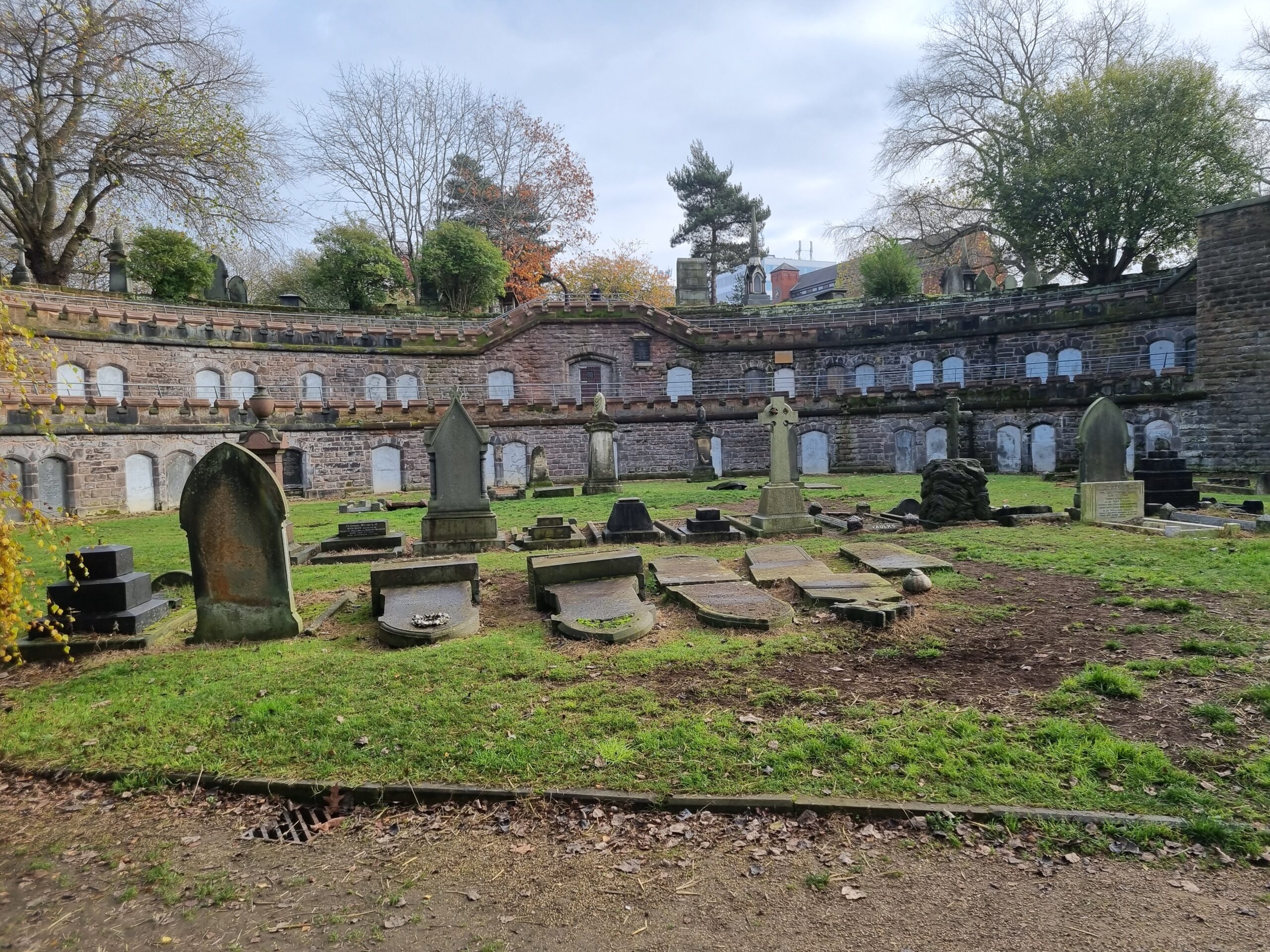
Some tombs which could do with being visited more often: The Birmingham Catacombs – excellent tour available at Birmingham Walking Tours

I am currently reading The End of Everything by M John Harrison, which I will be talking about at greater length in a future post. But one aspect I want to pick up now is how the response of the characters to the disappearance of many of the familiar landmarks post apocalypse is to lose their cognitive bearings. Thoughts come and go, often not joined up. They struggle to understand what other people are saying to them.

I think this is a much under-explored aspect of a period of change. Our ability to think about what is going on, to plan, to anticipate is affected. Many of us experienced this during the pandemic. Psychology as a discipline changed significantly as a result of World War 2.

This is also an aspect that speculative narratives like this one often miss. Told from the vantage point of 2100, it has humanity in despair in 2046:

I imagine that today’s world must have seemed like an impossible dream in 2046, when my parents were born in Charleston. Then, an estimated 60 million people had just died in the Great Hunger. The world had warmed by 2 °C, relative to its average temperature in the late 19th century. Ecosystems were collapsing, led by coral reefs.

Instead there is a scenario of an international climate agreement (“The Geneva Climate Compact”), followed by accelerated climate breakdown leading to emergency geoengineering (mostly solar radiation management) which stops global warming by 2080.

International agreements, emergency sessions of the United Nations (even the idea that such a session in 2047 would be the first such session since the pandemic!) and even the European Union is still present and correct in this otherwise devastated landscape. The problem with these sorts of projections is that everything the projector is not looking at (in this case everything except average global temperatures and their direct impacts) is assumed unchanged. Many climate models do the same thing. Indeed a perfectly valid use of climate models is to change one variable and keep everything else the same to try and measure the impact of that variable.

However to really think about the future you need to look to your novelists. Kim Stanley Robinson’s New York 2140 is a case in point. In it global sea levels have risen by 50 feet. Everyone lives in tower blocks connected by sky bridges which occasionally topple into the canals which were once streets.

I used to think that money markets would not survive events like this, but Robinson posits what I now believe is a more likely future scenario. The Intertidal Property Pricing Index is developed instead, carefully constructed to be reasonably stable despite the instability of the actual real estate being valued, and people bet on it. And soon everyone is fixated on what this index is saying daily rather than the buildings collapsing around them. This is exactly what our finance sector will do of course. There will be money to be made out of such activities after all. And so expectations that they will, in any way, be a leader out of the climate emergency are, in my view, unrealistic.

But also is the idea that our institutions as currently constructed will lead us out of catastrophe, or that a top down maintenance of international institutions will be a dominant feature of a post-apocalyptic world. Any plans we have for the future must be robust against the possible loss of central authority.

This does not lead us towards survivalist prepping, holing up in some remote area with canned foods, bottled water and armaments. As Alex Steffen teaches in his “ruggedization” classes:

I would put to you that if you find yourself in a situation where you’re having to let off some rounds to protect your canned goods, you’ve already failed, you have not understood the assignment.

It means the opposite. Remember another thing about the pandemic: people rose to the occasion, just as politicians sunk to it. People checked on the elderly in their neighbourhoods. In Birmingham for instance:

Within weeks of the crisis unfolding, near on 4,000 mutual aid groups registered on the mutual aid website with an estimated 3 million participants stepping forward to support their neighbours and communities. Widely heralded as the ‘early responders’ to the crisis, these groups – alongside thousands more neighbourhood groups – played a fundamental role in ensuring that local residents received immediate support.

This included “food distribution, errands, shopping and picking up prescriptions for those shielding”.

The truth is we all need each other, we all need back up and connecting with your local community is the most effective way that you can “ruggedize” your life. The characters in Harrison’s book have become isolated from each other.

In Goliath’s Curse, Luke Kemp makes the case that the collapse of the “Goliaths” (large imperial powers which dominate the landscape as now) are often linked with improvements in markers of human flourishing like height, life expectancy and equality. This is because, assuming you can avoid the violence associated with the groups scrabbling for status in the ruins of a collapsed state, the main contributors to that flourishing in the past have been local communities rather than at the state level. He worries that, in our current globalised inter-connected world (Ed Conway’s recent article about The 30,000-mile fish finger is one memorable example) this may not necessarily be our experience the next time. As Kemp says:

It is difficult to see through this fog of uncertainty which groups would fare best post-collapse. For now, being poor in wealth but rich in friends is a better strategy than being a suspicious billionaire under siege in a bunker. Not only that, but cultivating bonds of solidarity and mutual aid rather than ruthless self-interest means that the survivors are more likely to help recreate a world that is worth preserving.

If you want a thought experiment about what happens to the billionaires post-collapse, by the way, I recommend Naomi Alderman’s The Future and Cory Doctorow’s novella The Masque of the Red Death (not that one!). Both dark and hilarious in equal measure.

The future is all of ours to make, but we really need to think about it independently and not necessarily along the tracks that the political class funnel all discussions down. That is a 1% world they are discussing. I will leave the last word to Luke Kemp:

Our greatest achievements are not because of the 1 per cent; they are collective endeavours. As George Eliot once wrote, ‘The growing good of the world is partly dependent on unhistoric acts…half owing to the number who lived faithfully a hidden life, and rest in unvisited tombs.’ It’s time to drop the 1 per cent view and start paying attention to the unmarked tombs and unknown heroes upon whose shoulders we’ve built our world.