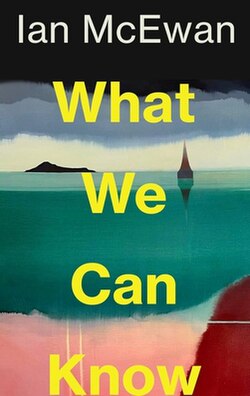
What We Can Know by Ian McEwan is a difficult book to categorise. Some might call it “cli-fi”, as it sets itself in a future significantly altered by human actions and the landscape’s response to those. The Sunday Times appears to think that it might have created a new genre entirely. I think it is best seen as an Oxford novel, even if many of Oxford’s landmarks are submerged for large parts of it. Radiohead even gets a mention. As the petty snobberies and clandestine affairs of academics play out on the much-changed landscape of 2119, earnest academics Tom Metcalfe and Rose Church explore the petty snobberies and clandestine affairs of 2014 and the quest for the long-lost poem from that year. “A Corona for Vivien” certainly feels like a poem which belongs in a past of barn conversions and dinner parties.
For these academics, The Derangement – which is how they refer to the developing crisis mindset between 2015 and 2030 – is just a backdrop to what they regard as the important drama of their lives. It is followed by the first of several climate wars in 2036 involving nuclear weapons, ironically causing a cooling before the Inundation of 2042 causes the deaths of 200 million, with the UK’s population halving and life needing to be eked out on a cluster of small radioactive islands.
I set this out because the book, while occasionally referring to the eeriness of things, carries on with the work obsessions and love lives of its characters pretty much regardless. If What We Can Know is to be believed, academia carries on much as before, with lectures and seminars and essay marking, despite all of this. For humanities departments currently under the cosh despite the absence so far of a nuclear war, this may seem unlikely.
My grumpiness about all this may be partly due to the fact that I am writing this during a series of record breaking heatwaves and unbudgeable heat domes, but I feel like I have had to make more accommodations to the climate – cancellation of plans, a whole new routine at home with the single aim of keeping the thermometer from moving up any further – than McEwan’s characters seem to be doing in their post-not-quite-apocalyptic lives. Whereas one visit to the swimming pool last month was reduced to bobbing about in water along with a couple of dozen others in a manner reminiscent of the wet bulb event at the start of Kim Stanley Robinson’s The Ministry for the Future, McEwan’s only concession to a future world that can still apparently support an academic entirely focused on a 105 year old poem which has never been seen since, seems to be that journeys anywhere are now more difficult and dangerous.
And yet Tom then travels to Snowdonia (where the Bodleian is now housed) fairly easily. And he and Rose then travel to the flooded valleys of the Cotswolds to attempt to retrieve the poem. The only difficult journey described is once they get on to the target island and have to navigate through thick vegetation without satnav (GPS is no more) or even rudimentary hiking skills between the two of them. At one point we are told the internet is on the way out and at another that there is a National Artificial Intelligence which remembers everything you have ever told it.
This book seems as complicit in the “crisis of realism in fiction” as McEwan, via Rose, accuses everything else written between 2015 and 2030 of being. However it is an entertaining Oxford novel, with tense conversations in parked cars and breathtaking egomaniacs everywhere you look.
What we can’t know is what Tom and Rose will make of it in 100 years’ time.
This review originally appeared in the May issue of Brum Group News, the newsletter of the Birmingham Science Fiction Group and is reproduced here (lightly edited) by kind permission
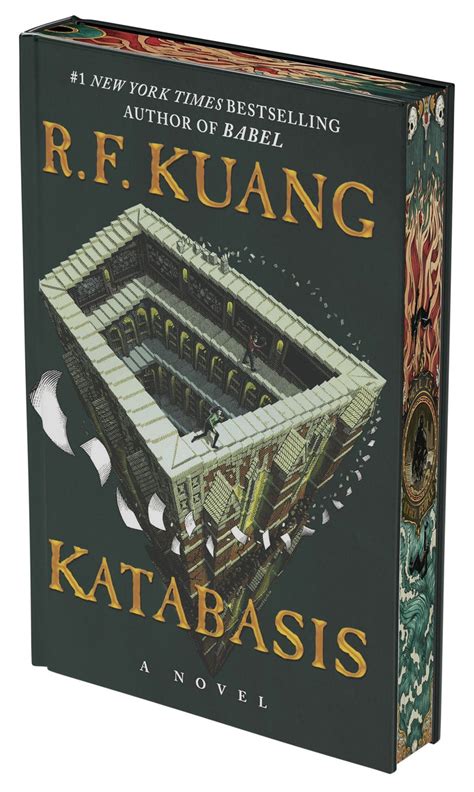
This book is so many things: a work of fantasy, a literature review of every major work about the journey into hell, a love story, a wicked academic satire, a philosophical musing on the meaning of life and a love letter to Cambridge. Or perhaps the title itself, which means both a retreat to the coast, in this case to the banks of the River Lethe, as well as a descent into Hell. Like its Oxford counterpart before it – Babel – its central leap is that magic (here referred to as magick, ie the academic discipline stretching back to the alchemists and beyond) sits alongside the other subjects at Oxbridge colleges. The magic we see practised, taught, researched and dissertationed feels very mathematical. So we are unsurprised to hear that the mathematicians hate the magicians.
Alice Law is the Chinese-American PhD student of the great Jacob Grimes, who (accidentally?) sends him to Hell and then, with her once-friend-now-mortal-enemy and Grimes’ other PhD student, Peter Morgan, sets out to bring him back. So that Grimes can pass their dissertations, because that’s a good enough reason to journey to Hell and sacrifice half of your future lifespan. And so the quest begins.
There is quite a bit of mathematical fun had despite Alice not really knowing any mathematics, including an Escher Trap, a Penrose Staircase and a hyperbolic geometry which makes the quest very heavy going at times. And so many logic puzzles. Comedy and total horror are nicely juxtaposed throughout, as Alice and Jacob get to understand each other better and start to wonder whether Grimes is worth it after all.
The constant side swipes at the life of a junior academic are often hilarious. Magicians in training are apparently told by all their professors that they should consider careers in other fields or “alt academia”, as they called it:
“…no one really meant it when they said alt academia was just as prestigious (or, more commonly, that there was no shame in it, really). They meant it even less when they emphasized that alt academia paid better, had kinder hours, was less stressful, gave you better job security, made you happier. Oh, magicians do really well in consulting, they said. Employers like critical thinking and problem-solving skills, they said. Fewer people die in industry, they said.”
The most enigmatic character is their not-quite-constant companion, Archimedes the cat, who guides them when he feels like it. All the way through all eight of the Courts of Hell, alongside and across the Lethe and finally to King Yama’s Domain, on a journey which threatens to destroy Alice’s very sense of self. Her catechism, which she repeats at stressful moments:
I am Alice Law I am a postgraduate at Cambridge I study analytic magick
Alice has always felt that if she could just hang on to the delusions which had got her this far until the end of her PhD all would be well, but these turn out to be precisely the things she needs to confront if she is ever going to get out of Hell.
This review originally appeared in the April issue of Brum Group News, the newsletter of the Birmingham Science Fiction Group and is reproduced here (with light editing) by kind permission
A few years ago the historian Adam Tooze said the following about the times we are living in:
If you’ve been feeling confused and as though everything is impacting on you at the same time, this is not a personal, private experience. This is actually a collective experience.
The word he came up with for this experience was “polycrisis”. It described the interplay of the Covid pandemic, Ukraine war and the energy, cost-of-living and climate crises. To that we could now add Trump 2nd term, war in Gaza and now the Gulf.
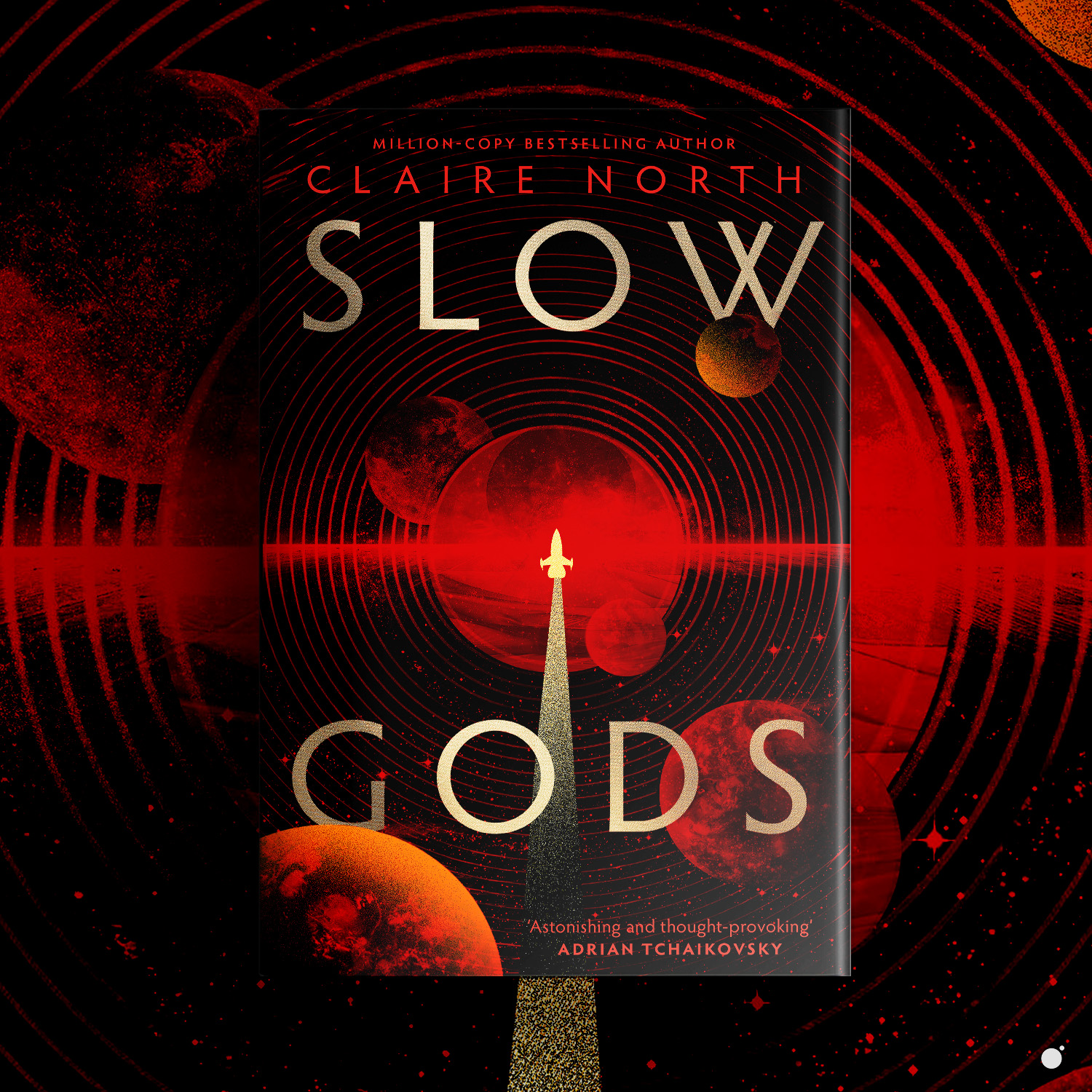
I am reviewing this book while I have Covid, which has certainly facilitated the kind of inner focus which I think the book is asking for. Because Slow Gods is polycrisis in the form of space opera, but a curiously interior-monologuey kind of space opera, more psychological than boom-boom.
The premise, as Claire North set out for us at the Birmingham Science Fiction Group last June, is that a binary star system is due to collapse which will obliterate all life within an 83 light-year blast radius. Unusually, the populations in the vicinity are warned of this precisely 100 years in advance by a perfect black sphere moving through space at sub-light-speed and known by everyone as the Slow.
The Slow listens to everything, remembers it and will consider it.
We follow the story through the eyes of Maw, who has been killed and has recovered in such a way as to be very difficult to kill after that. Making Maw an ideal candidate for Pilot, the organic sentient needed in the pilot’s seat of any ship wishing to enter arcspace which lets it travel across the universe faster than light, at huge personal cost. Pilots die frequently and each planetary system has its own way of choosing and rewarding its Pilots. Only Maw appears to be able to act as Pilot again and again, which makes the people around Maw nervous.
The main thing about Maw which makes people nervous is Maw’s relationship with “the darkness” which reaches into any ship in arcspace, in many cases sending people mad. Maw, instead, becomes “curious”, exploiting a changing relationship and perception of matter in the darkness to do monstrous things. But, despite all this, Maw is still required to keep running missions, although usually with a mechanical assistant to keep Maw from getting “dysregulated”.
This unusual set up turns out to be a way of observing the psychology of the polycrisis with some clarity. The United Social Venture is an empire where its subjects acquired debt just from being born (measured in Glint):
Everything the Venture gave us – the air we breathed, the roads we walked down, the schools we learned in – had been sweated for, bled for, and our debts were a marker of the needful labour we would give back in return.
This economic system was referred to as Shine. The Shine were one of the few systems which used prisoners for Pilot work.
One of the joys of the book is the exploration of difference, lots of details about avoiding giving offence when the Xi of Xihanna ask Maw to pilot a ship to Adjumir to bring out historical artefacts and Maw meets Gebre of the Haalo Institute. Maw finds that Normspeak is regarded as a very crude way of communicating and starts, haltingly, to learn Adjumiri (which is at least in part a click language). So begins a very moving love story.
Gender differences between systems are very striking. The Shine have only two genders – “he” and “she” – although the elite also have hé and shé. The most manly and the most feminine.
There are four genders in Xihanna, but they are not regarded as particularly important characteristics of a person and dispensed with once you know someone well. On Adjumir, there are eight, with very few Adjumiris remaining the same gender all their lives. These differences are picked out by the brilliant use of pronouns, a useful technique in a book full of characters. Even mechanicals, who have no particular interest in gender, are referred to as qe/qis as a mark of respect as “they do not wish to be put in the same category as a bowl of soup or a broken chair”.
We join Maw towards the end of the 100 year programme to evacuate the populations of Adjumir and Hadda to relative safety, with 800 million still on the planets and increasingly desperate. The Slow has effectively taken on a role as God through its massive databases, calculation capacity and sheer longevity. It seeks out Maw as it has plans for him. The Slow has been around so long that qe sees everything in the very long run. Which means that the emotional turmoil and intense highs and lows of individual lives are all averaged out to nothing. Qe calculates in terms of galaxy-level populations on the basis of what qe has come to think of as love.
What calculation would the Slow make about our world, with all our nation states and their often tiny differences blown up to justify war aims? Donald Trump certainly has to have the most Shine of any US President for some time.
Slow Gods moves slowly but relentlessly towards a showdown between Maw and Theodosius Rhode, the Executor of the Shine and executioner of his mother. There is much tragedy along the way and the ending is not straightforward but ultimately very satisfying. It’s an uplifting ride.
So this is my 42nd blog post of the year and the 8th where I have referenced Cory Doctorow. Thought it was more to be honest, so influential has he been on my thought, particularly as I have delved deeper into what, how and why the AI Rush is proceeding and what it means for the people exiting universities over the next few years.
Yesterday Cory published a reminder of his book reviews this year. He is an amazing book reviewer. There are 24 on the list this year, and I want to read every one of them on the strength of his reviews alone.
I would like to repay the compliment by reviewing his latest book: Enshittification (the other publication this year – Picks and Shovels – is also well worth your time by the way). Can’t believe this wasn’t the word of the year rather than rage bait, as it explains considerably more about the times we are living in.
I have been a fan of Doctorow for a couple of years now. I had had Walkaway sat on my shelves for a few years before I read it and was immediately enthralled by his tale of a post scarcity future which had still somehow descended into an inter-generational power struggle hellscape. I moved on to the Little Brother books, now being reenacted by Trump with his ICE force in one major US city after another. Followed those up with The Lost Cause, where the teenagers try desperately to bridge the gap across the generations with MAGA people, with tragic results along the way but a grim determination at the end “the surest way to lose is to stop running”. From there I migrated to the Marty Hench thrillers, his non-fiction The Internet Con (which details the argument for interoperability, ie the ability of any platform to interact with another) and his short fiction (I loved Radicalised, not just for the grimly prophetic Radicalised novella in the collection, but also the gleeful insanity of Unauthorised Bread). I highly recommend them all.
I came to Enshittification after reading his Pluralistic blog most days for the last year and a half, so was initially disappointed to find very little new as I started working my way through it. However what the first two parts – The Natural History and The Pathology – are is a patient explanation of the concept of enshittification and how it operates assuming no previous engagement with the term, all in one place.
Enshittifcation, as defined by Cory Doctorow, proceeds as follows:
First, platforms are good to their users.
Then they abuse their users to make things better for their business customers.
Next, they abuse those business customers to claw back all the value for themselves.
Finally, they have become a giant pile of shit.
So far, so familiar. But then I got to Part Three, explaining The Epidemiology of enshittification, and the book took off for me. The erosion of antitrust (what we would call competition) law since Carter. “Antitrust’s Vietnam” (how Robert Bork described the 12 years IBM fought and outspent the US Department of Justice year after year defending their monopolisation case) until Reagan became President. How this led to an opening to develop the operating system for IBM when it entered the personal computer market. How this led to Microsoft, etc. Then how the death of competition also killed Big Tech regulation ( regulating a competitive market which acts against collusion is much easier than regulating one with a small number of big players which absolutely will collude with each other).
And then we get to my favourite chapter of the book “Reverse-Centaurs and Chickenisation”. Any regular reader of this blog will already be familiar with what a reverse centaur is, although Cory has developed a snappy definition in the process of writing this book:
A reverse-centaur is a machine that uses a human to accomplish more than the machine could manage on its own.
And if that isn’t chilling enough for you, the description of the practices of poultry packers and how they control the lives of the nominally self-employed chicken farmers of the US, and how these have now been exported to companies like Amazon and Arise and Uber, should certainly be. The prankster who collected up the bottled piss of the Amazon drivers who weren’t allowed a loo break and resold it on Amazon‘s own platform as “a bitter lemon drink” called Release Energy, which Amazon then recategorised as a beverage without asking for any documentation to prove it was fit to drink and then, when it was so successful it topped their sales chart, rang the prankster up to discuss using Amazon for shipping and fulfillment – this was a rare moment of hilarity in a generally sordid tale of utter exploitation. My favourite bit is when he gets on to the production of his own digital rights management (DRM) free audio versions of his own books.
The central point of the DRM issue is, as Cory puts it, “how perverse DMCA 1201 is”:
If I, as the author, narrator, and investor in an audiobook, allow Amazon to sell you that book and later want to provide you with a tool so you can take your book to a rival platform, I will be committing a felony punishable by a five-year prison sentence and a $500,000 fine.
To put this in perspective: If you were to simply locate this book on a pirate torrent site and download it without paying for it, your penalty under copyright law is substantially less punitive than the penalty I would face for helping you remove the audiobook I made from Amazon’s walled garden. What’s more, if you were to visit a truck stop and shoplift my audiobook on CD from a spinner rack, you would face a significantly lighter penalty for stealing a physical item than I would for providing you with the means to take a copyrighted work that I created and financed out of the Amazon ecosystem. Finally, if you were to hijack the truck that delivers that CD to the truck stop and steal an entire fifty-three-foot trailer full of audiobooks, you would likely face a shorter prison sentence than I would for helping you break the DRM on a title I own.
DMCA1201 is the big break on interoperability. It is the reason, if you have a HP printer, you have to pay $10,000 a gallon for ink or risk committing a criminal offence by “circumventing an access control” (which is the software HP have installed on their printers to stop you using anyone else’s printer cartridges). And the reason for the increasing insistence on computer chips in everything from toasters (see “Unauthorised Bread” for where this could lead) to wheelchairs – so that using them in ways the manufacturer and its shareholders disapprove of becomes illegal.
The one last bastion against enshittification by Big Tech was the tech workers themselves. Then the US tech sector laid off 260,000 workers in 2023 and a further 100,000 in the first half of 2024.
In case you are feeling a little depressed (and hopefully very angry too) at this stage, Part 4 is called The Cure. This details the four forces that can discipline Big Tech and how they can all be revived, namely:
Competition
Regulation
Interoperability
Tech worker power
As Cory concludes the book:
Martin Luther King Jr once said, “It may be true that the law cannot make a man love me, but it can stop him lynching me, and I think that’s pretty important, also.”
And it may be true that the law can’t force corporate sociopaths to conceive of you as a human being entitled to dignity and fair treatment, and not just an ambulatory wallet, a supply of gut bacteria for the immortal colony organism that is a limited liability corporation.
But it can make that exec fear you enough to treat you fairly and afford you dignity, even if he doesn’t think you deserve it.
And I think that’s pretty important.
I was reading Enshittification on the train journey back from Hereford after visiting the Hay Winter Weekend, where I had listened to, amongst others, the oh-I’m-totally-not-working-for-Meta-any-more-but-somehow-haven’t-got-a-single-critical-word-to-say-about-them former Deputy Prime Minister Nick Clegg. While I was on the train, a man across the aisle had taken the decision to conduct a conversation with first Google and then Apple on speaker phone. A particular highlight was him just shouting “no, no, no!” at Google‘s bot trying to give him options. He had already been to the Vodaphone shop that morning and was on his way to an appointment which he couldn’t get at the Apple Store on New Street in Birmingham. He spotted the title of my book and, when I told him what enshittification meant, and how it might make some sense out of the predicament he found himself in, took a photo of the cover.
My feeling is that enshittification goes beyond Big Tech. It is the defining industrial battle of our times. We shouldn’t primarily worry about whether it is coming from the private or the public sector, as enshittification can happen in both places: from hollowing out justice to “paying more for medicines… at the exact moment we can’t afford to pay enough doctors to prescribe them” in the public sector, where we already reside within the Government’s walled garden, to all of the outrages mentioned above and more in the private sector.
The PFI local health hubs set out in last week’s budget take us back to perhaps the ultimate enshittificatory contracts the Government ever entered into, certainly before the pandemic. The Government got locked into 40 year contracts, took all the risk, and all the profit was privatised. The turbo-charging of the original PFI came out of the Blair-Brown government’s mania for keeping capital spending off the balance sheet in defence of Gordon Brown’s “Golden Rule” which has now been replaced by Rachel Reeves’ equally enshittifying fiscal rules. All the profits (or, increasingly, rents, as Doctorow discusses in the chapter on Varoufakis’ concept of Technofeudalism) from turning the offer to shit always seem to end up in the private sector. The battle is against enshittification from both private and, by proxy, via public monopolies.
Enshittification is, ultimately, a positive and empowering book which I strongly recommend you buy, avoiding Amazon if you can. We can have a better internet than this. We can strike a better deal with Big Tech over how we run our lives. But the surest way to lose is to stop running.
And next time a dead-eyed Amazon driver turns up at your door, be nice, they are probably having a worse day than you are.
I have just been reading Adrian Tchaikovsky’s Service Model. I am sure I will think about it often for years to come.
Imagine a world where “Everything was piles. Piles of bricks and shattered lumps of concrete and twisted rods of rebar. Enough fine-ground fragments of glass to make a whole razory beach. Shards of fragmented plastic like tiny blunted knives. A pall of ashen dust. And, to this very throne of entropy, someone had brought more junk.”
This is Earth outside a few remaining enclaves. And all served by robots, millions of robots.
Robots: like our protagonist (although he would firmly resist such a designation) Uncharles, who has been programmed to be a valet, or gentleman’s gentlerobot; or librarians tasked with preserving as much data from destruction or unauthorised editing as possible; or robots preventing truancy from the Conservation Farm Project where some of the few remaining humans are conscripted to reenact human life before robots; or the fix-it robots; or the warrior robots prosecuting endless wars.
Uncharles, after slitting the throat of his human master for no reason that he can discern, travels this landscape with his hard-to-define-and-impossible to-shut-up companion The Wonk, who is very good at getting into places but often not so good at extracting herself. Until they finally arrive in God’s waiting room and take a number.
Along the way The Wonk attempts to get Uncharles to accept that he has been infected with a Protagonist Virus, which has given Uncharles free will. And Uncharles finds his prognosis routines increasingly unhelpful to him as he struggles to square the world he is perambulating with the internal model of it he carries inside him.
The questions that bounce back between our two unauthorised heroes are many and various, but revolve around:
Is there meaning beyond completing your task list or fulfilling the function for which you were programmed?
What is the purpose of a gentleman’s gentlerobot when there are no gentlemen left?
Is the appearance of emotion in some of Uncharles’ actions and communications really just an increasingly desperate attempt to reduce inefficient levels of processing time? Or is the Protagonist Virus an actual thing?
Ultimately the question is: what is it all for? And when they finally arrive in front of God, the question is thrown back at us, the pile of dead humans rotting across the landscape of all our trash.
This got me thinking about a few things in a different way. One of these was AI.
Suppose AI is half as useful as OpenAI and others are telling us it will be. Suppose that we can do all of these tasks in less than half the time. How is all of that extra time going to be distributed? In 1930 Keynes speculated that his grandchildren would only need to work a 15 hour week. And all of the productivity improvements he assumed in doing so have happened. Yes still full-time work remains the aspiration.
There certainly seems to have been a change of attitude from around 1980 onwards, with those who could choose choosing to work longer, for various reasons which economists are still arguing about, and therefore the hours lost were from those who couldn’t choose, as The Resolution Foundation have pointed out. Unfortunately neither their pay, nor their quality of work, have increased sufficiently for those hours to meet their needs.
So, rather than asking where the hours have gone, it probably makes more sense to ask where the money has gone. And I think we all know the answer to that one.
When Uncharles and The Wonk finally get in to see God, God gives an example of a seat designed to stop vagrants sleeping on it as the indication it needed of the kind of society humans wanted. One where the rich wanted not to have to see or think about the poor. Replacing all human contact with eternally indefatigable and keen-to-serve robots was the world that resulted.
Look at us clever humans, constantly dreaming of ways to increase our efficiency, remove inefficient human interaction, or indeed any interaction which cannot be predicted in advance. Uncharles’ seemingly emotional responses, when he rises above the sea of task-queue-clutching robots all around him, are to what he sees as inefficiency. But what should be the goal? Increasing GDP can’t be it, that is just another means. We are currently working extremely hard and using a huge proportion of news and political affairs airtime and focus on turning the English Channel into the seaborne equivalent of the seat where vagrants and/or migrants cannot rest.
So what should be the goal? Because the reason Service Model will stay with me for some time to come is that it shows us what happens if we don’t have one. The means take over. It seems appropriate to leave the last word to a robot.
“Justice is a human-made thing that means what humans wish it to mean and does not exist at all if humans do not make it,” Uncharles says at one point. “I suggest that ‘kind and ordered’ is a better goal.”
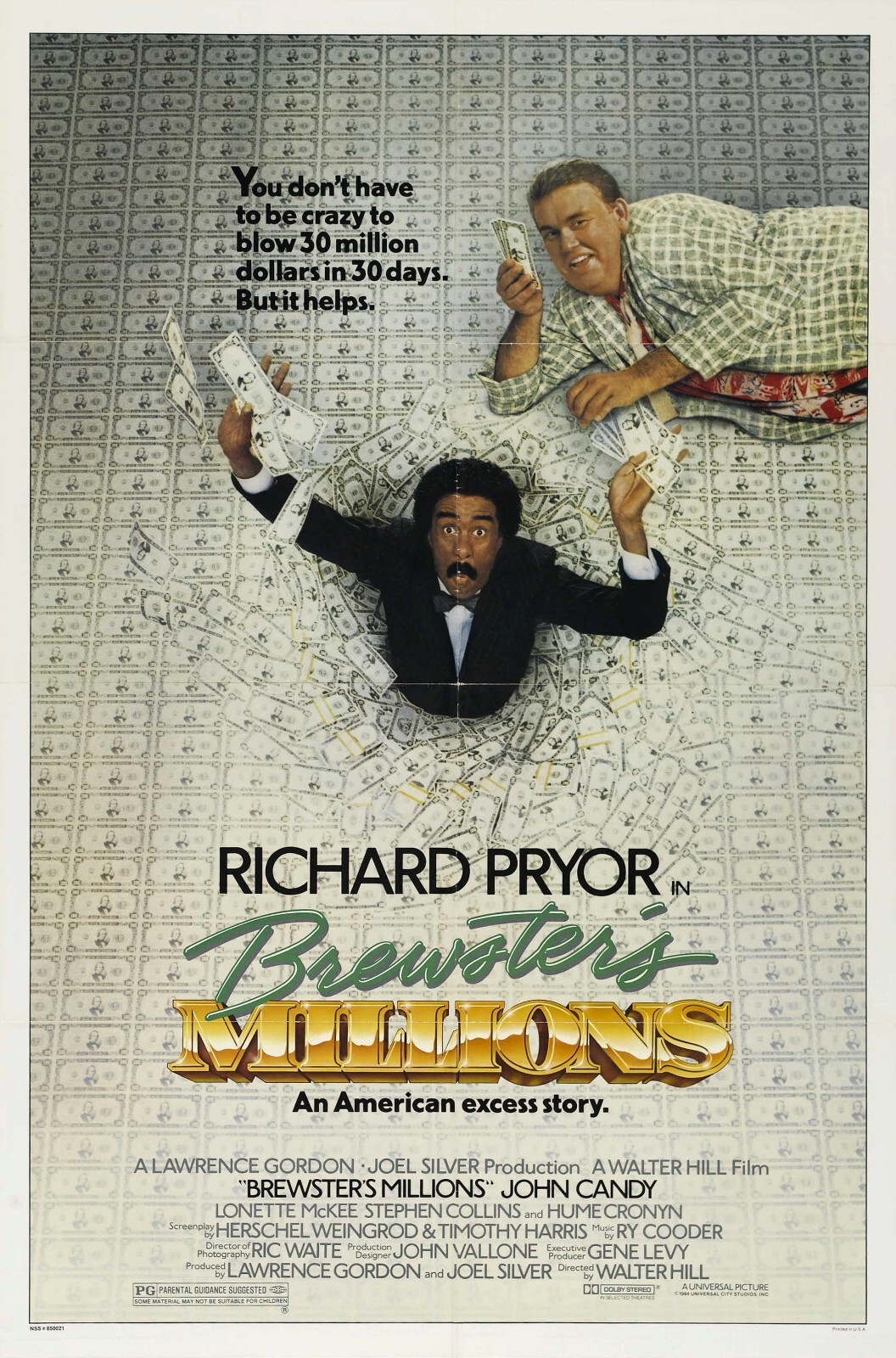
Last week I read The Million Pound Bank Note by Mark Twain and Brewster’s Millions by George Barr McCutcheon, from 1893 and 1902 respectively. Both have been made into films several times: the Mark Twain short story was first made into a silent movie by the great Alexander Korda in 1916, although the best known adaptations were the one starring Gregory Peck in 1954 and Trading Places (starring Eddie Murphy) in 1983 (which included elements of both The Million Pound Bank Note and Mark Twain’s novel The Prince and the Pauper); Cecil B DeMille was the first to attempt a film adaptation of Brewster’s Millions (from the earlier play) in 1914, with the best known adaptation being Walter Hill’s 1985 movie starring Richard Pryor (movie poster shown above).
Both stories were written before the First World War and it is interesting to see when each has been revived with new adaptations. In particular, although an early attempt was made to film Twain’s story, noone attempted it again until after the second world war, whereas there was a new adaptation of Brewster during the very interesting period between 1920 and 1922 when the first international financial conferences were being held in Brussels and Genoa to establish an international consensus for policies where “individuals had to work harder, consume less, expect less from the government as a social actor, and renounce any form of labour action that would impede the flow of production.” The aim was to return to a pre World War I economic orthodoxy and therefore remove what would be very painful economic measures for most people from the political sphere and into the sphere of “economic science”. In other words, it was a time when the political elite were trying to change the rules of the game.
This may be because Twain’s story, about a man who is given a million pound note and is feted by everyone he meets as a consequence and never has to spend it, winning a bet between the two men who gave him it as a consequence, was seen as a rather slight tale. Interestingly an American TV adaptation and the Gregory Peck film a few years later came out around the time when the Bank of England actually first issued such notes (called Giants) in 1948, which also relied on the power of people knowing they were there rather than ever having to use them.
The rules of the game certainly vary considerably across the Brewster adaptations: DeMille in 1914 was very respectful of the original but by 1921 the $7 million dollars had shrunk to $4 million. By 1926 in Miss Brewster’s Millions, Polly Brewster must spend $1 million dollars in 30 days to inherit $5 million. This was the point where Twenty20 fortune dissipation appears to have supplanted the Test Match variety. In 1935 a British version had Brewster needing to spend £500,000 in 6 months to inherit £6 million. In 1945 Brewster must spend $1 million dollars within 60 days to inherit $7 million. By 1954 the first Telugu adaptation has him spending ₹1 lakh in 30 days which, by 1985, has inflated to ₹25 lakh.
Later in 1985, the Richard Pryor film requires Brewster to spend $30 million within 30 days to inherit $300 million, with the tweak that he is given the option to take $1 million upfront, which for the sake of the movie he doesn’t. There have since been five further adaptations reflecting the globalisation of the ideas in the story (three from India, one from Brazil and one from China) before the sequel to the Richard Pryor film last year.
What is striking about both stories is how, although supposedly about financial transactions, albeit of a rather unusual kind, they are in fact all about how people behave around the display of money. In Twain’s tale, Henry Adams is transformed from being perceived as a beggar to being assumed to be an eccentric millionaire as a result of producing the note.
In the Brewster story, Monty Brewster has to spend the million dollars he has been left by his grandfather within a year so that he has no assets left in order to claim the seven million dollars left to him by an uncle on this condition. The original story explains the strange condition (something the Richard Pryor film doesn’t do as far as I can recall) as being due to his uncle hating his grandfather so much (due to his grandfather’s refusal to accept his uncle’s sister’s marriage). The uncle therefore wanted “to preclude any possible chance of the mingling of his fortune with the smallest portion of Edwin P Brewster’s”.
The problem for Monty is that he is not allowed to tell anyone of the condition, and therefore it is the difficulties the behaviour he then has to adopt causes him with New York high society that is the subject of the story. There are dinners and cruises and carnivals and holiday homes all bankrolled by Brewster for himself and whoever will journey with him, during which he falls in love and then out of love with one woman and then falls in love with the woman he had grown up alongside. Things normally regarded as good luck, like winning a bet or making a profitable investment, become bad luck for Monty.
By the end of the year, and very close to spending the whole million with nothing to show for it, he returns from a transatlantic cruise where he had been kidnapped by his friends at one stage to prevent him sailing to South Africa, to find himself spurned by the very society he had tried so hard to cultivate:
With the condemnation of his friends ringing in his troubled brain, with the sneers of acquaintances to distress his pride, with the jibes of the comic papers to torture him remorselessly, Brewster was fast becoming the most miserable man in New York. Friends of former days gave him the cut direct, clubmen ignored him or scorned him openly, women chilled him with the iciness of unspoken reproof, and all the world was hung with shadows. The doggedness of despair kept him up, but the strain that pulled down on him was so relentless that the struggle was losing its equality. He had not expected such a home-coming.
After a bit of a scare that the mysterious telegram correspondent Swearengen Jones, who held the 7 million and was assessing his performance, had disappeared, everything comes right for Monty in the end and he marries Peggy who had agreed to do so even when she thought him penniless.
And we are left to assume that everything in the previous paragraph is reversed in the same way as in The Million Pound Bank Note on being able to display wealth once more.
There is a lot of plot in the Brewster story in particular, a lot of which does not amount to much but keeps Monty Brewster feverishly busy throughout.
These two in many ways ridiculous stories, written as they are just as economics is trying to establish itself as a science and ultimately the discipline that shapes our current societies, I think reveal quite a lot about the nature of money amongst people who have a lot of it. Neither Henry nor Monty (apart from an opening twenty four hours for Henry and a scene revolving around a pear in the gutter after a night sleeping rough) experience hunger or the absence of anywhere to sleep at any point. Their concern for money seems to be entirely about social position, the respect of who they regard as their peers and being able to marry the women they have set their hearts on. In other words, money is not about money for these protagonists, it is about status.
It seems to me that almost the entire edifice that we call economics now has possibly been constructed by people in this position. Is this why money creation is represented in so many economic models via constructions clearly at odds with the actual activities of banks (one of many pieces by Steve Keen demonstrating this problem here), and why ideas such as loanable funds and the money multiplier, persist in economics education? Perhaps the original architects of these economic theories did not need money to live, as much as they needed the respect of who they saw as their peers.
David Graeber often used to point out how much more time people at the bottom of society spent thinking about people at the top than the people at the top spent thinking about them. Is this at the heart of the problem?
Of course we do still have some social mobility. A relatively small number of people from poor backgrounds can still enter influential professions. Some of them have even become economists! Of course the very process of becoming a professional is designed to distance you from your origins: years of immersion in a very academic discipline, requiring total concentration and dedication to internalising enough of the professional “truths” learnt so as to be assessed as qualified to practise, normally while engaged in highly intensive work alongside more senior people for who these truths have already been securely internalised.
And then once there you are in the Monty Brewster situation, so insecure about your position within this new society you have joined that you will do whatever it takes to maintain it. You are “upwardly mobile”. Your families are proud that you are “getting on” and doing better, certainly in terms of income and professional respect, than they did. There is no serious challenge to this path other than its difficulty, which again creates a massive sunk cost in your mind when considering alternatives. And it is a path which is invariably described as upward.
Meanwhile the societies we have constructed around these economic edifices also have a lot of plot, a lot of which does not amount to very much but it keeps us all feverishly busy most of the time.
English fans at Estádio Mineirão in Belo Horizonte during the Costa Rica-England match for the 2014 FIFA World Cup, Brazil. 24 June 2014, 11:17:21 Source: Mariordo (Mario Roberto Duran Ortiz)
Ever wondered why you often feel overwhelmed and powerless in the face of the daily news coming at you from TV, radio and social media? It is easy to lose sight of the culture we have surrounded ourselves with, to assume that it could be no other way and that we are seeing the world as it is when we are “assisted” to make judgements about things and people, that the way we organise our society has been distilled from hundreds if not thousands of years of experiment to arrive at something which we would be foolish to deviate from too much.
So it is always valuable to come across a book which challenges this very particular viewpoint, coming as it does from a very particular geography or geographies and at a very particular point in our history. Harvey Whitehouse’s excellent Inheritance – the Evolutionary Origins of the Modern World is just such a book. Its main contention is that our beliefs and behaviours have evolved much as our biology has and that three urges in particular can explain how our cultures have developed: conformism, religiosity and tribalism. All had strong survival advantages to them: conformism, via the urge to imitate, allowed us to store discoveries and innovations from generation to generation and build them up over time; religiosity, a by-product of our adaptive psychology – to anticipate how others will behave, to create lists and categorisations, our tendency to think things can be used as tools, and our other tendency to overdetect potential dangers around us; and finally tribalism. These urges have been used to create progressively more complex societies via routinisation of our lives and the fusion of our identities (the extreme state that causes people to lay their lives down for each other in military conflict in extreme cases for instance) with ever larger groups.
And some of the places Harvey and his co-researchers have ventured to test their ideas sound extremely challenging. Interviewing insurgents in the Libyan revolution, being initiated by the Baining tribe in Papua New Guinea, talking to a former member of the Indonesian terrorist organisation Jemaah Islamiyah about working with convicted terrorists in Indonesian prisons. People often with completely different perspectives on things which we have long regarded as settled in our own culture but also recognisably the same as us in all important ways. However I think my favourite attempted interviews were when they were making their way through the crowd at the England game against Costa Rica at the 2014 FIFA World Cup to test out their hypothesis that losing at football had “a more powerful bonding effect on supporters than winning”. 48 years of pain, etc.
The experiments they have carried out are also eye-opening. Creating made-up rituals of different intensities in a wooded field near Queens Belfast to see whether those who had been more scared by what they had been asked to do reflected more deeply on their experience and developed richer symbolic interpretations of the ritual. These developed until they were wiring up participants within a performance space with powerful speakers and lighting effects to lead them through rituals of even greater intensity.
Once you have started looking at your own society a bit more from the outside in this way, it is hard to stop. There is a great passage in the book about gossip:
When we lived in small communities, in which everybody knew everybody else, news consisted mainly of socially strategic information about who was hoarding wealth, who was telling lies, who was sleeping with whom, who was stealing, who was free-riding, and so on. In most of these newsworthy stories, there would be transgressors and victims, and news purveyors and consumers would be very sensitive to the reputational consequences of this information. The common term for this is gossip.
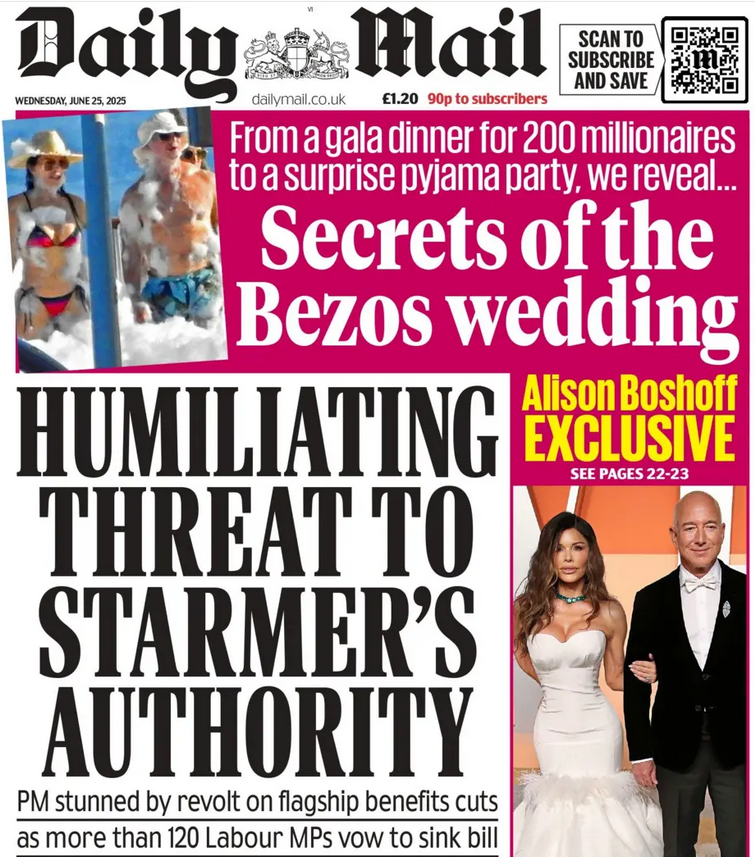
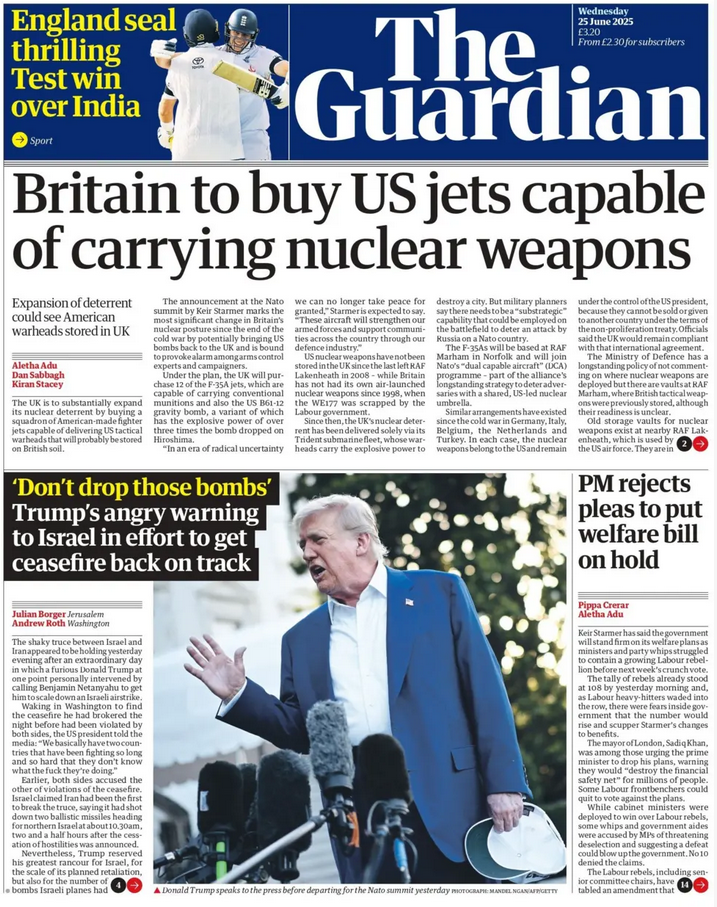
So today’s front page from The Daily Mail is almost purely gossip: an article about the wedding of a man widely regarded as having hoarded wealth on a literally galactic scale and the potential reputational damage to the Prime Minister of a backbench revolt against his proposed disability benefit cuts.
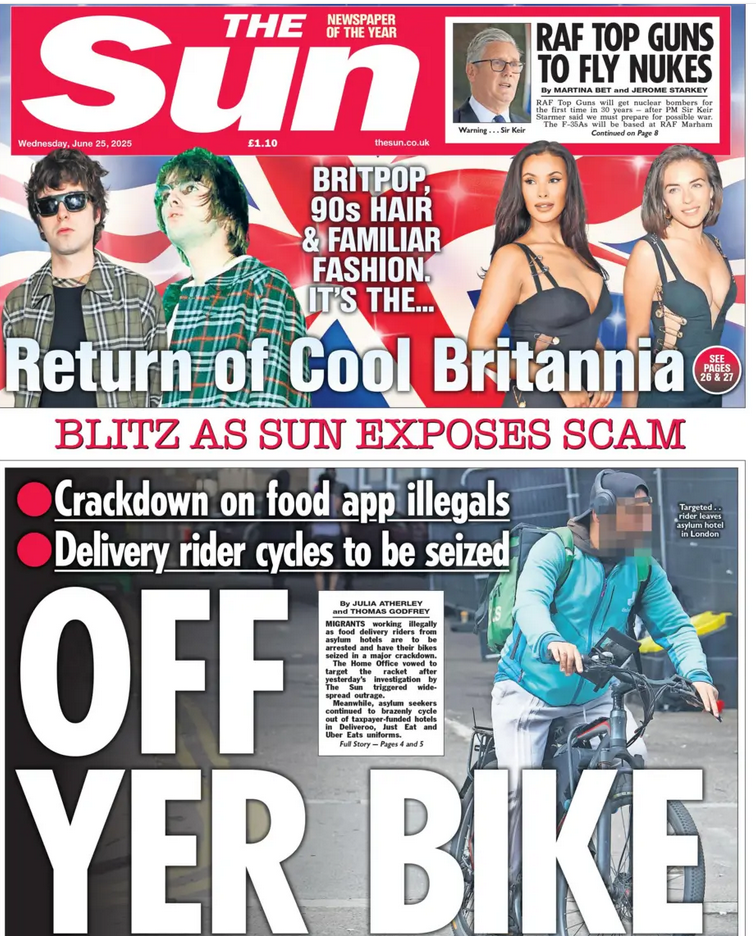
Similarly today’s front page from The Sun is also almost purely gossip: a story about people variously called migrants and asylum seekers (presented as the same thing) asserted to be illegally working as delivery riders, which the paper labels as a “scam”. Plus something about the return of Cool Britannia and Keir Starmer warning us to prepare for war and the story about us buying some new fast jets which could carry nuclear weapons.
Now these are potentially important stories about how we want to run our country (well not the Bezos wedding or the Cool Britannia ones), but they are all told through the medium of gossip. This means we focus on the moral transgressions of people we will never meet that do not affect us personally rather than whether we are managing our complex society remotely competently.
The Daily Star makes it even easier to see how a serious story about the war between Iran, Israel and the United States can be reduced to one about Trump’s so-called “F-bomb”. And it may look like I am picking on the red tops, but all these stories are present and correct in The Guardian too.
I have just focused on a few newspapers here, but obviously social media has turbo-charged this effect and now with the power increasingly to generate convincing images and videos of things which have never even happened, the ability to unhinge our “news” operations completely from real life has never been greater.
If you were being presented with this gossip in a social situation within a group of people all spouting the Deliveroo story, it would be hard to argue with it, as it would fight against your very strong instinct to conform in your behaviour and to belong to the tribe you were surrounded by. The conflation of the Cool Britannia idea and the fast jets with nukes is a mystical jingoistic attempt to pull at our natural religiosity.
I want to talk about The Future by Naomi Alderman. I read it last year, after wandering around the Hay Festival bookshop moaning that they don’t do science fiction and then coming across Naomi’s book and realising I had just missed her being interviewed. Then I watched the interview and bought both The Future and The Power (which I will talk about at some future date, but which is equally terrific).
The book is about Lenk Sketlish, CEO of the Fantail social network, Zimri Nommik, CEO of the logistics and purchasing giant Anvil, Ellen Bywater, CEO of Medlar Technologies, the world’ most profitable personal computing company, and the people working for them, and the people linked with those people. Zimri, Ellen and Lenk are at least as monstrous as Jeff, Sundar, Elon, Tim and Mark. And they are all preparing for the end of the world.
(If you need to remind yourself what Elon, Jeff, Mark and Sundar all look like milling around, below is a link to Trump’s inauguration:
Anvil is set up with alerts for signs of the end of the world being reported anywhere: giant hailstones, plague of locusts, Mpox, rain of blood which turned out to be a protest for menstrual equity involving blood-soaked tampons being thrown at Lenk and co as they emerged from a courthouse in Washington. The information Zimri, Ellen and Lenk have on everybody else in the world makes them feel all seeing, all hearing, all knowing. Combined with riches unknown to anyone before in history it makes them feel invulnerable, even to the end of the world, even to each other. Which turns out, of course, to be their decisive vulnerability.
It takes in survivalism, religious cults and wraps it all up in a thriller plot which is absolutely the kind of science fiction you want to be reading now instead of listening out for the latest antics of the horse in the hospital. And it was all written over a year before Elon even started with DOGE. The Future by Naomi Alderman is a fantastic read, particularly if you would like to see someone like Musk get an appropriate end to his story. I obviously won’t spoil it by saying what that is, but I don’t think I would be giving anything away by saying rockets are involved!
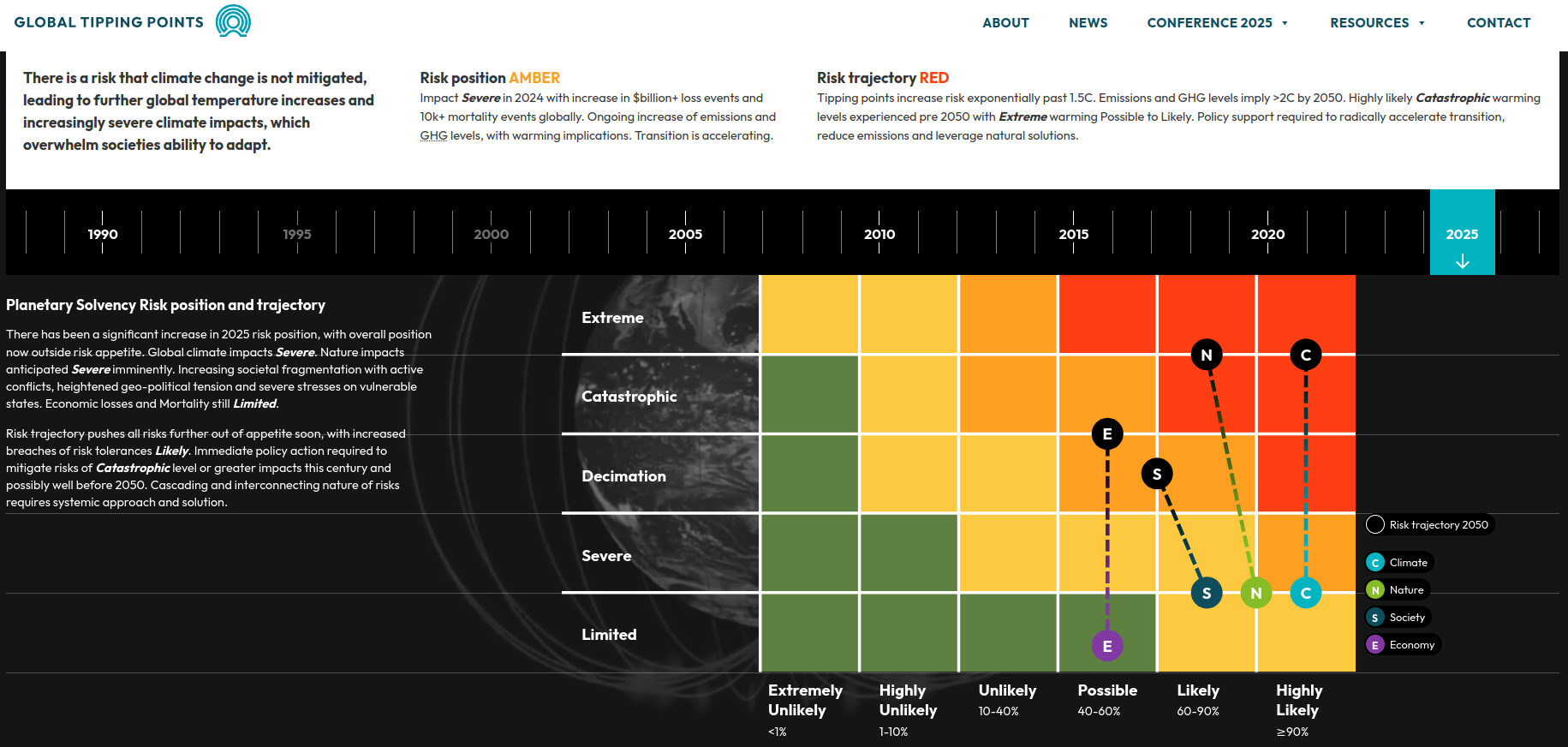
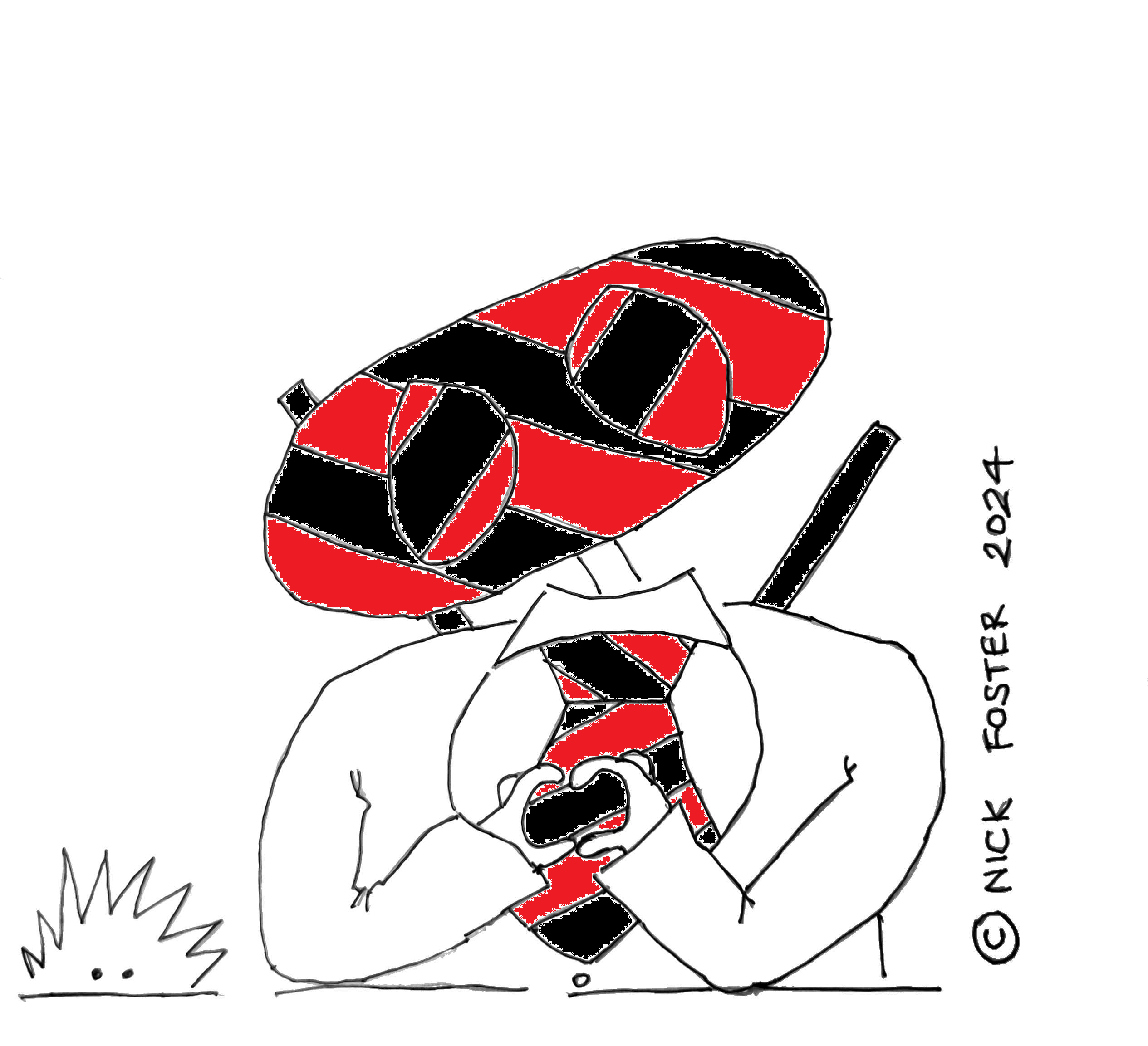
Imagine a super-hero who could not be killed. No I don’t mean Deadpool. A more apt name for our super-hero would be Deadmeat. Deadmeat is empirically dead, but, rather like the Monty Python parrot, is being energetically kept alive by the pretence of its continued existence amongst all of those around it. So much so that it becomes impolite to expose the pretence and point out that Deadmeat is in fact dead. If you really push, and someone likes you enough to want to give you an explanation, you will have a hand put on your shoulder and be led away to a corner to have the pretence explained to you. What that explanation turns out to be is something like this. Deadmeat is of course the Paris climate agreement from 2015 which committed 193 countries plus the EU to “pursue efforts” to limit global temperature rises to 1.5C, and to keep them “well below” 2.0C above those recorded in pre-industrial times.
Deadmeat, it turns out, wasn’t shot. Deadmeat was overshot. Under overshoot, we bring the terrible thing back under control after it has done the damage and hope we can fix the damage at a later date. It’s a bit like the belief in cryopreservation or uploading our brains into cyberspace in the hope that we can have our bodies fixed with future medicine or be provided with artificial bodies. It means relying on science fiction to save us.
Andreas Malm and Wim Carton have considered this approach and how we got here in their latest book Overshoot. For me there are two big ideas in this book, although the account of how things definitively got away from us immediately post pandemic and exactly how that played out is mesmerising too. I thoroughly recommend a read.
The first big idea is the problem with the justification for overshoot in the first place, which is that at some point in the future we will be so much richer and more technologically advanced that it will be much easier to bring carbon dioxide levels down to sustainable levels than to try and stay within sustainable levels now. In what they call “The Contradiction of the Last Moment” Malm and Carton show how an intense fresh round of fossil fuel investment is almost certain to occur close to a temperature deadline (ie fossil fuel companies rushing to build more infrastructure while it is still allowed), whether it is 1.5 or 2 degrees or something higher. Then, as they put it “the interest in missing it will be overwhelmingly strong”. If an investment is 40 or 50 years old, then it might not be so disastrous to have it retired, but if a fossil fuel company has invested billions in the last few years in it? They will fight tooth and nail to keep it open and producing. And by prolonging the time until the retirement of fossil fuel infrastructure, the capital which has used the time to entrench its position and now owns a thousand new plants rather than a few hundred will be in a much stronger position to dictate policy. The longer we leave it, they argue, the harder it will become to retire fossil fuels, not easier.
The second big idea explains why, despite the enormous price collapse of solar power in particular, there is no Big Solar to compete with Big Oil. As they put it “there was no Microsoft or Apple or Facebook. More broadly, there was no Boulton & Watt of the flow, no Edison Machine Works, no Ford factories, no ascendant clusters of capital accumulation riding this wave.” The only remotely comparable company would be Tesla, but they produced cars. Why is this?
Malm and Carton talk about “the scissor”, the difference between the stock of the fossil fuel industry and the flow of renewable power. Fossil fuel’s “highly rivalrous goods: the consumption of one barrel of oil or one wagon-load of coal means that no one can ever consume it again. Every piece of fossil fuel burns once and once only. But supplies of sunlight and wind are in no way affected by any one consumer’s use.”
And this is the key I think. What economists call “public goods”, goods which are non-rivalrous (ie your use of the sun’s energy does not stop somebody else’s unless you put them in the shade) and non-excludable (ie you cannot easily stop someone else from using it, in this case by sticking a solar panel on their roof), are very difficult if not impossible to make a profit from. Private markets will therefore not provide these goods, possibly at all without extremely artificial regulation (something we have probably had enough of with our utilities in the UK) and certainly not in the quantity that will be required.
In Postcapitalism, Paul Mason discussed the options when the price mechanism disappears and additional units of output cannot be charged for. As he put it:
Technologically, we are headed for zero-price goods, unmeasurable work, an exponential takeoff in productivity and the extensive automation of physical processes. Socially, we are trapped in a world of monopolies, inefficiency, the ruins of a finance-dominated free market and a proliferation of “bullshit jobs”.
This also ties in with my own experience and others I have spoken to over the years about how hard it is to invest outside of fossil fuels and make a return.
Therefore if the private sector will not provide public goods and renewable power is predominantly a public good, then it follows that renewable power needs to be in public ownership. And if the climate crisis requires all power to be renewable and zero carbon, which it does, then it also follows that the entire power sector ultimately needs to be in public ownership too.
And then the motivation for overshoot becomes clear and how high the stakes are: not just the proceeds of the sale from one dead parrot as it turns out, but the future of private power generation. My fear is that the Deadmeat franchise may end up having as many sequels as Godzilla (38 and counting). With the potential to do rather more damage in the process.