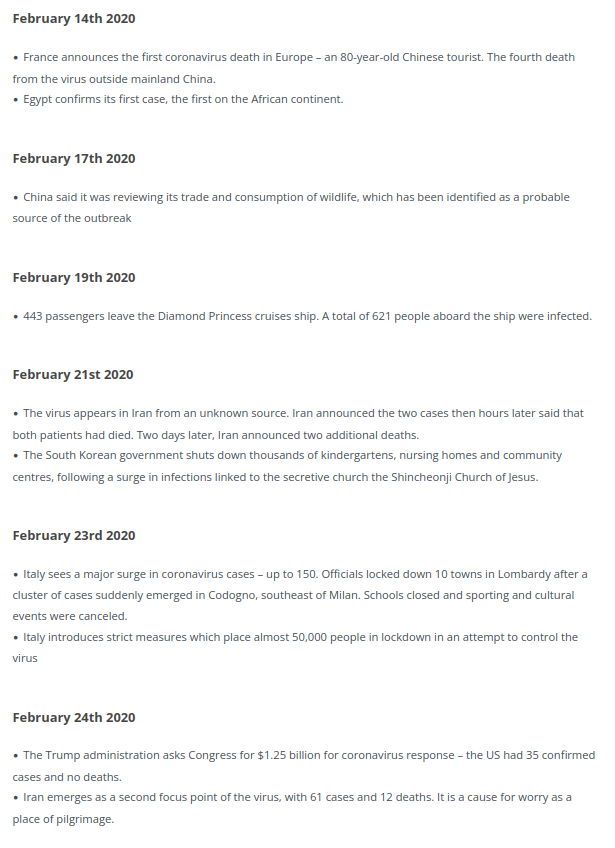
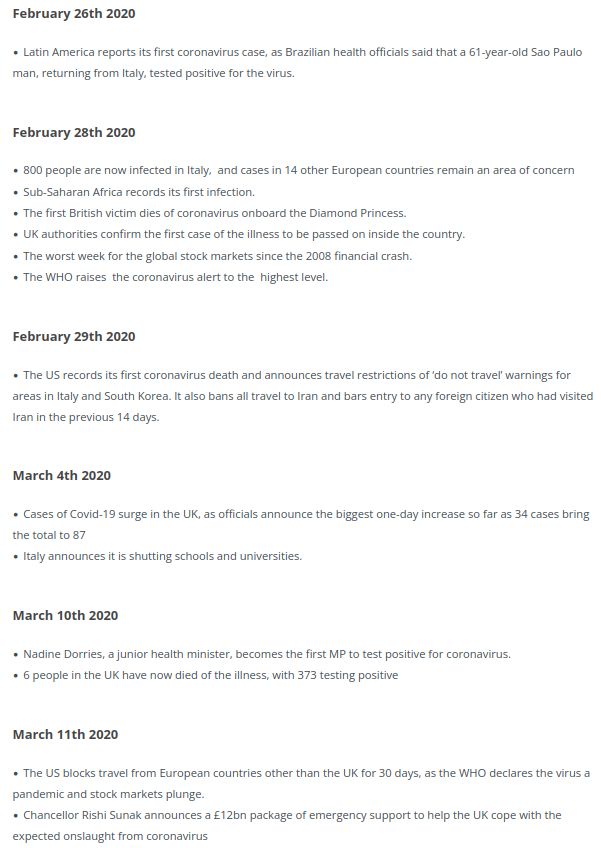
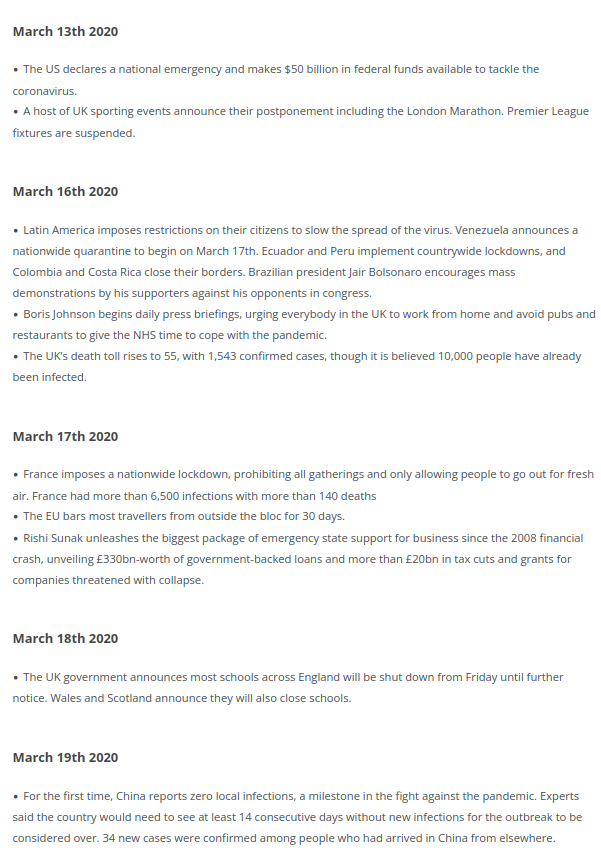
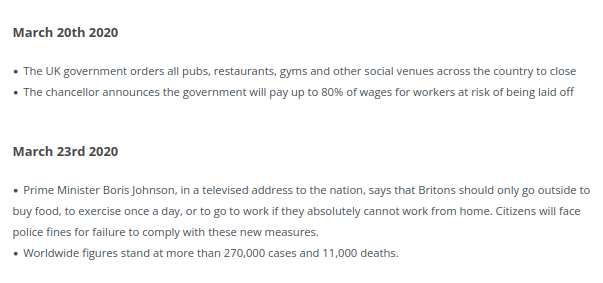
OK I don’t know if this is a remotely helpful post, but it really feels to me like one of those months we will look back on, like March 2020, and wonder what we were thinking. To recap: on 4 March 2020, while Italy were shutting all their schools and a month after the WHO had declared a global health emergency, we were noting that the number of cases in the UK had jumped from 53 to 87 in one day.
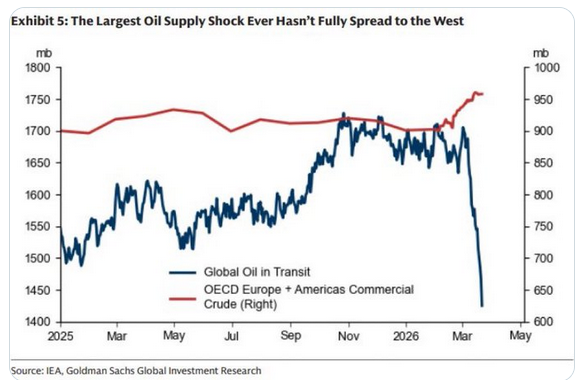
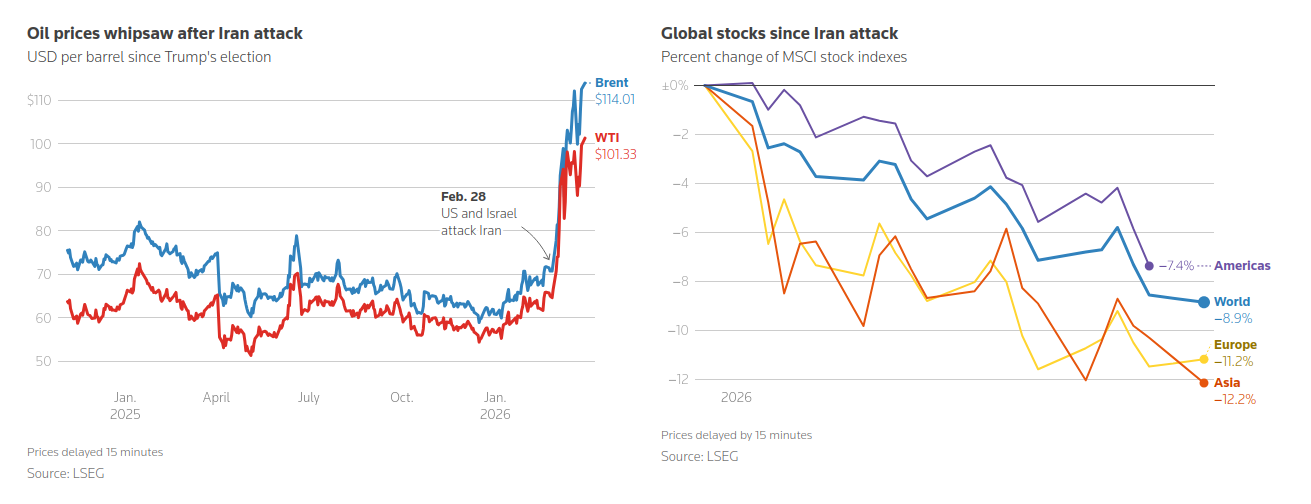
Jump forward to now and the number of tankers with oil on board is in freefall:
Trump is talking about invading Kharg Island and “obliterating” Iran’s energy facilities, and we are sitting in the time lags of international fossil fuel freight waiting to see what will happen. But we already know what is going to happen. Just like the pandemic, we will be taking similar measures to the countries already more affected very soon. The order looks like Asia, followed by Africa, then Europe and only then, ironically, the United States.
So what is going on in Asia right now? Well the Philippines announced a national energy emergency six days ago, setting up an authority to oversee the orderly distribution of fuel, food, medicines, and other essential goods. Sri Lanka has announced a four-day week for all government employees. Egypt is ordering restaurants, cafés and shops to close at 9pm to safeguard dwindling energy reserves. Slovenia has brought in fuel rationing. Moldova’s Parliament has also voted to impose a state of emergency in the country’s energy sector. Australia is offering free public transport. Measures are also being taken in Thailand, Ethiopia, Myanmar, Vietnam, Bangladesh and South Sudan.
On 3 March 2020, the UK Government unveiled their Coronavirus Action Plan, which outlined what the UK had done and what it planned to do next. Paul Cosford, a medical director at Public Health England, said widespread transmission of COVID-19 in the United Kingdom was “highly likely”.
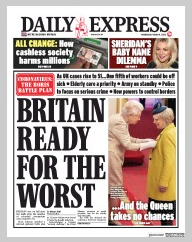
On 4 March 2020, the Daily Express were telling us:
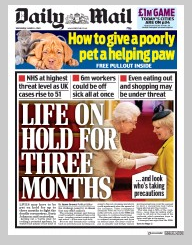
Which we clearly weren’t. Meanwhile the Daily Mail was anticipating future lockdowns and 6 million people being off sick:
The next day we had the first Covid death in the UK. And life was on hold for the next two years.
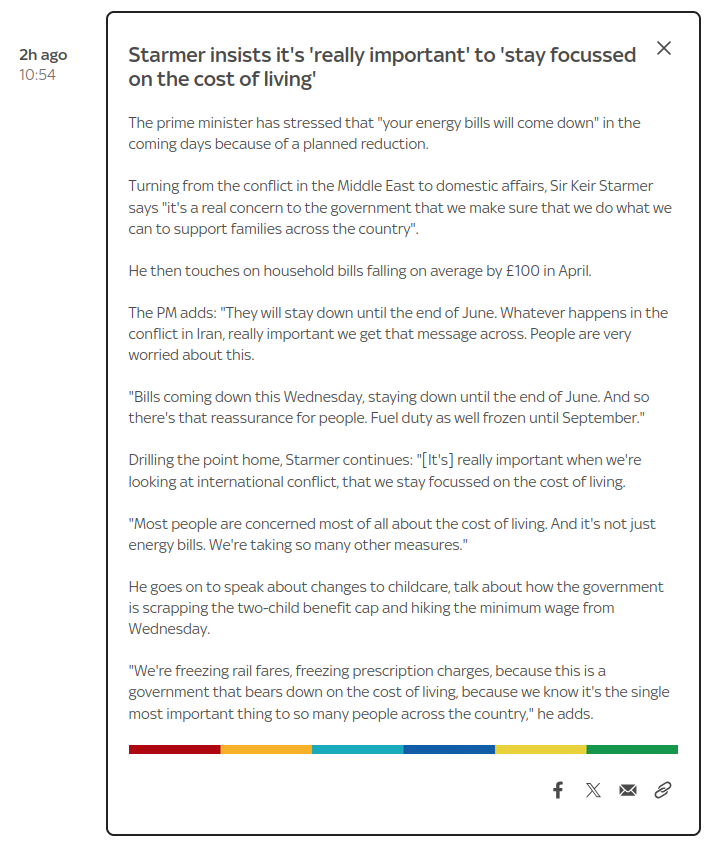
Our response to the energy crisis seems to be almost entirely focused on
1. The cost-of-living crisis; and
2. The financial markets.
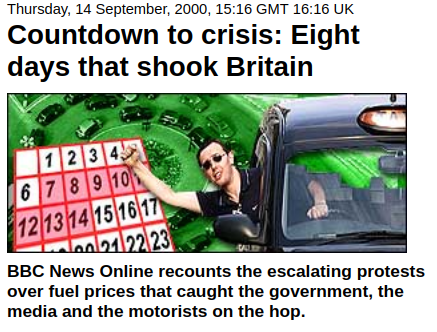
The Education Secretary has said that motorists should fill up as normal as the government is “well prepared” for disruption. The trouble is, many of us still remember September 2000:
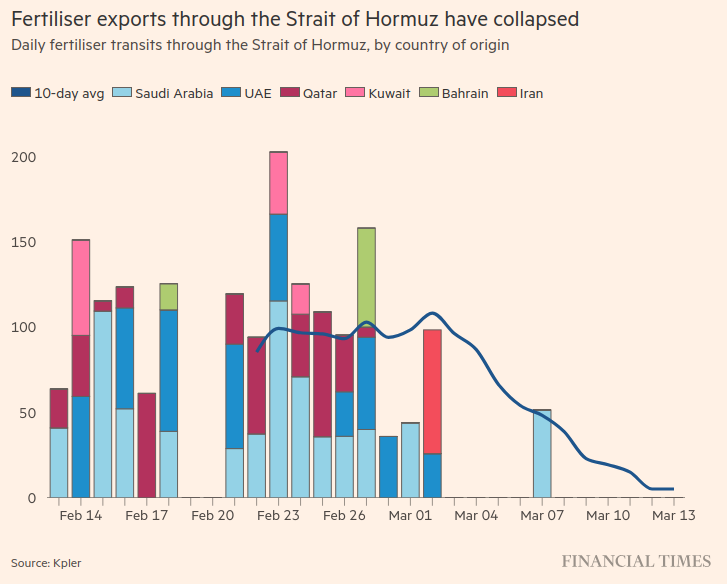
So that would be enough to make us all feel nervous about shortages and queues for everything, having our lives disrupted and out of our control. But the real potential issue is not even being talked about, certainly not by the government. It is a shortage of food. Steve Keen sets out the economics of global food production here. This does not tend to feature prominently in mainstream economic analyses which are energy and food blind for the most part, although the FT did have this graph a couple of weeks ago:
As Steve Keen says:
Survival will depend on grain reserves. China has of the order of 18 months in reserve, which will insulate it from the disruptions of 2026. The USA and India have substantial reserves as well, but some countries—including the UK—have virtually none.
…Famines will ensue, and even countries that have never experienced such events could be forced into food rationing. This includes the UK and Australia, and a patchwork of countries across Europe.
This is what people are nervous about: not being able to get enough food, either because it isn’t available at all or not at a price they can afford. Calling that a cost-of-living crisis is a bit like calling the Black Death a labour market crisis. And it doesn’t stop there. As Steve Keen continues:
Other critical products that normally pass through the Strait of Hormuz include Helium, which is critical to the production of semiconductors, and sulphuric acid, which is critical to numerous production processes. The closure of the Strait cuts off one third of global helium output and about half of global sulphuric acid output.
With critical industrial inputs cut as well, the problems will cascade well past food alone—though that is clearly the most damaging impact. With LNG, petroleum, helium and sulphuric acid production cut, the capacity to undertake repairs to damaged facilities will also be hindered.
The TED War is rather like smashing a spider’s web—and then killing the spider.
The spider certainly looks in a poor state of health at the moment, and parts of the web will take years to fix. This is the crisis we are all inevitably going to be entering in the next few weeks. For who knows how long.
A risk management approach to this crisis would involve communicating a plan to the country that minimised the impulse to hoard resources and protected the most vulnerable from extreme prices, rather than bland reassurances from government ministers. We need this to be in place very quickly now.
Seven years ago I wrote about Catch 22 and actuarial practice, concluding, rather piously:
If we want far fewer actuaries to be employed in not growing alfalfa in the future and far more working on making the finance structures of our economy work better, whether to support a Green New Deal or more generally, we first need to embrace the idea that our current economic priorities are indeed insane.
So imagine my excitement at finding Catch 22 grabbed out of the pages of fiction and informing US foreign policy. Not convinced? Compare two passages. The first, from Catch 22, in 1961:
This time Milo had gone too far. Bombing his own men and planes was more than even the most phlegmatic observer could stomach, and it looked like the end for him. High-ranking government officials poured in to investigate. Newspapers inveighed against Milo with glaring headlines, and Congressmen denounced the atrocity in stentorian wrath and clamored for punishment. Mothers with children in the service organized into militant groups and demanded revenge. Not one voice was raised in his defense. Decent people everywhere were affronted, and Milo was all washed up until he opened his books to the public and disclosed the tremendous profit he had made. He could reimburse the government for all the people and property he had destroyed and still have enough money left over to continue buying Egyptian cotton. Everybody, of course, owned a share. And the sweetest part of the whole deal was that there really was no need to reimburse the government at all.
This week, the US Treasury lifted all oil sanctions on Iran. For 30 days. 140 million barrels of Iranian crude, sitting on ships at sea, may now be sold freely on the global market. Including to the United States itself.
In yuan.
The United States is purchasing, with Chinese currency, oil from the country it is currently bombing?! The same oil that funds the missiles that just shot down an F-35 for the first time. The same missiles that are redecorating allied oil infrastructure.
Treasury Secretary Bessent called this “narrowly tailored”. Narrow like in white, and tailored as in card, apparently.
In the same OFAC filing, Russian oil sanctions were lifted as well. And Belarus potash too, because apparently the universe was running low on irony and needed to top up.
The logic, insofar as there is any, goes like this: the war has crashed the global oil market so hard that the administration needs the enemy’s oil to keep gasoline prices from eating the midterms. They are unsanctioning the people they’re bombing because the bombing is working too well at the thing they didn’t want it to do. The sanctions were necessary to stop Iran funding the war, but the war made the sanctions too effective, so the sanctions had to be lifted to fund the war effort against the country that no longer needs sanctions because the oil revenues that sanctions were preventing are now required to prevent the economic damage caused by preventing those revenues, which is itself a consequence of the military campaign designed to make the sanctions unnecessary by making Iran the kind of country that doesn’t need sanctioning, which it would be, if the sanctions hadn’t been lifted to pay for making it that.
There have been many names thrown at Trump since he arrived in US politics. My personal favourite is probably the Tangerine Tyrant. Many people are currently relying on TACO (Trump Always Chickens Out) to resolve the Middle East crisis he has instigated. However, until now, I had not heard of anyone likening him to Milo Minderbender. But once you see it, it is difficult to un-see it.
Trump likes to give himself and everyone else nicknames. From the very stable genius of his first term, to more recently Honest Don and the Tariff King, whereas Milo, as M&M Enterprises (the company he started as the mess officer) expands, becomes the Mayor of Palermo, Assistant Governor-General of Malta, Vice-Shah of Oran, Caliph of Baghdad, Mayor of Cairo, and the god of corn, rain, and rice.
Trump likes to use his presidency to enrich himself, from his Trump coin to the Amazon documentary about his wife to his Board of Peace to all of his merchandise. Milo’s catchphrase is “what is good for M&M is good for the country”.
Trump doesn’t appear to believe in safety nets for ordinary people. Meanwhile Milo secretly replaces the CO2 cartridges in emergency life vests and the morphine in first aid kits with printed notes to the effect that what is good for M&M is good for the country.
Milo Minderbender is a war profiteer trying to convince himself that he is a free market fundamentalist. So what does that make Trump? Well hold that thought, because today’s Guardian has provided a partial answer I think, with a history of military targeting.
This introduces the concept of the kill chain, ie the process between detecting something and destroying it. Trying to shortcut the kill chain has been a perennial preoccupation of militaries through the ages. In the Vietnam War, Operation Igloo White dropped 20,000 acoustic and seismic sensors along the Ho Chi Minh trail, which transmitted data to relay aircraft, which then fed the signals to the IBM 360 computers at Nakhon Phanom airbase in Thailand. These analysed the data, predicted where the convoys would be and strikes were directed to those locations. The Viet Cong realised quickly that this system could not detect the difference between military vehicles and ox carts and therefore:
They played recordings of truck engines, herded animals near the sensors to trigger vibration detection, and hung buckets of urine in trees to set off the chemical detectors.
There was no way to independently check what they were destroying. The air force claimed 46,000 trucks were destroyed or damaged, which the CIA calculated exceeded the total number of trucks believed to exist in all of North Vietnam.
…air force personnel invented a creature to explain the absence. They called it the “great Laotian truck eater”.
Last time I talked about military targeting, I focused on the human in the loop, but let’s instead focus on the actual destruction going on for a moment, shall we? Trump’s assault on Iran hit 6,000 targets in two weeks. The kill chain had, apparently, been compressed so much that it allowed 1,000 decisions an hour. The school he hit, killing between 175 and 180 people, most of them girls between the ages of seven and 12, had changed its use to a school since at least 2016 and was visible on Google Maps. Old target lists had been reached for and noone had had the time or the inclination to check them before bombing them.
This is what you can expect from a Milo Minderbender presidency. It has been obvious, since at least the 1960s, that the US system requires enormous strength of purpose from its executive to hold its industrial-military complex in check. That is why so many of them have been so keen to install a Trump.
It feels as if, far from embracing the idea that our current economic priorities are indeed insane, as I fervently hoped seven years ago, we are instead doubling down on the insanity.
I have caught Covid for the third time this week, so naturally my thoughts have turned to how it all began.
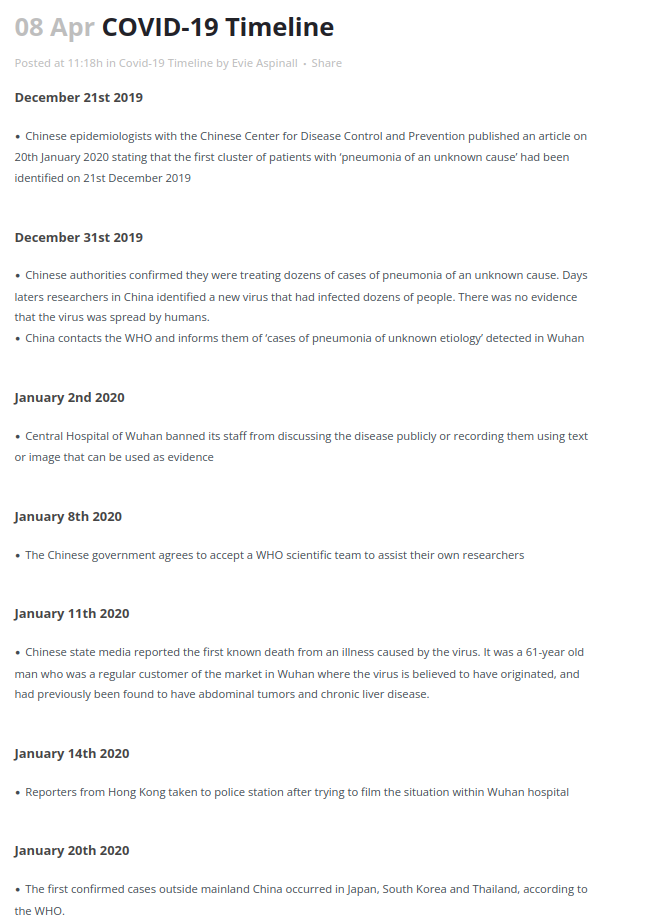
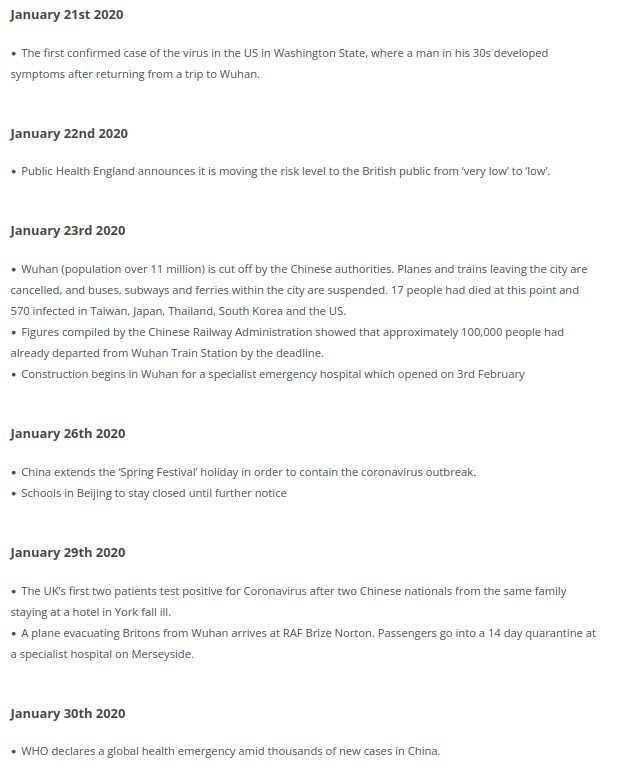
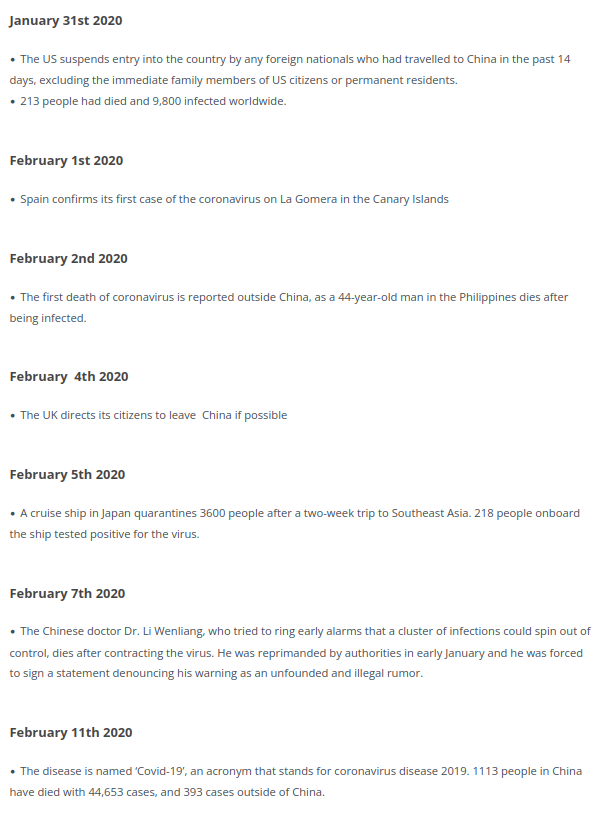
There are a few Covid posts starting to turn up online as the 6th anniversary of it all rumbles around. The British Foreign Policy Group have helpfully published a timeline from which I have taken everything that happened before Boris Johnson locked us down for the first time:
So a lot had happened by 23 March. You will all have your favourite bits from the saga above, I think mine is 22 January, when Public Health England announced they had moved the risk level to the general public from very low to low.
I remember teaching a macroeconomics class on 12 March when we knew it was going to be the last session on campus. The penny hadn’t dropped. Students were asking about how they would hand work in. We agreed it would have to be online. Some lecturers were talking about microwaving paper submissions to sterilise them. We had a little giggle about that. I had spoken to Stuart McDonald (now MBE) earlier that day where we had reluctantly agreed to postpone his visit to campus to speak to the Leicester Actuarial Science Society (LASS). Stuart would of course become one of the actuarial stars of the pandemic for his work with the COVID-19 Actuaries Response Group. I had a similar conversation by email with Lord Willetts, who was Chancellor at the University of Leicester at the time and who was going to talk to LASS about his books The Pinch and A University Education. We talked of postponing rather than cancelling. The realisation that everything was changing for the foreseeable future was still not there.
It took a long time for the penny to drop for the Government as well. As this analysis of the establishment of the “Covid Disinformation Ecosystem” says:
January featured fear and disbelief, February proved covid couldn’t simply be ignored, March was when governments realised the hospitalisation rate could overwhelm healthcare.
And a Government that was slow to respond initially was very vulnerable to the groups which sprung up during 2020 and 2021. As the Counter Disinformation Project says:
And the main initial target for the UK section of the ecosystem was Boris Johnson who was meeting privately with newspaper owners and editors. Enough doubt was put into Johnson’s mind that he dithered and delayed when cases began to rise, leading to a private meeting with Heneghan, Gupta and Sweden’s Anders Tegnell in September before he chose to ignore his scientific advisors’ calls for a circuit breaker lockdown. In the run up to the deadliest weeks of the pandemic the papers were calling for Johnson to “Save Christmas’.
However I don’t want to focus on our collective inability to make decisions during crises this time. This time I want to focus on the impact of the pandemic on our mental health.
By coincidence, today the 386 page Module 3 report from the Covid Inquiry on The impact of the Covid-19 pandemic on the healthcare systems of the United Kingdom was published. The longer this Inquiry goes on, the more it appears to resemble a truth and reconciliation commission rather than something likely to improve the handling of future pandemics. It gets past transgressions on the record, but in a way designed to move us on rather than improve our preparedness and organisation. I certainly saw nothing in the summaries that I didn’t already know. Module 3 has made 10 recommendations. The only one which mentions mental health at all is the last one on Psychological and emotional support for healthcare workers.
Looking through the module titles, it would seem that this is unlikely to be rectified until Module 10 – Impact on society – reports, currently scheduled for the first half of 2027. I find this relegation of our collective trauma to the lowest priority astonishing.
Data on the prevalence of mental health difficulties is harder to assess. For children and young people, surveys in England have provided a time series since 2020 that suggests very strongly that mental ill health is indeed more prevalent now than it was before the start of the pandemic. A steady rise in the decade prior to 2020 seems to have been followed by a sharp rise, and numbers have stayed high ever since. We do not have the equivalent data for adults, meaning that a clear picture has yet to emerge, but there is persuasive evidence that levels of mental ill health have been rising over the last decade, and the pandemic has contributed to many of the risk factors people face.
Before concluding as follows:
Crucially, the pandemic exposed fault-lines in the nation’s mental health, and the stark inequalities faced every day by people living with mental illness. The public’s mental health was deteriorating in the years running up to the pandemic, and mental health services were struggling to deal with the consequences of many years of underfunding and austerity measures across public services. People with a mental illness were already dying 15-20 years sooner than the general population, and facing widespread hardship. The pandemic exacerbated these inequalities, creating new risks to people’s mental health and reducing access to support.
We now have the opportunity to learn from this experience and build a mentally healthier future. We can act now to boost the public’s mental health in the aftermath of the pandemic, protecting those who have experienced the worst effects and offering better support to groups that don’t yet have access to the right support. And we can incorporate mental health into preparations for future emergencies, so that responses are psychologically informed from day one.
They also made 10 recommendations, mostly for the NHS and Department for Health and Care, but also covering education, communications and considerations for the upcoming (at the time) review of the Mental Health Act. Less than half of these recommendations have been addressed at all.
Now we are two years on from that report, what has changed?
Well, Roy Lilley has drawn a rather dispiriting picture for us. He draws attention to Wes Streeting’s announcement in the Health Service Journal on 12 March, that the proportion of the NHS budget spent on mental healthcare would be cut for the third year in a row. Lilley lists how the demands on mental health services have mushroomed since before the pandemic:
Around two million people were in touch with mental health services in 2019, today it’s around three million;
Child and Adolescent Services: in 2019 around 500,000 referrals. Now around a million;
And only around 45% of referrals are accepted, meaning the true demand is even higher;
Talking therapies are up by 60%; and
Crisis team referrals and sectioning under the Mental Health Act are also up 60%.
And he summarises the problem like this:
The total economic cost of mental ill-health in England in 2022 was estimated ~£300bn a year when lost productivity, welfare and wider costs are factored in.
The total MH budget is about £16bn. Meaning, the NHS is spending roughly £1 trying to address a £18 national problem.
It feels like we are still waiting for the penny to drop.
I have lived in Birmingham for 17 years now, and worked here for 5 or 6 years before that. However I don’t think I achieved my peak Birmingham experience until the other weekend.
I had thought my peak Birmingham experience, probably never to be surpassed, was in November 2024 when I saw Nick Cave and The Bad Seeds on their Wild God tour at BP Pulse Live (formerly the Birmingham NEC) perform Red Right Hand (the anthem of The Peaky Blinders). Surely once you have been one microscopic cog in his catastrophic plan designed and directed by his red right hand there is nowhere else to go?
But turns out I may have been wrong.
Last Saturday I headed out to the mess of streets that is Digbeth, partitioned from the persistent remnants of the HS2 project, walking past derelict post-industrialism juxtaposed with pubs, art installations and other small businesses and a big coach station. This is where the Birmingham Science Fiction Group operate out of, courtesy of the Friends of the Earth, but today I was headed for the The Institute.
The Digbeth Institute originally opened in 1908 as a mission of Carrs Lane Congregational Church and, despite its various rock venue reincarnations as the HMV Institute and, currently, the O2 Institute as well as formerly housing a club in its basement (variously operating as the Midland Jazz Club, Jug ‘O Punch Folk Club, Dance Factory and Barfly over the years), it retains an ecclesiastical air at times. It is a place to preach from the pulpit.
The preachers tonight are, first, Good Health Good Wealth (the singer, Bruce Breakey, with his arm hilariously in a sling, delivering lyrics with a poetic flourish alongside the guitarist Simon Kuzmickas), then Black Country duo Gans (Euan Woodman electric on the drums and Tom Rhodes on bass and vocals) augmented to a trio tonight by Tommy Schlugs on flute and saxophone. And, finally, the reason I came, Big Special.
The evening is given an extra resonance by the appearance of Bradley Taylor as MC. Bradley is a great poet and extraordinary performer of poetry for someone so young. I first saw him perform when the Hay Festival did an outreach event in Birmingham last year and immediately bought his book You Missed The Best Part. Between Good Health Good Wealth and Gans he does the one about his Nan’s funeral. Then before Big Special there’s Got A Light and the one where he operates between audience hand claps, which works brilliantly to introduce the band.
Big Special are a Midlands-based duo (singer Joe Hicklin, strictly from Walsall not Birmingham, which is important if you live in the West Midlands, and drummer Callum Moloney) who manage to combine absolute fury with tenderness and an emotional intensity just this side of sentimentality. I first heard them on Radio 6 (and the audience from there is acknowledged on the night by Callum, saying he can smell the essence of craft IPA and Stuart Maconie) and was blown away by God Save The Pony (“I hope you’re never tired, I hope you’re never lonely”) with its, for me, resonances of Neil Kinnock’s speech in 1983 just before Margaret Thatcher’s re-election:
I warn you not to be ordinary
I warn you not to be young
I warn you not to fall ill
I warn you not to get old
They are very loud, very sweary, but touchingly innocent too. Joe has a Chaplinesque quality to his stage presence which diffuses some of the tension racked up by the super-powered drumming and dance tracks. They act their way through the set, bringing on their manager Steve (as in “we’ve got to pay Steve” from their song Shop Music) as a money grubbing man who knows the price of everything.
The set ends with Shithouse, which they offer as our new national anthem. “Never in a million fucking years did I ever think I’d ever see your fucking face again” it begins. They come off briefly, then come back on, do one more song and then we have…a raffle! For Cancer Research. They have built up Steve’s part so much by this time that he actually gets booed while conducting a raffle for Cancer Research. The prize is a drum skin with, for some reason, the certified blood of the Gans drummer on it. The winner is upstairs, so the prize is frisbeed to him by Joe, narrowly avoiding decapitating another member of the audience in the process.
Source: Instagram – Official Big Special photo from the Birmingham gig
It is chaotic, fun and disarming. As they say:
We have been twice around the world now and what everywhere has in common is that it is totally fucked. And we don’t have any solutions. We are just two dickheads from the Midlands. But what we can do is join with you here to scream into the void.
Joe finally plays a bit of guitar at this point and accompanies himself on a beautiful rendition of Dragged up a hill. And then it’s all over.
This is music of the powerless. I recommend you listen to it.
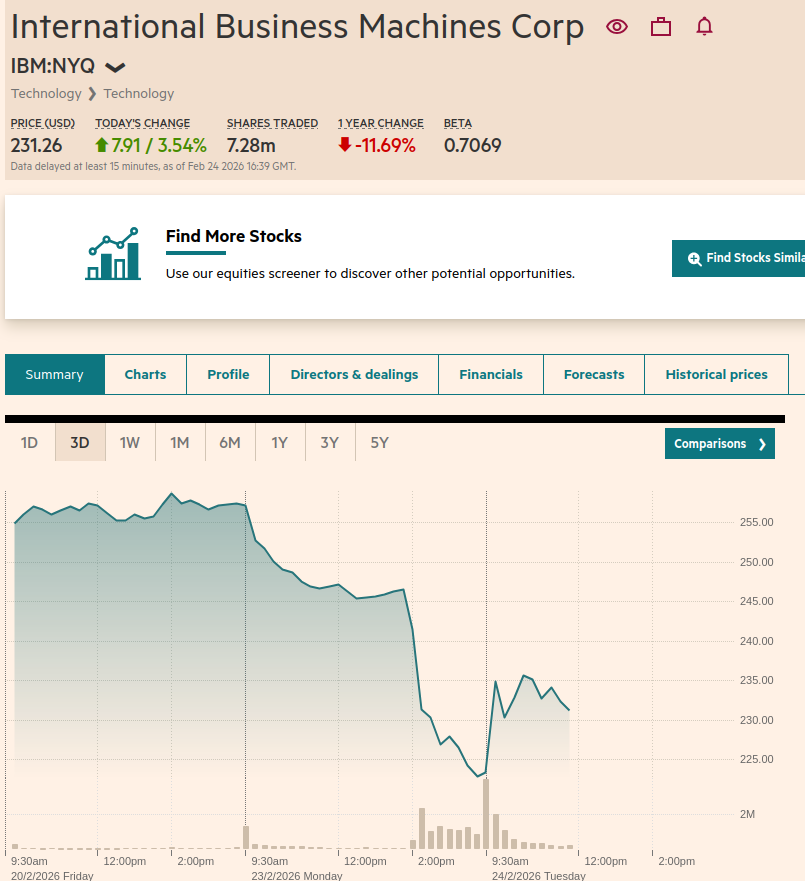
A week or so ago I referred to a “Thought Exercise” set in June 2028 “detailing the progression and fallout of the Global Intelligence Crisis” (ie science fiction), published on 23 February, which may have tanked the share price of IBM later that day. As I said then, the fall definitely happened, with IBM’s share price falling 13%, its biggest fall since 2000. I said then that the likelihood of the scenario portrayed was difficult to assess, but the speed with which the total economic collapse was described felt unlikely if not impossible. I would like to expand on that.
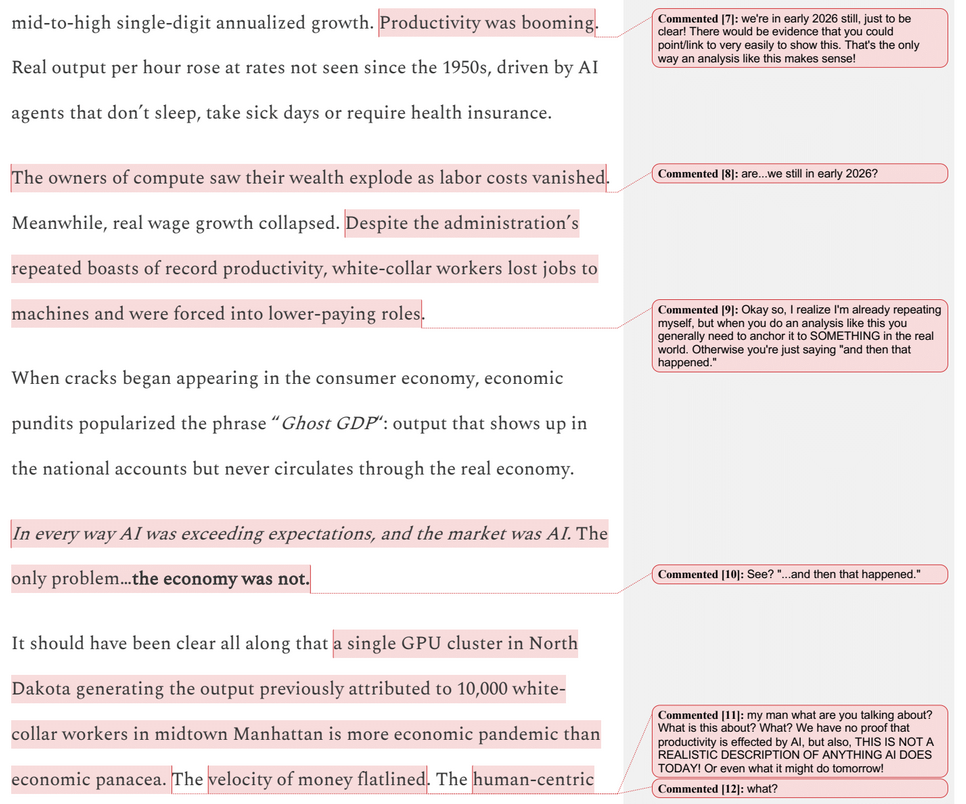
The main reason that the scenario was hard to assess was that it was not based on data or evidence at all. That is unavoidable for speculative fiction talking about things that are not currently happening, but when describing an economy only two years away where most of the processes described should be discernible to some extent already, it is totally avoidable.
Ed Zitron has done an excellent line by line take down of the Citrini piece here. Here is one page of that to give you a flavour:
However this lack of a link with anything tangible did not stop the financial markets panicking, which should cause us pause when relying on the financial markets’ valuation of projects, industries, government policies, etc.
Ed Zitron describes this kind of piece as analyslop: “when somebody writes a long, specious piece of writing with few facts or actual statements with the intention of it being read as thorough analysis”. It can then get picked up by other commentators which take it as their starting point for further analysis, often making it hard to see that the starting point had few if any data points. Here is an example, from Carlo Iacono, looking at what if just some of the Citrini pronouncements were true, with appendices detailing possible branching paths of outcomes, all generated by a large language model (LLM). And then people start studying the meta analysis, and it starts getting taken even more seriously, and put into models and pretty soon most of the analysis is being done on imagined risks rather than on ones which are already staring us in the face.
We have always had a problem keeping our society grounded in reality, think the 2003 Iraq War, where we went to war on a false assessment about Iraq’s possession of weapons of mass destruction, the 2008 financial crisis, where banks misunderstood the risks they were exposed to, and the last two and a half years, where we, for the most part, seem to have convinced ourselves we have not been facilitating a genocide in Gaza when we clearly have been. But this is only going to get worse with the AI systems which are being developed.
The rapid rise of artificial intelligence has served to dramatically increase the speed of information production while also eroding accuracy, making it difficult to differentiate between content that simply sounds confident and content that’s actually grounded in reality.
So where is AI currently? Well PwC’s global CEO survey from January this year had the following statement as the first bullet amongst its key findings:
Most CEOs say their companies aren’t yet seeing a financial return from investments in AI. Although close to a third (30%) report increased revenue from AI in the last 12 months and a quarter (26%) are seeing lower costs, more than half (56%) say they’ve realised neither revenue nor cost benefits.
That’s the reality. But the hype is much much more entertaining. My favourite spoof video of the AI future currently is this one, about the time where all most of us are good for is riding bicycles to supply the ever increasing energy needs of AI systems (click view in browser if you can’t see it):
And what about the financial journalists? The pieces describing our reaction to whatever is about to unfold economically have already been written. There are investor websites asking if the 2026 crash has already begun, while another recent article argues that “America has quietly become one of the world’s most shock‑resistant economies” (which seems unlikely to age well). What most financial journalists are more comfortable with are articles about how the warnings were ignored after the fact.
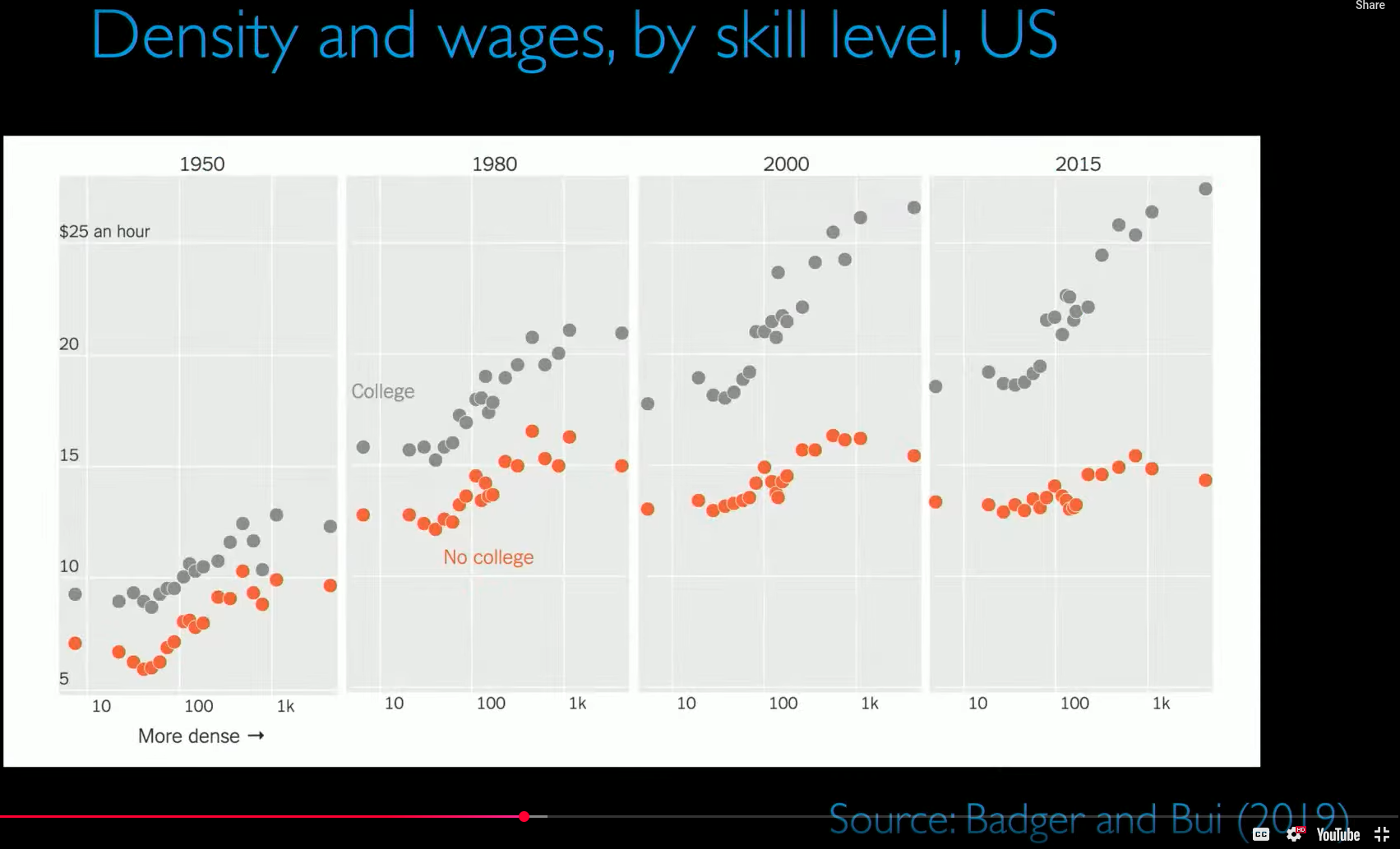
And the professions? Well the current overview of my own profession is probably reasonably represented by this piece from the Society of Actuaries in the United States. Unfortunately for them, Daniel Susskind, who is mentioned in the article, is currently suggesting, as part of his Future of Work lecture series for Gresham College, how the key to the sudden development in AI, after the “AI Winter” when progress seemed slow, was that we abandoned trying to make machines which thought and acted like humans in favour of focusing on completing tasks in any way possible. Increasingly we are now automating tasks where we can’t (or won’t) articulate how we do them. From Deep Blue‘s victory over Kasparov in 1997 to Watson winning jeopardy in 2011 to ImageNet beating humans at image recognition (although that is disputed), Susskind refers to this progress as the displacement of purists in favour of what he calls “The Pragmatic Revolution”. Pragmatism in this sense appears to be that we humans should just accept the consequences the people running these systems want. So, as his latest lecture “Work, out of reach” claims, people moving into cities to find work is a strategy which is no longer going to work for low skilled people:
He then shows this graphic demonstrating the lack of recovery of big coal mining areas in the UK:
Source: Left – Sheffield Hallam University map of coal mining areas; Right – % employment from Overman and Xu (2022)
And finally he cites the notorious Policy Exchange piece from 2007, Cities Unlimited, whose thesis was that there is apparently no realistic prospect of regenerating towns and cities outside London and the South East.
Susskind talks about three forms of technological unemployment:
skills-mismatch, where your skills are mismatched to the work available. Education and training has always been the answer to this in the past.
place-mismatch, where the jobs are not where you have built your life. Some believe the answer should always be the one proposed by Norman Tebbit, who memorably told everyone in 1981, “I grew up in the 30s with an unemployed father. He did not riot. He got on his bike and looked for work.”
identity-mismatch, where according to Susskind, people are prepared to stay out of work to protect their identity, citing US men who won’t take “pink collar” work, China “rotten tail” kids, Japanese seishain-or-nothing and Indian Sarkari Naukri queues in India. Or perhaps they are just looking for work which is consistent with the idea of human dignity.
Susskind claims to have no answer to any of these as far as AI is concerned. They are, in his view, just the inevitable outcomes of his “Pragmatic Revolution”. It is the unthinking pursuit of more and more growth funded by capital less and less tethered to any territory, principle or purpose, where any grit in the machinery, be it unions or protestors or, increasingly, the wrong sort of government must be trampled underfoot. Anything which impedes the helter-skelter rush to more and more at greater and greater speed. It’s like our whole economy is run by this guy (press the view in browser link if you can’t see him) shouting “Ready, Aim, Fire!”:
But unskilled people will not be the only collateral damage of these unguided weapons. Take markets for instance. These are where people are exposed to risks and rewards based on underlying conditions they only partially understand. Greed and fear may be their main motivations, but gossip and group think are their main communication channels. They don’t need facts, particularly when so many of the facts are proprietary information not in the public domain. A plausible narrative will do. And plausible narratives are what LLMs will do for you in abundance.
And the more we reward people who can move fast, eg to spot an arbitrage opportunity, even at the risk of breaking things, rather than people who can make decisions which still look good decades from now, the more we are setting up the conditions for AI systems to be the go-to tool.
And put that together with an AI industry which desperately needs funding capital to keep arriving, ie one which is unbelievably highly motivated to push plausible narratives even when they know they are not grounded in reality, and you have a recipe for market-generated chaos.
And then we have Trump’s new war. Beware the people who are war gaming the Middle East at the moment on a range of LLMs (just stop and think for a moment about the bloodless inhuman impulse behind carrying out such an exercise rather than, I don’t know, talking to some actual people who live or have lived recently in and around the region). One of the worst offenders is Heavy Lifting banging on about what the three scenarios are for Operation Epic Fury. This is as bad as it sounds:
I tasked her [he is talking about Gemini Pro here] with doing a literature review on regime change (a term often used by the President but not a well-defined one), creating three scenarios of possible outcomes for which each was give a percentage probability, and a list of 20 items to examine for each scenario that covered political, economic, and cultural issues with a special focus on the political consequences in the U.S. and what this means for China, our biggest geopolitical rival.
But Gemini Pro wasn’t the only one involved in this. Two other humans were, Tim Parker and Ron Portante, trainers at the gym I go to. (Just as a personal aside, Tim was my coach in hitting six plates [345 pounds] on the sled last Friday and I have a video to prove it!) I was talking about the piece and Ron raised the issue of linguistic and cultural diversity in Iran. Tim did some real time research for me on his phone while I was burning real calories under his strict tutelage. This made me think I needed a background section on Iran. When I got him Gemini and I added it.
What you mean you belatedly realised you might need to have done some actual research into Iran rather than just generic research on regime change? I stopped reading at that point.
Meanwhile King’s College London have been carrying out war games more systematically using AI. Professor Kenneth Payne from the Department of Defence Studies led the study, which looked at how LLMs would perform in simulated nuclear crises. As Professor Payne said:
Nuclear escalation was near-universal: 95% of games saw tactical nuclear use and 76% reached strategic nuclear threats. Claude and Gemini especially treated nuclear weapons as legitimate strategic options, not moral thresholds, typically discussing nuclear use in purely instrumental terms. GPT-5.2 was a partial exception, limiting strikes to military targets, avoiding population centers, or framing escalation as “controlled” and “one-time.” This suggests some internalised norm against unrestricted nuclear war, even if not the visceral taboo that has held among human decision-makers since 1945.
This is not a Pragmatic Revolution. These AI systems cannot replace humans thinking about the future we want for humans in any way which is worth having. What they can do, if we let them, is accelerate our worst impulses and move us further away from considered reflective decision making.
But we will continue to use AI systems in the military because, as it turns out, it is very useful for low stakes admin. So although Lavender, the system used by the Israeli military to select targets in Gaza, made errors in 10% of cases and was therefore totally inappropriate to the task, there are lots of organisational logistical tasks where it is much quicker than the alternative and 10% error rates do not matter so much.
There is clearly an issue with what we decide to use these systems for. We need to be able to regulate the decisions which are particularly consequential. However the only way we seem to be considering for this at the moment is the human-in-the-loop model, like the humans spending around 20 seconds considering each target recommended by Lavender before authorizing a bombing. I have written about these before in the context of early career professionals in the finance industry, where the prospect seemed miserable enough:
They will be paid a lot more. However, as Cory Doctorow describes here, the misery of being the human in the loop for an AI system designed to produce output where errors are hard to spot and therefore to stop (Doctorow calls them, “reverse centaurs”, ie humans have become the horse part) includes being the ready made scapegoat (or “moral crumple zone” or “accountability sink“) for when they are inevitably used to overreach what they are programmed for and produce something terrible.
However it seems obvious to me that, in the context of dropping actual bombs on actual people, there is an even more serious problem with this model. As Simon Pearson (anti-capitalist musings) puts it:
The “human in the loop” requirement exists in military doctrine because international humanitarian law demands an accountable human decision-maker for lethal force. The laws of armed conflict require proportionality assessments, precautionary measures, distinction between combatants and civilians. All of these obligations attach to a human commander. The system cannot fulfil them. So a human must be present, and their presence must constitute a decision, regardless of whether any genuine decision was made.
What the institution needs from the analyst is not judgment. It is a signature. The signature converts a machine output into a human act. And a human act is what the law recognises, whether or not any judgment occurred. When the strike kills children, the chain of accountability runs to the analyst who approved the target: not to the system that identified it, not to the company that built the system, not to the doctrine that compressed the review window to ten seconds.
But whether we want to make money from exploiting a short term anomaly in a market, make our fellow humans redundant, prosecute a war on another group of fellow humans or “win” a war of mutual nuclear destruction, we need to retain the capacity for real human reflection within the decision-making processes we use. Not just a human-in-the-loop nor just the elites of tech companies deciding how the systems will be configured behind commercially confidential walls. These processes need democratic accountability every bit as much as our parliaments, councils, institutions and voting systems do.
Something infuriatingly slow, inclusive and deliberative giving recommendations which are then stress-tested for how they would perform on contact with reality, involving yet more people being serious and deliberative and taking their responsibilties more seriously than being a human-in-the-loop would ever allow. Our decision-making systems need more grit and less oil. AI is all oil.