So, as a way of signing off until next year, I thought I would write something short about length.
My first job was with De La Rue and, specifically, within their print division which was still named after the original founder, sometime straw hat and playing card manufacturer and Guernseyman, Thomas De La Rue. Or TDLR for short. As a result of which I can never see tl;dr written anywhere (and it does seem to be everywhere on social media these days as the amount of written material to work our way through becomes ever more overwhelming) without thinking of my first years of employment, which momentary distraction, I assume, is the complete opposite of what tl;dr is often designed for, which is to help you understand something you don’t have time to read.
It feels like there is a shift happening in the etiquette of social media on this. Only recently I saw a response to a piece which was not particularly long which started “Don’t have time to read but probably agree as follows…”. This seemed rude to me but perhaps I am being old-fashioned about this. Because there are a lot of writers now where I am regularly skimming them or only reading the first halves of their articles. Writers who often have a really good point, but appear to want to say it in as many different ways as possible, nailing every single example imaginable for completeness. But really, who values completeness? I think what we are looking for is careful selection from someone who knows something we don’t about the terrain and who can therefore guide us through at least a swamp or two before leaving us to the next writer. If we wanted completeness, we could stumble into every sink hole for ourselves.
I did a mini review for Service Model by Adrian Tchaikovsky as a blog post recently which got the following response from the author which I was very chuffed about:
Fascinating (and spot on) little essay on Service Model and how it relates to the real world.
My wife (the one who calls me Swampy Dave sometimes) said “aren’t you a little insulted by the reference to a ‘little essay’?” and I realised that I wasn’t at all. Quite the reverse. I had managed to say something which had a point to it and which others could understand and all within 850 words. If I had to encapsulate why I blog in a sentence that would be it.
Returning to Tchaikovsky, he arranges his books on his website between novels, novellas, shorts and free. People appear to differ about how long each form should be, but Tchaikovsky described a novella as having a beginning and an end but no middle (section 6 of the interview here), which tended to pursue one idea to its logical conclusion. A short story took him a week to write. Everything else is a novel.
Definitions vary, this source defined the different forms as follows:
Flash fiction: under 1000 words (although a lot of competitions stipulate maximum 500 words)
Short stories: 3,500-7,500 words
Novelette (yes I know! I hadn’t heard of this before either!): 7,500-17,000 words
Novella: 17,000-40,000 words
Novel: 40,000 words plus
And then this other source helpfully listed the word count for 175 famous books.
Growing up I regarded War and Peace (finally slogged through it in the late 80s) as the ultimate long book but, at 561,304 words, it is not even close to being the longest, which appears to be Proust’s In Search of Lost Time or A la recherche du temps perdu (1,267,069 in English or slightly fewer in the original French), although it was published in 7 volumes originally. Meanwhile HG Wells’ The Time Machine, Orwell’s Animal Farm and Steinbeck’s Of Mice and Men are officially defined as novellas, despite being, in the view of many, some of the most important books ever written.
I am quite a slow reader, which is perhaps why the question of book length seems to be bothering me so much. I have therefore decided to try and restrict myself to novellas and shorter fiction for 2026 (although the non-fiction is likely to be as long as ever, until the concept of non-fictionella is embraced if ever!) in order to read a wider range of writers. Might also mean there are more book reviews here next year!
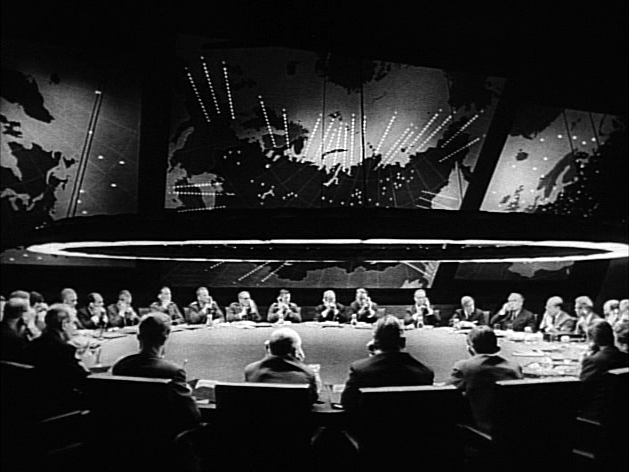
The War Room with the Big Board from Stanley Kubrick’s 1964 film, ”Dr. Strangelove” Source=”Dr. Strangelove” trailer from 40th Anniversary Special Edition DVD, 2004
This is a piece about risk management. To be read to the soundtrack of The Beatles singing Revolution (the slow version from The White Album).
Dr Strangelove is a movie which can be described in many ways, but one way to think of it is as a movie where governance arrangements made in a different time are no longer adequate to the task at hand. General Ripper can only order a nuclear strike as a retaliatory nuclear attack on the Soviets if all of his superior officers have been killed in a first strike on the United States. However the aircraft crew’s knowledge of whether there has been a first strike is dependent upon a communication system which has been set to only accept messages preceded by a secret three-letter code known only to the same General Ripper. The Soviet Union has a Doomsday Machine of cobalt bombs, which would be automatically triggered as a nuclear deterrent if attacked, which would make the Earth uninhabitable for 93 years and only had a point if the United States were aware that it existed. However the Soviet leadership had delayed the announcement of its existence so that it could be a surprise for the following week’s Party Congress.
Our first past the post voting system can be described in many ways, but one way to think of it is as a set of governance arrangements made in a different time which are no longer adequate to the task at hand.
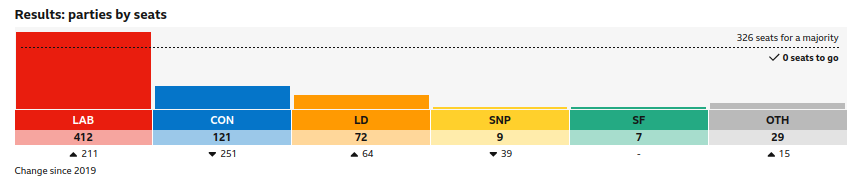
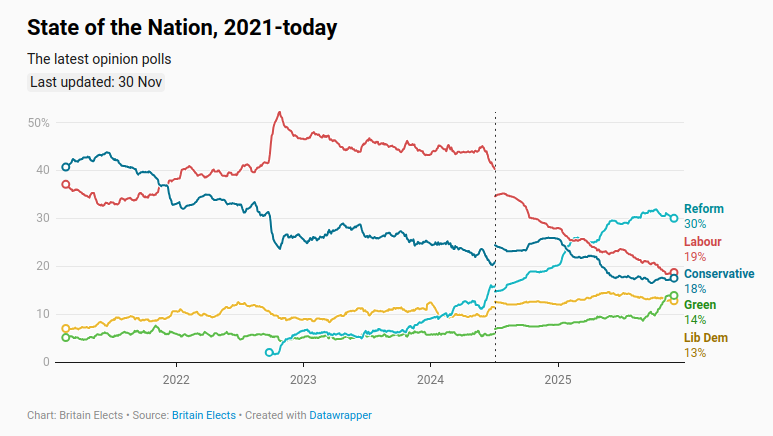
Labour won 63% of the seats with 34% of the vote. The Government have therefore been reluctant to change the voting system. Despite a conference vote demanding it, it didn’t make it into their election manifesto. However fast forward 17 months and the polls look like this:
With one conversion into projected seats (by Electoral Calculus) looking like this:
So this time, Reform are predicted to have 48% of the seats based on 29% of the vote. This is no way to run a railroad. We need proportional representation now. Join the campaign here.
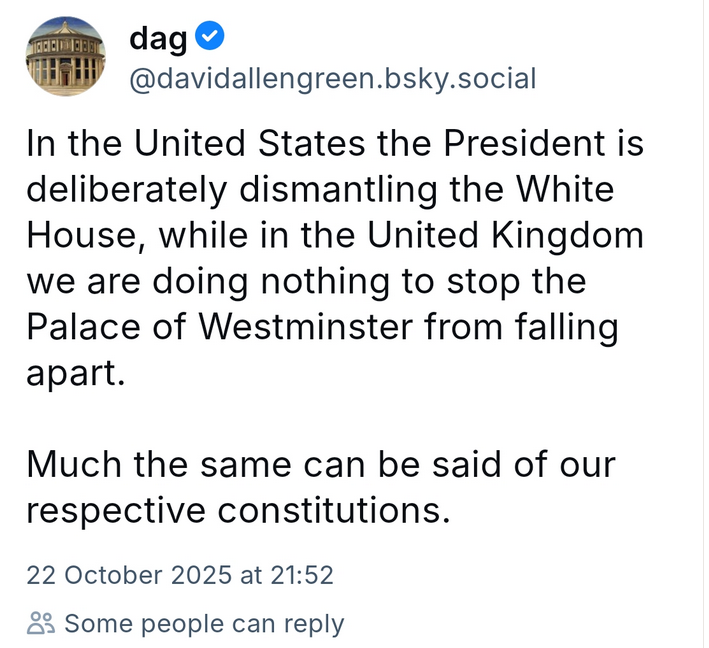
We have an example playing out across the Atlantic of a government taking on powers they don’t have to enact policies that noone voted for. And that is when they do have a constitution which they could use if they had the will, whereas, as David Allen Green said in October:
Our current constitutional arrangements are our Doomsday Machine. As The Institute for Government have found in their Review of the UK Constitution:
Weaknesses in the system of checks and balances have been exposed – the UK system is in theory self-regulating. It relies on those within it being willing to exercise restraint, adhering to largely unwritten rules of behaviour, and, when they fail to do so, facing political consequences. In recent years, various political actors have shown an increased willingness to test constitutional boundaries – seen most brazenly in proposals to break international law and by the executive repeatedly passing legislation on devolved matters without consent from their respective legislatures – with such political checks providing little impediment to them doing so. Debates over constitutional principle have increasingly been considered secondary to other political goals, and MPs, the media and the public have lacked sufficient understanding of the constitution to hold decision makers to account.
The problem with The Institute for Government in my view is their earnestness. It is the reason we can all remember Dr Strangelove from over 60 years ago when we have forgotten the almost identical subject matter of the far more po-faced Fail Safe (that, and the fact that Kubrick had their release date postponed by launching a lawsuit) and long after I expect us to have forgotten Bigelow’s recent A House of Dynamite. The thing is that, for me, the characters in Dr Strangelove remind me of the general ridiculousness of humanity and I don’t want them to die, even the mad ones. Whereas I find myself fairly indifferent to the fate of the relatively very serious cast of Dynamite. The Institute for Government‘s problem is that I feel the same way about some of their characters. Like Citizen Assembly for instance. Whenever this character is mentioned I find myself thinking of the Lennon line from The Beatles‘ Revolution:
“If you go carrying pictures of Chairman Mao, you ain’t gonna make it with anyone anyhow.”
We badly need a campaign capable of energising people about how we are governed. Something that, in my view, The Institute for Government are not currently providing.
And then there is the money. As Democracy for Sale have revealed, 75% of donations, totalling £23 million, to the likely ruling party at our next election have come from just three people. If you think there should be a cap on political donations you can sign the petition here. Think of the country owned by three people (and all for £23 million) and it starts to make Blackadder‘s Dunny-on-the-Wold, with its constituency of “three rather mangy cows, a dachshund named `Colin’, and a small hen in its late forties”, look positively democratic. You might as well put General Ripper in charge.
Our governance arrangements are satirising themselves at the moment. Let’s do something about it this year.
The rear view mirror isn’t going to help us any more Source: Wikimedia Commons: Shattered right-hand side mirror on a 5-series BMW in Durham, North Carolina by Ildar Sagdejev
I would like to start this week’s post with a quote from Carlo Iacono, from a Substack piece he did a couple of weeks ago called The Questions Nobody Is Funding:
What is a human being for? What do we owe the future? What remains worth the difficulty of learning?
These are not questions you will find in the OECD’s AI Literacy Framework. They are not addressed in the World Economic Forum’s Education 4.0 agenda. They do not appear in the competency matrices cascading through national education systems. Instead, we get learning objectives and assessment criteria. Employability outcomes and digital capabilities. The language of preparation, as if the future were already decided and our job were simply to ready people for it.
I think this articulates well the central challenge of AI for education. Whether you think this is the beginning of a future where augmented humans move into a different type of existence to any we have known before; or you believe very little will be left behind in the rubble from the inevitable burst of the AI bubble when it comes and will be, at least temporarily, forgotten in the most devastating stock market crash and depression for a century; or you hold both these beliefs at the same time; or you are somewhere in between, it is difficult to see how the orderly world of competency matrices, learning objectives, assessment criteria, employability outcomes and digital capabilities can easily survive the period of technological, cultural, economic and political disruption which we appear to have entered. Looking in the rear view mirror and trying to extrapolate what you see into the future is not going to work for us any more.
Whether you think, like Cory Doctorow, in his recent speech at the University of Washington called The Reverse Centaur’s Guide to Criticizing AI, that:
AI is the asbestos in the walls of our technological society, stuffed there with wild abandon by a finance sector and tech monopolists run amok. We will be excavating it for a generation or more.
Technologies such as LLMs are neither going to transcend humanity as the holdouts on one side still hope, nor disappear, as other holdouts might like. We’re going to have to figure out ways to talk about them better and more clearly.
We are certainly going to have to figure out ways to talk about LLMs and other forms of AI more clearly, so that the decisions we need to make about how to accommodate them into society can be made with the maximum level of participation and consensus. And this seems to be the key for me with respect to education too. We do need people graduating from our education system understanding clearly what LLMs can and cannot do, which is a tricky path to navigate at the moment as a lot of money is being concentrated on persuading you that it can do pretty much anything. One example here has created a writers’ room of four LLMs where they are asked to critique each other by pushing the output from one into the prompts for the others, reminiscent of The Human Centipede. Which immediatel reminded me of this take from later in that Cory Doctorow speech:
And I’ll never forget when one writer turned to me and said, “You know, you prompt an LLM exactly the same way an exec gives shitty notes to a writers’ room. You know: ‘Make me ET, except it’s about a dog, and put a love interest in there, and a car chase in the second act.’ The difference is, you say that to a writers’ room and they all make fun of you and call you a fucking idiot suit. But you say it to an LLM and it will cheerfully shit out a terrible script that conforms exactly to that spec (you know, Air Bud).”
So, back to Carlo’s little questions:
What is a human being for?
A lofty question certainly, and not one I am going to tackle in a blog post. But perhaps I can say a bit about what a human being is not for. This is the key to Henry Farrell’s piece which is his take on the humanist critique of AI. We are presumably primarily designing the future for humans. All humans. Not just Tech Bros. And the design needs to bear that in mind. For example, a human being is not, in my opinion, for this (from the Cory Doctorow link):
Like an Amazon delivery driver, who sits in a cabin surrounded by AI cameras, that monitor the driver’s eyes and take points off if the driver looks in a proscribed direction, and monitors the driver’s mouth because singing isn’t allowed on the job, and rats the driver out to the boss if they don’t make quota.
The driver is in that van because the van can’t drive itself and can’t get a parcel from the curb to your porch. The driver is a peripheral for a van, and the van drives the driver, at superhuman speed, demanding superhuman endurance. But the driver is human, so the van doesn’t just use the driver. The van uses the driver up.
The first task of the education establishment, I think, is to attempt to protect the graduate from becoming the reverse-centaur described above, whether a deliver driver, a coder (where additionally the human-in-the-loop becomes the accountability sink for everything the AI gets wrong) or a radiologist. This will often be resisted by the employers you are currently very sensitive to the needs of as educators (many of who are senior enough to get to use the new technologies as a centaur rather than be used by them as a reverse-centaur, tend to struggle to put themselves in anyone else’s shoes and, frankly, can’t see what all the fuss is about) but, remember, the cosy world of employability outcomes is over. The employers are not sticking to the implicit agreement to employ your graduates if you delivered the outcomes and therefore neither should you. Your responsibility in education is to the students, not their potential future employers, now their interests no longer appear to be aligned.
What do we owe the future?
This depends on what you mean by “the future” of course. If it is some technological dystopia of diminished opportunities for most (even for making friends as seemingly envisioned by some of the top Tech Bros), then nothing at all. But if it is the future which is going to support your children and their children, you obviously owe it a lot. But what do you owe it? What is owed is often converted into money by the political right, and used to justify not running up public debt in the present so as not to “impoverish” future generations. What that approach generally achieves is to impoverish both the current and future generations.
But if you think of owing resources, institutions and infrastructure to the next generation, then that is a responsibility that we should take seriously. And part of that is to produce an educated generation with tools, systems, institutions and infrastructure. The education institutions must take steps to make sure they survive in a relevant way, embedded in systems which support individuals and proselytising the value of education for all. They must ensure that their graduates understand and have facility with the essential tools they will need, and have developed the ability to learn new skills as they need them, and realise when that is. This is about developing individuals who leave no longer dependent on the institutions, able to work things out for themselves rather than requiring never-ending education inside an institution.
What remains worth the difficulty of learning?
The skills already mentioned will be the core ones for everyone, and these will need to be hammered out in terms everyone can understand. But in the world of post scarcity education, which is here but which we have not yet fully embraced, the rest will be up to us. A large part of the education of the future will need to be about equipping us all to understand what we now have access to and when and how to access it. We will all have different things we are interested in, or end up involved with and needing to be educated about. It will be up to each of us to decide which things are worth the difficulty of learning, but to make those decisions we will need education that can support the development of judgement.
For education institutions, the question will be what is not worth the difficulty of learning? Credentialising based on now relatively meaningless assessment methods will not cut it. This is where the confrontation with employers and politicians is likely to come. Essential skills and their related knowledge will be better developed and assessed via more open-ended project work and online assessment of it to check understanding. These will need to become the norm, with written examinations becoming less and less prevalent. Not because of fear of cheating and plagiarism, but because an outcome which can be replicated that easily by AI is not worth assessing in the first place.
So this is my 42nd blog post of the year and the 8th where I have referenced Cory Doctorow. Thought it was more to be honest, so influential has he been on my thought, particularly as I have delved deeper into what, how and why the AI Rush is proceeding and what it means for the people exiting universities over the next few years.
Yesterday Cory published a reminder of his book reviews this year. He is an amazing book reviewer. There are 24 on the list this year, and I want to read every one of them on the strength of his reviews alone.
I would like to repay the compliment by reviewing his latest book: Enshittification (the other publication this year – Picks and Shovels – is also well worth your time by the way). Can’t believe this wasn’t the word of the year rather than rage bait, as it explains considerably more about the times we are living in.
I have been a fan of Doctorow for a couple of years now. I had had Walkaway sat on my shelves for a few years before I read it and was immediately enthralled by his tale of a post scarcity future which had still somehow descended into an inter-generational power struggle hellscape. I moved on to the Little Brother books, now being reenacted by Trump with his ICE force in one major US city after another. Followed those up with The Lost Cause, where the teenagers try desperately to bridge the gap across the generations with MAGA people, with tragic results along the way but a grim determination at the end “the surest way to lose is to stop running”. From there I migrated to the Marty Hench thrillers, his non-fiction The Internet Con (which details the argument for interoperability, ie the ability of any platform to interact with another) and his short fiction (I loved Radicalised, not just for the grimly prophetic Radicalised novella in the collection, but also the gleeful insanity of Unauthorised Bread). I highly recommend them all.
I came to Enshittification after reading his Pluralistic blog most days for the last year and a half, so was initially disappointed to find very little new as I started working my way through it. However what the first two parts – The Natural History and The Pathology – are is a patient explanation of the concept of enshittification and how it operates assuming no previous engagement with the term, all in one place.
Enshittifcation, as defined by Cory Doctorow, proceeds as follows:
First, platforms are good to their users.
Then they abuse their users to make things better for their business customers.
Next, they abuse those business customers to claw back all the value for themselves.
Finally, they have become a giant pile of shit.
So far, so familiar. But then I got to Part Three, explaining The Epidemiology of enshittification, and the book took off for me. The erosion of antitrust (what we would call competition) law since Carter. “Antitrust’s Vietnam” (how Robert Bork described the 12 years IBM fought and outspent the US Department of Justice year after year defending their monopolisation case) until Reagan became President. How this led to an opening to develop the operating system for IBM when it entered the personal computer market. How this led to Microsoft, etc. Then how the death of competition also killed Big Tech regulation ( regulating a competitive market which acts against collusion is much easier than regulating one with a small number of big players which absolutely will collude with each other).
And then we get to my favourite chapter of the book “Reverse-Centaurs and Chickenisation”. Any regular reader of this blog will already be familiar with what a reverse centaur is, although Cory has developed a snappy definition in the process of writing this book:
A reverse-centaur is a machine that uses a human to accomplish more than the machine could manage on its own.
And if that isn’t chilling enough for you, the description of the practices of poultry packers and how they control the lives of the nominally self-employed chicken farmers of the US, and how these have now been exported to companies like Amazon and Arise and Uber, should certainly be. The prankster who collected up the bottled piss of the Amazon drivers who weren’t allowed a loo break and resold it on Amazon‘s own platform as “a bitter lemon drink” called Release Energy, which Amazon then recategorised as a beverage without asking for any documentation to prove it was fit to drink and then, when it was so successful it topped their sales chart, rang the prankster up to discuss using Amazon for shipping and fulfillment – this was a rare moment of hilarity in a generally sordid tale of utter exploitation. My favourite bit is when he gets on to the production of his own digital rights management (DRM) free audio versions of his own books.
The central point of the DRM issue is, as Cory puts it, “how perverse DMCA 1201 is”:
If I, as the author, narrator, and investor in an audiobook, allow Amazon to sell you that book and later want to provide you with a tool so you can take your book to a rival platform, I will be committing a felony punishable by a five-year prison sentence and a $500,000 fine.
To put this in perspective: If you were to simply locate this book on a pirate torrent site and download it without paying for it, your penalty under copyright law is substantially less punitive than the penalty I would face for helping you remove the audiobook I made from Amazon’s walled garden. What’s more, if you were to visit a truck stop and shoplift my audiobook on CD from a spinner rack, you would face a significantly lighter penalty for stealing a physical item than I would for providing you with the means to take a copyrighted work that I created and financed out of the Amazon ecosystem. Finally, if you were to hijack the truck that delivers that CD to the truck stop and steal an entire fifty-three-foot trailer full of audiobooks, you would likely face a shorter prison sentence than I would for helping you break the DRM on a title I own.
DMCA1201 is the big break on interoperability. It is the reason, if you have a HP printer, you have to pay $10,000 a gallon for ink or risk committing a criminal offence by “circumventing an access control” (which is the software HP have installed on their printers to stop you using anyone else’s printer cartridges). And the reason for the increasing insistence on computer chips in everything from toasters (see “Unauthorised Bread” for where this could lead) to wheelchairs – so that using them in ways the manufacturer and its shareholders disapprove of becomes illegal.
The one last bastion against enshittification by Big Tech was the tech workers themselves. Then the US tech sector laid off 260,000 workers in 2023 and a further 100,000 in the first half of 2024.
In case you are feeling a little depressed (and hopefully very angry too) at this stage, Part 4 is called The Cure. This details the four forces that can discipline Big Tech and how they can all be revived, namely:
Competition
Regulation
Interoperability
Tech worker power
As Cory concludes the book:
Martin Luther King Jr once said, “It may be true that the law cannot make a man love me, but it can stop him lynching me, and I think that’s pretty important, also.”
And it may be true that the law can’t force corporate sociopaths to conceive of you as a human being entitled to dignity and fair treatment, and not just an ambulatory wallet, a supply of gut bacteria for the immortal colony organism that is a limited liability corporation.
But it can make that exec fear you enough to treat you fairly and afford you dignity, even if he doesn’t think you deserve it.
And I think that’s pretty important.
I was reading Enshittification on the train journey back from Hereford after visiting the Hay Winter Weekend, where I had listened to, amongst others, the oh-I’m-totally-not-working-for-Meta-any-more-but-somehow-haven’t-got-a-single-critical-word-to-say-about-them former Deputy Prime Minister Nick Clegg. While I was on the train, a man across the aisle had taken the decision to conduct a conversation with first Google and then Apple on speaker phone. A particular highlight was him just shouting “no, no, no!” at Google‘s bot trying to give him options. He had already been to the Vodaphone shop that morning and was on his way to an appointment which he couldn’t get at the Apple Store on New Street in Birmingham. He spotted the title of my book and, when I told him what enshittification meant, and how it might make some sense out of the predicament he found himself in, took a photo of the cover.
My feeling is that enshittification goes beyond Big Tech. It is the defining industrial battle of our times. We shouldn’t primarily worry about whether it is coming from the private or the public sector, as enshittification can happen in both places: from hollowing out justice to “paying more for medicines… at the exact moment we can’t afford to pay enough doctors to prescribe them” in the public sector, where we already reside within the Government’s walled garden, to all of the outrages mentioned above and more in the private sector.
The PFI local health hubs set out in last week’s budget take us back to perhaps the ultimate enshittificatory contracts the Government ever entered into, certainly before the pandemic. The Government got locked into 40 year contracts, took all the risk, and all the profit was privatised. The turbo-charging of the original PFI came out of the Blair-Brown government’s mania for keeping capital spending off the balance sheet in defence of Gordon Brown’s “Golden Rule” which has now been replaced by Rachel Reeves’ equally enshittifying fiscal rules. All the profits (or, increasingly, rents, as Doctorow discusses in the chapter on Varoufakis’ concept of Technofeudalism) from turning the offer to shit always seem to end up in the private sector. The battle is against enshittification from both private and, by proxy, via public monopolies.
Enshittification is, ultimately, a positive and empowering book which I strongly recommend you buy, avoiding Amazon if you can. We can have a better internet than this. We can strike a better deal with Big Tech over how we run our lives. But the surest way to lose is to stop running.
And next time a dead-eyed Amazon driver turns up at your door, be nice, they are probably having a worse day than you are.