So, as a way of signing off until next year, I thought I would write something short about length.
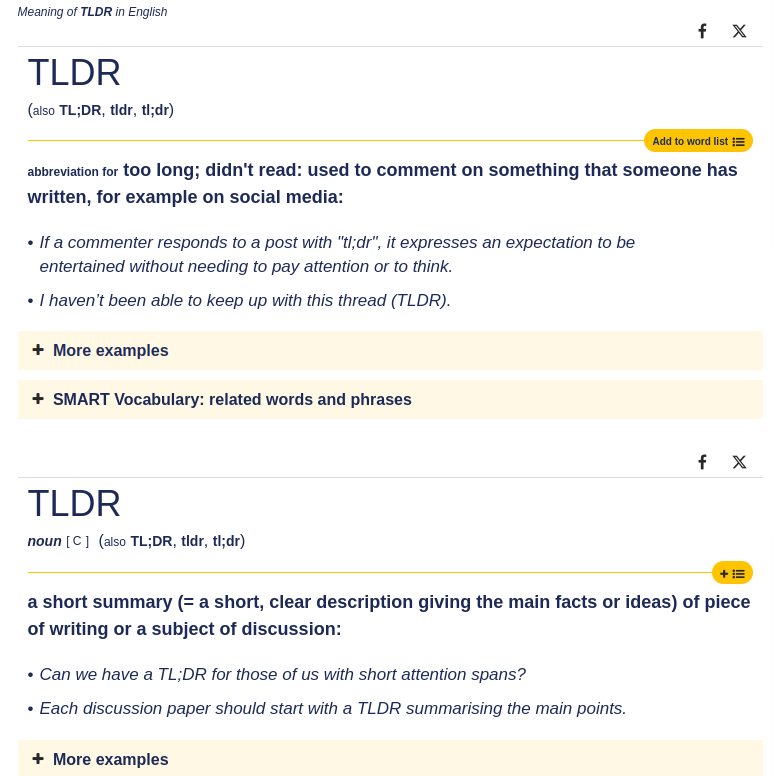
My first job was with De La Rue and, specifically, within their print division which was still named after the original founder, sometime straw hat and playing card manufacturer and Guernseyman, Thomas De La Rue. Or TDLR for short. As a result of which I can never see tl;dr written anywhere (and it does seem to be everywhere on social media these days as the amount of written material to work our way through becomes ever more overwhelming) without thinking of my first years of employment, which momentary distraction, I assume, is the complete opposite of what tl;dr is often designed for, which is to help you understand something you don’t have time to read.
It feels like there is a shift happening in the etiquette of social media on this. Only recently I saw a response to a piece which was not particularly long which started “Don’t have time to read but probably agree as follows…”. This seemed rude to me but perhaps I am being old-fashioned about this. Because there are a lot of writers now where I am regularly skimming them or only reading the first halves of their articles. Writers who often have a really good point, but appear to want to say it in as many different ways as possible, nailing every single example imaginable for completeness. But really, who values completeness? I think what we are looking for is careful selection from someone who knows something we don’t about the terrain and who can therefore guide us through at least a swamp or two before leaving us to the next writer. If we wanted completeness, we could stumble into every sink hole for ourselves.
I did a mini review for Service Model by Adrian Tchaikovsky as a blog post recently which got the following response from the author which I was very chuffed about:
Fascinating (and spot on) little essay on Service Model and how it relates to the real world.
My wife (the one who calls me Swampy Dave sometimes) said “aren’t you a little insulted by the reference to a ‘little essay’?” and I realised that I wasn’t at all. Quite the reverse. I had managed to say something which had a point to it and which others could understand and all within 850 words. If I had to encapsulate why I blog in a sentence that would be it.
Returning to Tchaikovsky, he arranges his books on his website between novels, novellas, shorts and free. People appear to differ about how long each form should be, but Tchaikovsky described a novella as having a beginning and an end but no middle (section 6 of the interview here), which tended to pursue one idea to its logical conclusion. A short story took him a week to write. Everything else is a novel.
Definitions vary, this source defined the different forms as follows:
- Flash fiction: under 1000 words (although a lot of competitions stipulate maximum 500 words)
- Short stories: 3,500-7,500 words
- Novelette (yes I know! I hadn’t heard of this before either!): 7,500-17,000 words
- Novella: 17,000-40,000 words
- Novel: 40,000 words plus
And then this other source helpfully listed the word count for 175 famous books.
Growing up I regarded War and Peace (finally slogged through it in the late 80s) as the ultimate long book but, at 561,304 words, it is not even close to being the longest, which appears to be Proust’s In Search of Lost Time or A la recherche du temps perdu (1,267,069 in English or slightly fewer in the original French), although it was published in 7 volumes originally. Meanwhile HG Wells’ The Time Machine, Orwell’s Animal Farm and Steinbeck’s Of Mice and Men are officially defined as novellas, despite being, in the view of many, some of the most important books ever written.
I am quite a slow reader, which is perhaps why the question of book length seems to be bothering me so much. I have therefore decided to try and restrict myself to novellas and shorter fiction for 2026 (although the non-fiction is likely to be as long as ever, until the concept of non-fictionella is embraced if ever!) in order to read a wider range of writers. Might also mean there are more book reviews here next year!
Have a great Christmas everyone! See you in 2026!