Things have been moving quickly after weeks of just listening to Trump. Last week it was Davos and the other world leaders suddenly had something to say. Carlo Iacono rather neatly skewered them in advance with his Snow Globe of the Reasonable piece. As he says:

I keep returning to a phrase from the coverage: “globalization triage.” It captures something true. The old story, the one that said integration and openness would lift all boats, has been bleeding out for years. What is happening at Davos is not a recommitment to that story. It is an attempt to stabilise the patient long enough to extract remaining value before the next configuration emerges. The conversations about chips and data centres and export controls are not about innovation in any innocent sense. They are about who will control the commanding heights of the next economy, and the language of cooperation is the anaesthetic administered while the surgery proceeds.

And then, lo and behold, was Mark Carney, equally at home leading central bankers in 2008, appearing in thick jumpers on election night in Canada and now presenting Canada to the WEF as the enlightened way forward in the wake of Trump, without mentioning him once. He signalled Canada’s break with the rules-based order with a story told by Vaclav Havel about a greengrocer who put out a sign saying “Workers of the world unite” without believing a word of it. He says:

The system’s power comes not from its truth, but from everyone’s willingness to perform as if it were true, and its fragility comes from the same source. When even one person stops performing, when the greengrocer removes his sign, the illusion begins to crack. Friends, it is time for companies and countries to take their signs down.

He argued against the impulse for every country to look after itself, while finding it understandable:

A country that can’t feed itself, fuel itself or defend itself, has few options. When the rules no longer protect you, you must protect yourself.

Instead he argued for what he calls “variable geometry”:

…different coalitions for different issues based on common values and interests.

And in what, for me, was the most eye-catching part:

We are taking the sign out of the window. We know the old order is not coming back. We shouldn’t mourn it. Nostalgia is not a strategy, but we believe that from the fracture, we can build something bigger, better, stronger, more just. This is the task of the middle powers, the countries that have the most to lose from a world of fortresses and most to gain from genuine cooperation.

This was Carney staking a claim to leadership in a world working around the United States. And he sounds so reasonable within his snow globe that you can almost forget the impact of his last attempt at global leadership. Ann Pettifor, in her excellent review of the 2008 crisis 10 years after and its aftermath, quoted Professor Vogl of Princeton University:

the crisis has proved itself as a way to solidify the existing economic order…One can thus argue that the financial and economic state of emergency in recent years has given rise to …action that resembles a continuous coup d’Etat.” (INET Berlin, 2012.)

And as Iacono concluded his article:

The room in Davos is warm. The rooms beyond it are getting colder. The spirit of dialogue, whatever it once meant, now means the management of decline through the performance of concern. This is not a conspiracy. It is an emergent property of a system that has learned to stabilise itself by absorbing its critics and converting their language into its own. The only dialogue that would matter is the one that questions the room itself. That conversation is not scheduled.

The solutions proposed from within the Snow Globe will always sound measured and reasonable. The actors were mainly polished and impressive, all the better to contrast with the ramblings of Trump. The lines were well known. After all, as Samuel Miller McDonald’s Progress tells us, they have been delivered in one form or another for 5,000 years, when Mesopotamian cities came together to form the world’ first empires. McDonald describes the new approach as “parasitic energy capture”, both concrete in terms of resources required to survive and abstract in terms of the power structures within these new types of societies. As McDonald notes:

When the limits to their extraction of resources are exceeded, the parasitic systems must either suffer a crash or must invade and take the energy of a more distant ecology or society.

This type of parasitism was both justified and celebrated by the progress myths which accompanied each society: The Epic of Gilgamesh for the Babylonians, Zoroastrianism for the ancient Iranian kingdoms and empires, the creation myth of Judaism where, as McDonald puts it:

The book of Genesis provides the theological basis for dominion, but it also contains the promise of progress, which takes the shape of frontiers, or living space set aside for God’s chosen people, to be found in new land.

And on to the Greeks, with Thucydides’ History of the Peloponnesian Wars seeing Athenian civilisation as the pinnacle of human achievements. Sure enough, Carney was quoting him last week:

Right, as the world goes, is only in question between equals in power, while the strong do what they can and the weak suffer what they must.

Then on to the Roman Empire, legitimised by Virgil’s Aeneid, in which Jupiter says:

To the Romans I assign limits neither to the extent nor to the duration of their empire; dominion have I given them without end.

Then Rome embraced Christianity, with Constantine reasoning, according to McDonald, “that a monotheistic empire would be more effective at both unity and continued expansion than a more pluralistic or polytheistic one”.

Alongside Christianity, a new progress narrative was born in the 7th century to power an Islamic empire. As McDonald says:

Perhaps more than any that came before, the Islamic society that arose during this period mixed mythic forms of the progress narrative formula with secular ideas…that presaged those that would follow in the European Enlightenment.

And of course the European Enlightenment followed the expansion of parasitism from around 1400 from “a primarily regional, contiguous form to a global, disparate form”. As McDonald goes on to say:

This change was made possible first by the large oceanic vessels that could move goods, weapons, messages and colonists rapidly across large waterways, and then again by the deployment of fossilised energy in machines that could speed up extraction, communication, transportation and manufacturing even more.

What we are talking about here is global capitalism. And this brings me to one of the great mysteries, often referred to by Steve Keen, which I think I now have an answer to, of why economists have failed to properly incorporate the role of energy in production for so long. If mainstream economics now performs the role of the progress narratives of the past in justifying our continued parasitic expansion beyond all boundaries in pursuit of economic growth (which is now even acknowledged in official UK government documents like this one), then it needs to hide the role of parasitic energy capture from us in order to keep us doing it.

Which brings us back to the Snow Globe. I will leave the last word to Carlo Iacono:

The problems are structural, and I am not in a position to restructure them. The powerful will keep meeting, and the meetings will keep producing the facsimile of progress that forestalls the real thing. What I can do, what any of us can do, is refuse to be fooled by the snow globe. To name what is happening even when the naming has no immediate effect. To remember that legitimacy is not conferred by eloquence or venue, that a room full of billionaires discussing inequality is not the same as addressing inequality, that dialogue without the possibility of transformation is just noise arranged pleasingly.
I have spent many days in rooms with groups of men (always men) anxious about their future income, where I advised them on how much to ask their companies for. Most of my clients as a scheme actuary were trustees of pension schemes of companies which had seen better days, and who were struggling to make the necessary payments to secure the benefits already promised, let alone those to come. One by one, those schemes stopped offering those future benefits and just concentrated on meeting the bill for benefits already promised. If an opportunity came to buy those benefits out with an insurance company (which normally cost quite a bit more than the kind of “technical provisions” target the Pensions Regulator would accept), I lobbied hard to get it to happen. In many cases we were too late though, the company went bust and we moved it into the Pension Protection Fund instead. That was the life of a pensions actuary in the West Midlands in the noughties. I was often “Mr Good News” in those meetings, the ironic reference to the man constantly moving the goalposts for how much money the scheme needed to meet those benefits bills. I saw my role as pushing the companies to buy out funding if at all possible. None of the schemes I advised had a company behind them which could sustain ongoing pension costs long term. I would listen to the wishful thinking and the corporate optimism, smile and push for the “realistic” option of working towards buy out.

Then I went to work at a university, and found myself, for the first time since 2003, a member of an open defined benefit pension scheme. It was (and still is) a generous scheme, but was constantly complained about by the university lecturers who comprised most of its membership. I didn’t see any way that it was affordable for employers which seemed to struggle to employ enough lecturers, were very reluctant to award anything other than fixed term contracts, and had an almost feudal relationship with their PhD students and post docs. Staff went on strike about plans to close the scheme to future accrual and replace it with the most generous money purchase scheme I had ever seen. I demurred and wrote an article called Why I Won’t Strike. I watched in wonder when even actuarial lecturers at other universities enthusiastically supported the strike. However, over 10 years later, that scheme – the UK’s biggest – is still open. And I gained personally from continued active membership until 2024.

Now don’t get me wrong, I still think the UK university sector is wrong to maintain, unique amongst its peers, a defined benefit scheme. The funding requirement for it has been inflated by continued accrual over the last 8 years and therefore so has the risk it will spike at just the time when it is least affordable, a time which may soon be approaching with 45% of universities already reporting deficits. However the strike demonstrated how important the pension scheme was to staff, something the constant grumbling before the strike had led university managers to doubt. And, once the decision had been made to keep the scheme open to future accrual, I had no more to add as an actuary. Other actuaries had the responsibility for advising on funding, in fact quite a lot of others as the UCU was getting its own actuarial advice alongside that the USS was getting, but my involvement was now just that of a member, just one with a heightened awareness of the risks the employers were taking.

The reason I bring this up is because I detected something of the same position as my lonely one from the noughties amongst the group of actuaries involved in the latest joint report from the Institute and Faculty of Actuaries and the University of Exeter about the fight to maintain planetary climate solvency.

It very neatly sets out the problem, that the whole system of climate modelling and policy recommendations to date has been almost certainly underestimating how much warming is likely to result from a given increase in the level of carbon dioxide in the atmosphere. Therefore all the “carbon budgets” (amount we can emit before we hit particular temperature levels) have been assumed to be higher than they actually are and estimates for when we exhaust them have given us longer than we actually have. This is due to the masking effects of particulate pollution in the air, which has resulted in around 0.5C less warming than we would otherwise have had by now. However, efforts to remove sulphur from oil and coal fuels (themselves important for human health) have acted to reduce this aerosol cooling effect. The goalposts have moved.

An additional reference I would add to the excellent references in the report is Hansen’s Seeing the Forest for the Trees, which concisely summarises all the evidence to suggest the generally accepted range for climate sensitivity is too low.

So far, so “Mr Good News”. And for those who say this is not something actuaries should be doing because they are not climate experts, this is exactly what actuaries have always done. We started the profession by advising on the intersection between money and mortality, despite not being experts in any of the conditions which affected either the buying power of money or the conditions which affected people’s mortality. We could however use statistics to indicate how things were likely to go in general, and early instances of governments wasting quite a lot of money without a steer from people who understood statistics got us that gig, and a succession of other related gigs over the years ahead.

The difficult bit is always deciding what course of action you want to encourage once you have done the analysis. This was much easier in pensions, as there was a regulatory framework to work to. It is much harder when, as in this case, it involves proposing changes in behaviour which are ingrained into our societies. If university lecturers can oppose something that is clearly not in the long term financial interests of their employers and push for something which makes their individual employers less secure, then how much more will the general public resist change when they can see no good reason for it.

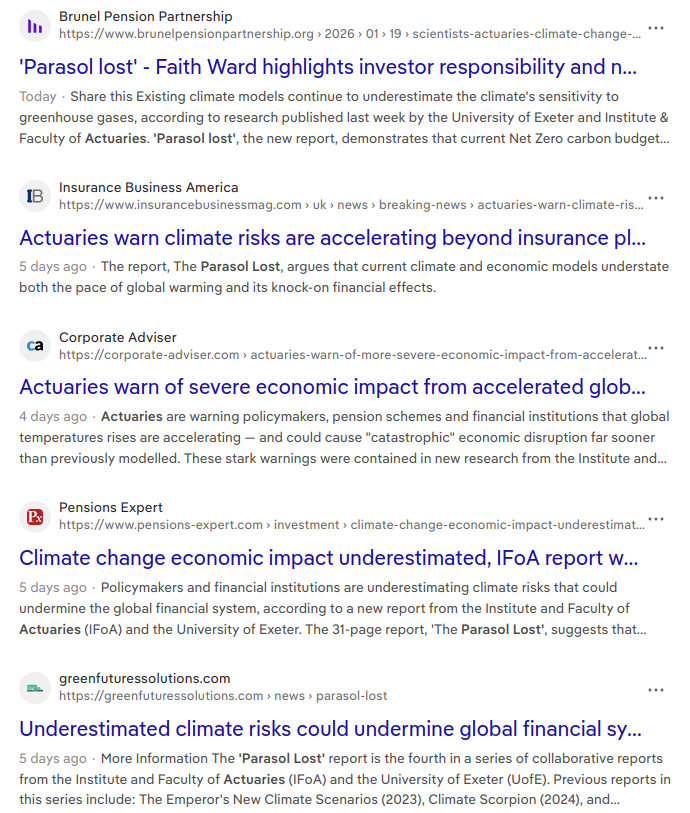
And in this regard this feels like a report mostly focused on the finance industry. The analogies it makes with the 2008 financial crash, constant comparisons with the solvency regulatory regimes of insurers in particular and even the framing of the need to mitigate climate change in order to support economic growth are all couched in terms familiar to people working in the finance sector. This has, perhaps predictably, meant that the press coverage to date has mostly been concentrated in the pension, insurance and investment areas:

However in the case of the 2008 crash, the causes were able to be addressed by restricting practices amongst the financial institutions which had just been bailed out and were therefore in no position to argue. Many of those restrictions have been loosened since, and I think many amongst the general public would question whether the decision to bail out the banks and impose austerity on everyone else is really a model to follow for other crises.

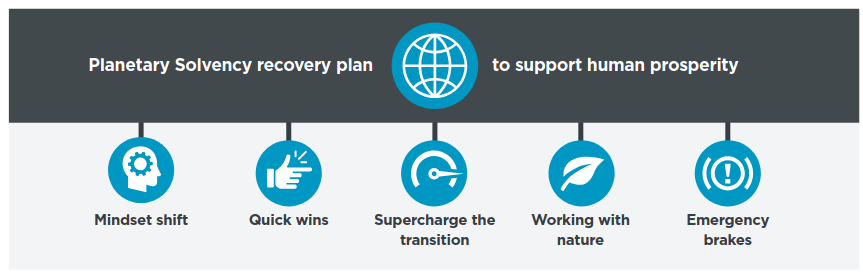
The next stage will therefore need to involve breaking out of the finance sector to communicate the message more widely, perhaps focusing on the first point in the proposed Recovery Plan: developing a different mindset. As the report says:

This challenge demands a shift in perspective, recognising that humanity is not separate from nature but embedded in it, reliant on it and, furthermore, now required to actively steward the Earth system.
To maintain Planetary Solvency, we need to put in place mechanisms to ensure our social, economic, and political systems respect the planet’s biophysical limits, thus preserving or restoring sufficient natural capital for future generations to continue receiving ecosystem services…

…The prevailing economic system is a risk driver and requires reform, as economic dependency on nature is unrecognised in dominant economic theory which incorrectly assumes that natural capital is substitutable by manufactured capital. A particular barrier to climate action has been lobbying from incumbents and misinformation which has contributed to slower than required policy implementation.

By which I assume they mean this type of lobbying:

And this is where it gets very difficult, because actuaries really do not have anything to add at this point. We are just citizens with no particular expertise about how to proceed, just a heightened awareness of the dangers we are facing if we don’t act.

But we can also, as the report does, point out that we still have agency:

Although this is daunting, it means we have agency – we can choose to manage human activity to minimise the risk of societal disruption from the loss of critical support services from nature.

This point chimes with something else I have been reading recently (and which I will be writing more about in the coming weeks): Samuel Miller McDonald’s Progress. As he says “never before have so many lives, human and otherwise, depended on the decisions of human beings in this moment of history”. You may argue the toss on that with me, which is fine, but, in view of the other things you may be scrolling through either side of reading this, how about this for a paragraph putting the whole question of when to change how we do things in context:

We are caught in a difficult trap. If everything that is familiar is torn down and all the structures that govern our day-to-day disintegrated, we risk terrible disorder. We court famines and wars. We invite power vacuums to be filled by even more brutal psychopaths than those who haunt the halls of power now. But if we don’t, if we continue on the current path and simply follow inertia, there is a good chance that the outcome will be far worse than the disruption of upending everything today. Maintaining status-quo trajectories in carbon emissions, habitat destruction and pollution, there is a high likelihood of collapse in the existing structure anyway. It will just occur under far worse ecological conditions than if it were to happen sooner, in a more controlled way. At least, that is what all the best science suggests. To believe otherwise requires rejecting science and knowledge itself, which some find to be a worthwhile trade-off. But reality can only be denied for so long. Dream at night we may, the day will ensnare us anyway.

One thing I never did in one of those rooms full of anxious men was to stand up and loudly denounce the pensions system we were all working within. Actuaries do not behave like that generally. However we have a senior group of actuaries, with the endorsement of their profession, publishing a report that says things like this (bold emphasis added by me):

Planetary Solvency is threatened and a recovery plan is needed: a fundamental, policy-led change of direction, informed by realistic risk assessments that recognise our current market-led approach is failing, accompanied by an action plan that considers broad, radical and effective options.

This is not a normal situation. We should act accordingly.

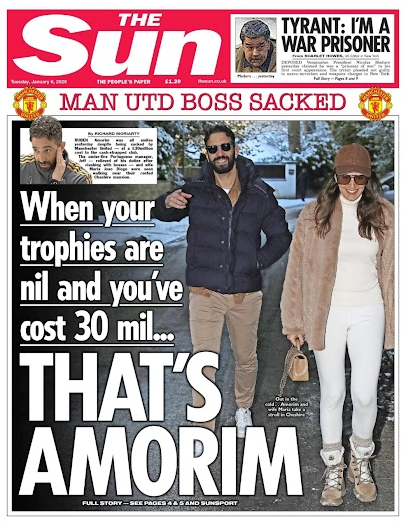
The Sun attempts to get a new song going on the terraces. Still not going to be selling newspapers in Liverpool though

Disclaimer: I support Liverpool FC, so it is entirely possible that the following may be a slightly skewed account of recent football history and its implications.

Last week Manchester United sacked their manager after 14 months. Since Alex Ferguson left in the summer of 2013, United have now had 10 different managers (it was announced this week that Michael Carrick was coming back for a second bash at caretaker manager).

This is despite the fact that it is very difficult to establish whether changing managers helps, with most studies citing how many different factors are at play. One masters dissertation concludes that, although it may produce a short term boost, it is generally not enough to save a club from relegation from the Premier League. So why do it?

Surprisingly this leads us into something called Ritual Scapegoating Theory, first cited at least 60 years ago as a possible explanation for managerial succession in baseball. So changing manager may or may not make much difference to performance, but it does make everyone feel better.

And it may be that the catharsis of sacking a Special One every season or so is making Manchester United supporters feel better than the two FA Cups, two League Cups and a Europa League win (that they have managed in the 13 years since Ferguson left) have. In that time Liverpool, with just three managers, have won two Premier League titles and a Champions League, UEFA Super Cup and Club World Cup as well as an FA Cup and two League Cups. Manchester City, with just two managers in that time, have won seven Premier League titles, a Champions League, UEFA Super Cup and Club World Cup as well as two FA Cups and six League Cups.

In the previous 27 years when Manchester United had just one manager, they won 13 League titles, two Champions Leagues, five FA Cups, four League Cups, and the UEFA Europa League, Super Cup and Cup Winners’ Cup, and the FIFA Club World Cup and the Intercontinental Cup. The lesson Manchester United have learned from this apparently is not that they need to minimise manager turnover.

Chelsea are even worse. They have had 13 different managers over the same period. They sacked the current England manager Thomas Tuchel after just 20 months despite him winning them the UEFA Champions League, Super Cup and Club World Cup. They sacked Enzo Maresca after just 18 months despite him winning them the UEFA Conference League and the Club World Cup. That appears to be catharsis on steroids.

Now this doesn’t matter very much when it is just about baseball or football. Despite what Bill Shankly said, life and death and our politics more generally are much more important than football. My fear is that the view that we need to sack someone whenever we don’t get the result we want immediately is leaching out of football into everything else.

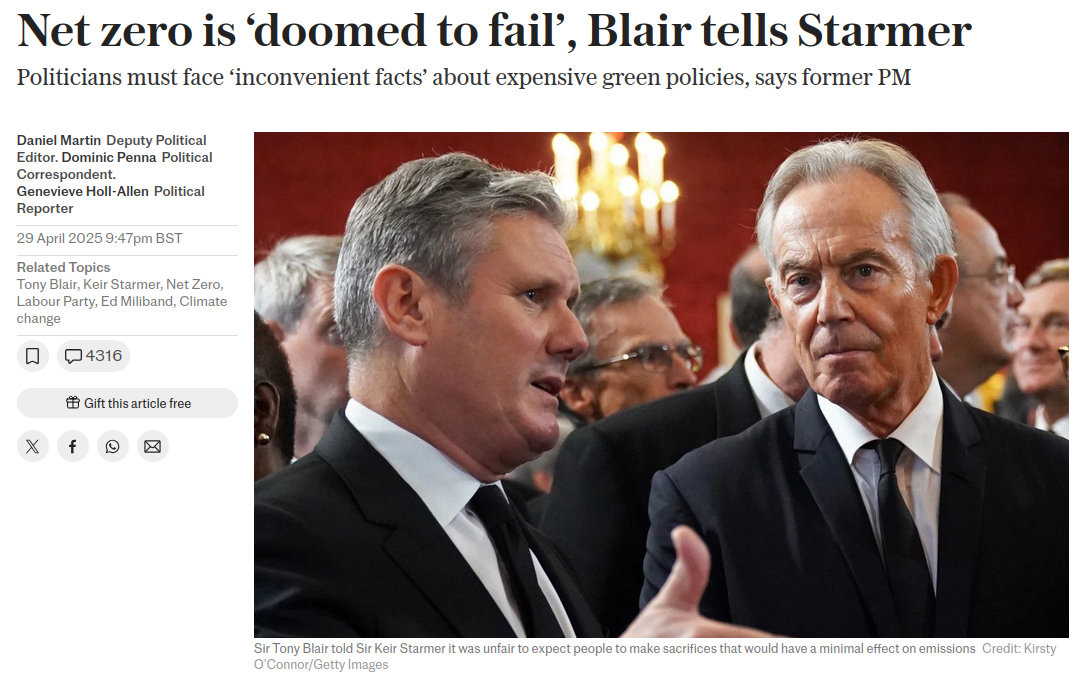
Nigel Farage’s favourite phrase appears to be that “Heads must roll”. He has deployed it about the head of children’s services in Rotherham over three children being removed from their foster families in 2012, the whole of the NatWest board when he was refused a Coutts account in 2023, unspecified individuals from Essex Police managing the demonstrations outside an Epping hotel last year, and also last year again feeling that some head rolling was in order in response to the Government’s national inquiry into grooming gangs.

Meanwhile Kemi Badenoch said in 2024 of civil servants “There is about 5 per cent to 10 per cent of them who are very, very bad. You know, ‘should be in prison’ bad”. Last week she called for the Chief Constable of West Midlands Police to go over the decision to ban fans of Maccabi Tel Aviv from the Aston Villa ground for their Champions League match in November (which, hilariously, now appears to have been, at least partly, influenced by how badly Maccabi Tel Aviv supporters behaved at an entirely fictional game against West Ham United). Also in November, she called for the people involved in making the Panorama documentary about the Capitol Riots, to be sacked (another “heads should roll” headline). Also in November, she decided other BBC “heads must roll” over the decision to uphold complaints and reprimand a newsreader for altering her script from “pregnant people” to “pregnant women” on camera in a piece about groups most at risk during UK heatwaves.

It feels like the footballisation of public life. Farage and Badenoch are routinely reported as furious about something or other, in addition to the frequent demands for sackings, nearly always of public servants. They can clearly see there are votes in it, but the effects of this continuous vilification of public services and the people running them go way beyond that.

The immediate effect is often to make someone’s job untenable. So both the NatWest and Coutts CEOs left after the Farage complaint. The BBC’s Director General and BBC News Chief Executive both left soon after the Badenoch complaint. Now these are all comfortably off individuals who will no doubt be fine, but the impact on an organisation of the idea that any of its leaders could be hounded out at any moment, not through any regulatory process or indeed any process at all, but by someone in politics with a big mouth can be seen increasingly in our public institutions.

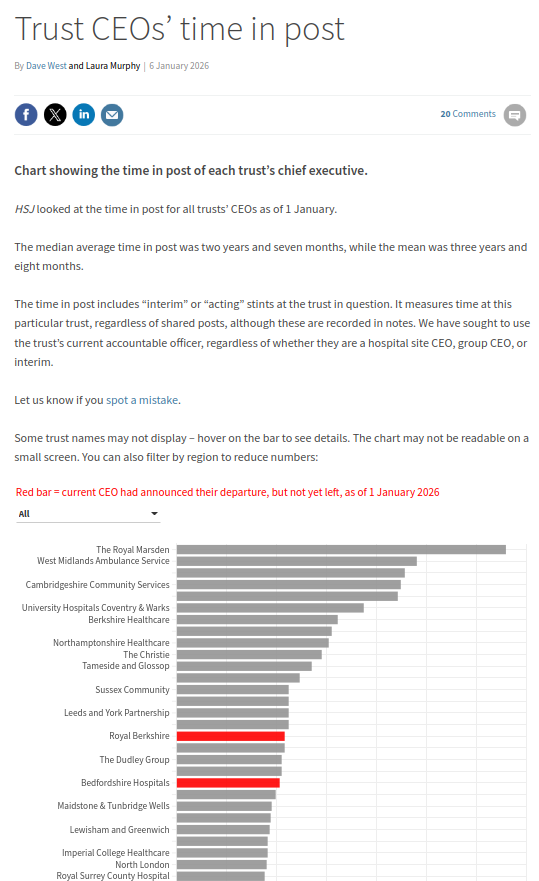
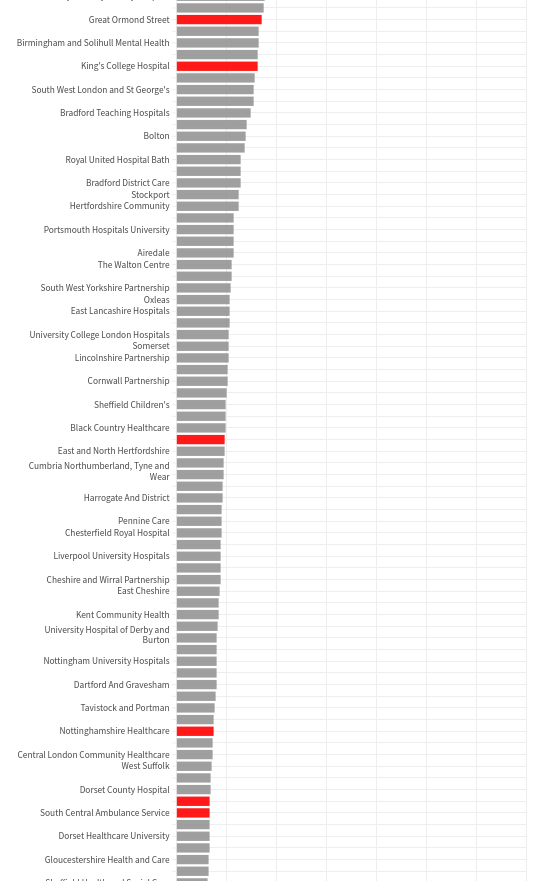
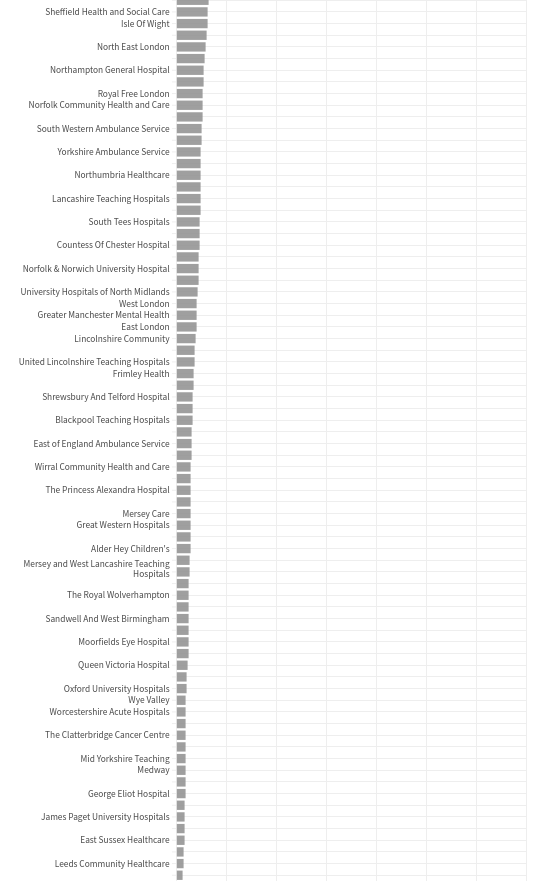
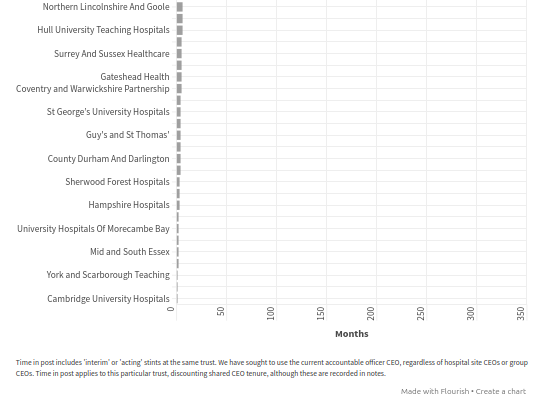
One example would be in the NHS. The HSJ recently published an article on the distribution of tenure of trust chief executives (it required four screenshots to show you just how long a tail can be!). Notice how it is not until half way up the 3rd screenshot (counting up from the bottom) that you find a CEO who has been in post for 50 months, and four of them are about to leave.

Source: https://www.hsj.co.uk/leadership/trust-ceos-time-in-post/7040645.article?storyCode=7040645

As Roy Lilley says:

Public reporting over the last eighteen months points to exits by:

  • NHS England CEO, plus
  • a cluster of senior national directors exiting.
  • At least 10 ICB chief executives stepping down or being replaced.
  • Trust CEO turnover approaching a quarter of posts;
  • implying 50 or more trust-level departures, including permanent and unplanned exits.

Taken together, a guesstimate is between 60 and 80 chief executives and equivalent senior leaders have left their roles across the NHS in the last eighteen months.

As he goes on to say:

High turnover at the top tells the rest of the system that leadership is temporary. Risk is unrewarded and survival matters more than stewardship.

Authority is put at question.

That encourages short-term-ism, compliance and caution. Precisely the opposite of what complex service reform needs.

For those fans of Manchester United’s way of running things who seem to be running things at the moment, that is a hell of a lot of catharsis. Evidence suggests that it is unlikely to achieve much else.

The catharsis never lasts, as at some point the music has to stop, and someone needs to actually be sitting in actual chairs, actually managing the thing. Just ask Chelsea and Manchester United.

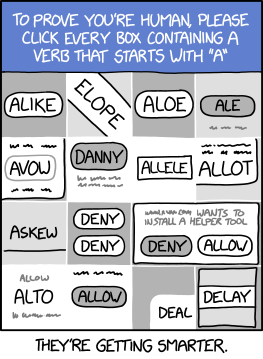
Source: https://xkcd.com/2415/ licence at: https://creativecommons.org/licenses/by-nc/2.5/

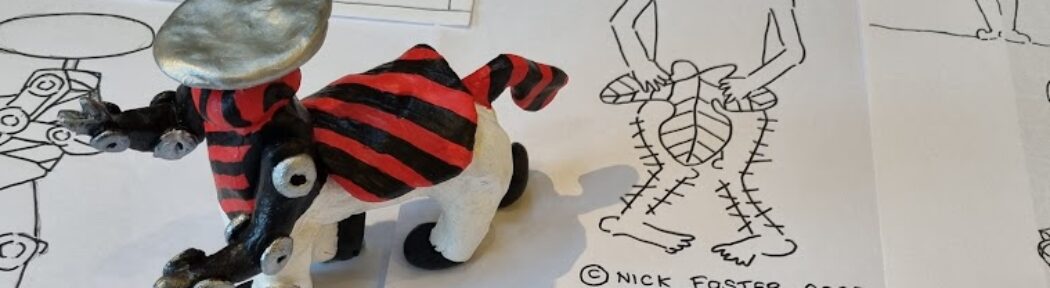
Happy new year all! New year, new banner, courtesy of my brilliant daughter who presented me with a plausible 3-D model of my very primitive cartoon of a reverse-centaur over Christmas. And I thought I would kick off with a relatively uncontentious subject: examinations!

“Back to normal!” That was the cry throughout education when the pandemic had finally ended enough for us to start cramming students into rooms again. The universities had all leveraged themselves to the maximum, and perhaps beyond, to add to the built estate, so as to entice students in both the overseas and the uncapped domestic market to their campuses, and one by-product of this was they had plenty of potential examination halls. So let’s get away from all of that electronic remote nonsense and get everyone in a room together where you can keep an eye on them and stop them cheating. This united the purists who yearned for the days of 10% of the cohort turning up for elite education via chalk and talk rather than the 50% we have today, senior management needing to justify the size of the built estate and politicians who kept referring to traditional exams in an exam hall as the “gold standard”.

So, in a time when students have access to information, tools, how to videos of everything imaginable, the entire output of the greatest minds of thousands of years of human history, as well as many of the less than great minds, in short anything which has ever caught anyone’s attention and been committed to some form of media: in this of all times, we want to sort the students into categories for the existing job market based on how they answer academic questions about what they can remember unaided about the content of their lecture courses and reading lists with a biro on a pad of paper perched precariously on a tiny wooden table surrounded by hundreds of other similar scribblers, for a set period of time as minders wander the floors like Victorian factory owners.

And for institutions that thought the technology we fast-tracked for education delivery and assessment in the pandemic would surely be part of education’s future? Or perhaps they just can’t afford to borrow half a billion or have the the land available to construct more cathedrals of glass and brick to house more examination halls? Simple! We just create the conditions for that gold standard examination right there in the student’s own bedroom or the company they work for!

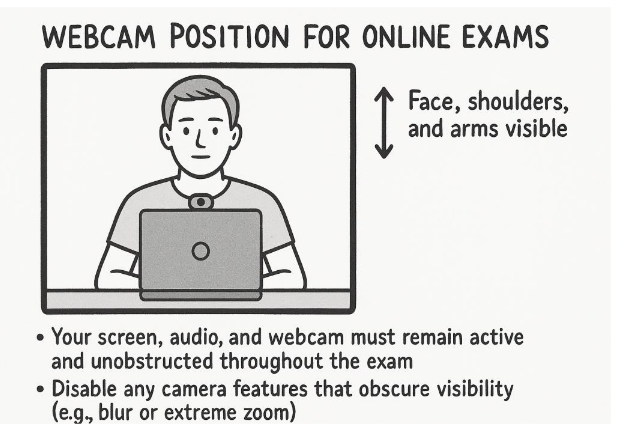
There are 54 pages to the Institute and Faculty of Actuaries’ (IFoA’s) guidance for remotely invigilated candidates. It covers everything from the minimum specification of equipment you need, including the video camera to watch your every movement and the microphone to pick up every sound you make, to the proprietary spying software (called “Guardian Browser”) you will need to download onto your own computer, how to prove who you are to the system, what you are allowed to have in your bedroom with you and even how you need to sit for the duration of the exam (with a maximum of two 5 minute breaks) to ensure the system has sufficient visibility of you at all times:

These closed book remote arrangements replaced the previous open book online exams which most institutions operated during the pandemic. The reason given was that the exam results shot up so much that widespread cheating was suspected and the integrity of the qualifications was at risk. The IFoA’s latest assessment regulations can be found here.

The belief in examinations is very widespread. A couple of months ago I was discussing the teacher assessments which replaced them briefly during the pandemic with a secondary business studies teacher. He took great pride in the fact that he based his assessments solely on mock results, ie an assessment carried out before all of the syllabus had been covered and when students were unaware it would be the final assessment. But still in his mind more “objective” than any opinion he might have of his own students.

If a large language model can perform enormously better in an examination than your students can without it, what it actually demonstrates is that the traditional examination is woefully unprepared for the future. As Carlo Iacono puts it:

The machines learned from us.

They learned what we actually valued and it turned out to be different from what we said we valued.

We said we valued originality. We rewarded conformity to genre. We said we valued depth. We measured surface features. We said we valued critical thinking. We gave higher marks to confident assertion than to honest uncertainty.

So now the machines produce what the world trained them to produce: fluent, confident, passable output that fits the shapes we reward.

And we’re horrified. Not because they stole something from us. Because they showed us what the systems were selecting for all along.

The scandal isn’t that a model can imitate student writing. The scandal is that we built an educational and professional culture where imitation passes as competence, and then acted shocked when a machine learned to imitate faster.

We trained the incentives. We trained the rubrics. We trained the career ladders.

The pattern recognition which gets you through most formal examinations is just too cheap and easy to automate now. It is no longer a useful skill, even by proxy. It might as well be Hogwarts’ sorting hat for all the use it is in a post scarcity education world. If the machines have worked out how to unlock the elaborate captcha system we have placed around our gold standard assessments, an arms race of security measures protecting a range of tests which look increasingly narrow compared to the capabilities which matter does not seem like the way to go.

What instead we are doing is identifying which students are prepared to put themselves through literally anything to get the qualification. Companies like students like that. They will make ideal reverse-centaurs. The description of life as a reverse-centaur even sounds like the experience of a proctored exam:

Like an Amazon delivery driver, who sits in a cabin surrounded by AI cameras, that monitor the driver’s eyes and take points off if the driver looks in a proscribed direction, and monitors the driver’s mouth because singing isn’t allowed on the job, and rats the driver out to the boss if they don’t make quota.

The driver is in that van because the van can’t drive itself and can’t get a parcel from the curb to your porch. The driver is a peripheral for a van, and the van drives the driver, at superhuman speed, demanding superhuman endurance. But the driver is human, so the van doesn’t just use the driver. The van uses the driver up.

Source: Cory Doctorow, Enshittification

And, even if you are OK with all of that, all of these privacy intrusions don’t even work to prevent cheating! The ACCA, the world’s largest accounting professional body, has just announced it is stopping all remote exams after giving up the arms race against the cheats, facilitated in some cases seemingly by their Big Four employers lying about what had gone on.

Actuarial exams started in 1850, only 2 years after the Institute of Actuaries was established (Dermot Grenham wrote about them recently here). This pre-dated the establishment of the first examination boards by a few years (1856 Society of Arts, the Society for the encouragement of Arts, Manufactures and Commerce, later the Royal Society for the encouragement of Arts, Manufactures and Commerce (Royal Society of Arts); 1857: University of Oxford Delegacy of Local Examinations (founded by the University of Oxford); and 1858: University of Cambridge Local Examinations Syndicate (UCLES, founded by the University of Cambridge)), so keen were actuaries to institute examinations. However it was the massive expansion of the middle classes as the Industrial Revolution disrupted society in so many ways that led to the need for a new sorting hat beyond the capacity of the oral examinations that had previously been the norm.

Now people seem to be lining up to drag everyone back into the examination hall. Any suggestion of a retreat from traditional exams is met by howls of outrage from people like Sam Leith at The Spectator about lack of “rigour”. However, in my view, they are wrong.

Yes of course you can isolate students from every intellectual aid they would normally use, as a centaur, to augment their performance, limit the sources they can access, force them to rely on their own memories entirely, and put them under significant time pressure. You will definitely reduce marks by doing that. So that has made it harder and therefore more rigorous and more objective, right?

Well according to the Merriam-Webster dictionary, rigorous is a synonym of rigid, strict or stringent. However, while all these words mean extremely severe or stern, rigorous implies the imposition of hardship and difficulty. So promoting exams above all as an exercise in rigour reveals their true nature as a kind of punishment beating in written form, for which the prize for undergoing it is whatever it qualifies you for. Suddenly the sorting hat looks relatively less arbitrary.

The problems of traditional exams are well known, but the most important ones in my view are that they measure a limited range of abilities and therefore are unlikely to show what students can really achieve. Harder does not mean more objective. It is like deciding who can act by throwing students out, one at a time, in front of a baying mob of, let’s say for argument, readers of The Spectator. Sure, some of the students might be able to calm the crowd, some may even be able to redirect their anger towards a different target. But are the people who can play Mark Antony for real necessarily the best all-round actors? And has someone who can only stand frozen on the spot under those circumstances really proved that they could never act well?

It also means that education ends a month or more before the exams, to allow the appropriate cramming, followed by engaging all of the teaching staff in the extended exercise of marking, checking and moderating what has been written in answer to academic questions about what the students can remember unaided about the content of their lecture courses and reading lists with a biro on a pad of paper perched precariously on a tiny wooden table surrounded by hundreds of other similar scribblers, for a set period of time as minders wander the floors like Victorian factory owners. But what if instead the assessment was part of the teaching process? What if students felt that their assessment had been a meaningful part of their educational experience? What if, instead of arguing the toss over whether they scored 68% or 70% on an assessment, students could see for themselves whether they had demonstrated mastery of their subject.

One model of assessment which is getting a lot of attention at the moment, one I am a big fan of having used it at the University of Leicester on some modules, is something called interactive oral assessment, where students meet with a lecturer or tutor, individually or in a small group, and answer questions about work they have already submitted. It is a highly demanding form of assessment, for both the students and the assessors, but it means the final assessment is done with the student present and, with careful probing from the assessors, who will obviously need to have done a close reading of the project work beforehand, you can be highly confident of the degree to which the student understands the work they have submitted. It also allows the student to submit a piece of work of more complexity and ambition than can be accommodated by a traditional exam. And it needn’t take any more time if the interviews are carried out online when set against the exam marking time of the traditional exam. Something which all the technology we developed through the pandemic allows us to do, without the need for spyware.

There are other models which also assess the technological centaurs we wish our students to become rather than the reverse-centaurs we are currently dooming too many to become. It is looking like it may be time to start telling students to stop writing and to put down their pens on the traditional exam. And perhaps the actuarial profession, who led us into the era of professional written examinations so enthusiastically 175 years ago, might now want to take the lead in navigating our way out of them?