Politics is a bit depressing this week, so I thought instead I would focus on the asymmetry of our attitudes towards different high octane liquids.
I remember when I first got interested in wine. It was the early noughties and I was out at a restaurant in Cardiff called Le Cassoulet (no longer trading under that name I understand) with my then boss who liked to hit his expense account pretty hard from time to time. The sommelier seemed to know him quite well and scurried off to get him some particularly old claret to accompany the meal. I think it was from 1972 or thereabouts. I remember noting that it had a different colour (brown) from the red wine I was used to drinking and, when sipped, there were a lot of different flavours and smells competing for my attention. Something which I later heard described as “complexity”. From then on I realised that wine drinking could involve something a bit more than just something nice in a glass to accompany a meal.
The journey of alcoholic drinks from drinks to luxury consumer items and assets is nicely illustrated by the Bond franchise. There are a number of movies we could choose but let’s go for Goldfinger, shall we?
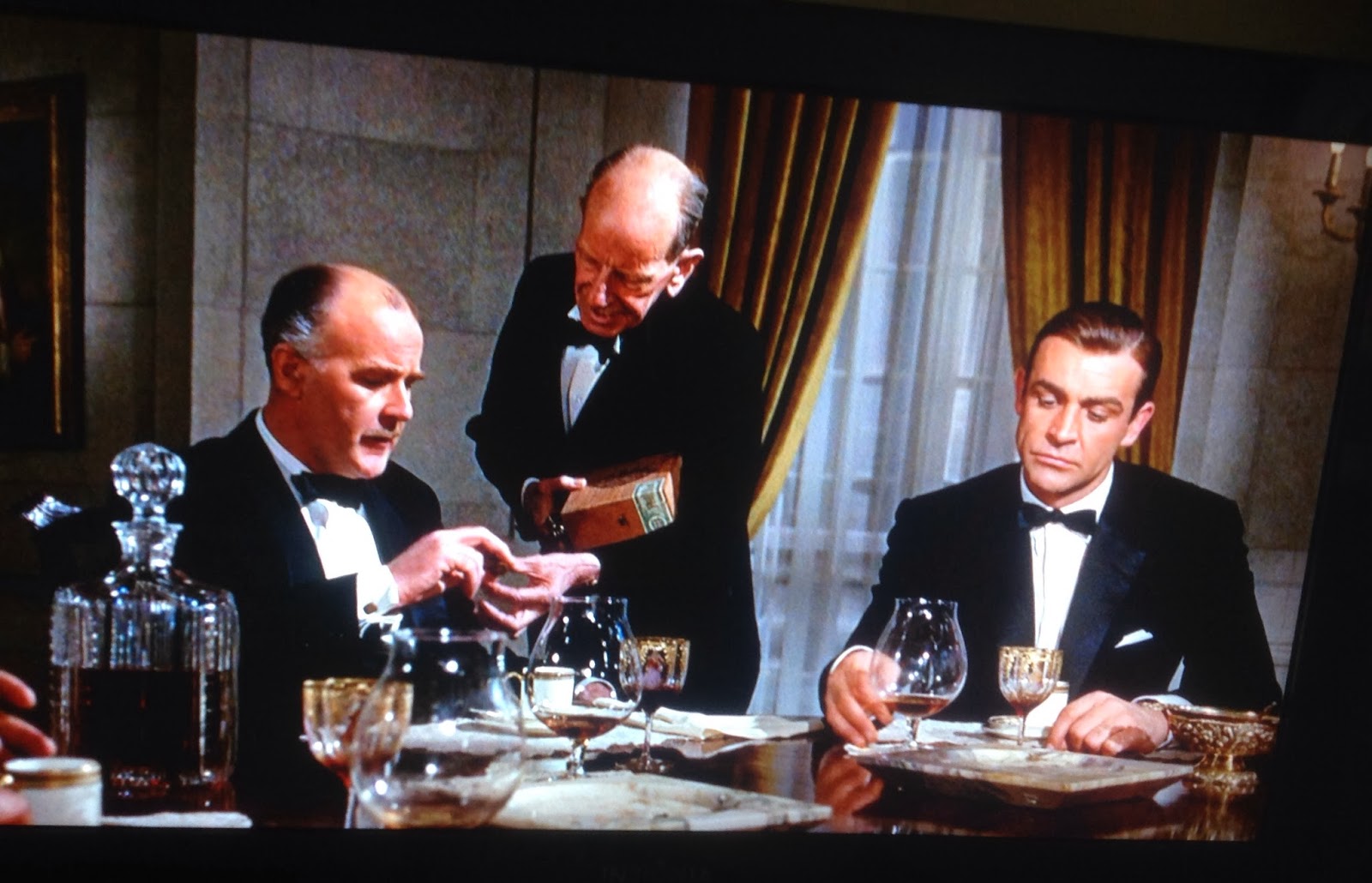
In the disappointing brandy scene from Goldfinger, we have this exchange between M, Bond and the Governor of the Bank of England, Colonel Smithers:
Smithers: “Have a little more of this rather disappointing brandy.”
M: “What’s the matter with it?”
Bond: “I’d say it was a 30-year-old Fine indifferently blended, sir…with an overdose of Bons Bois.”
M: “Colonel Smithers is giving the lecture, 007.”
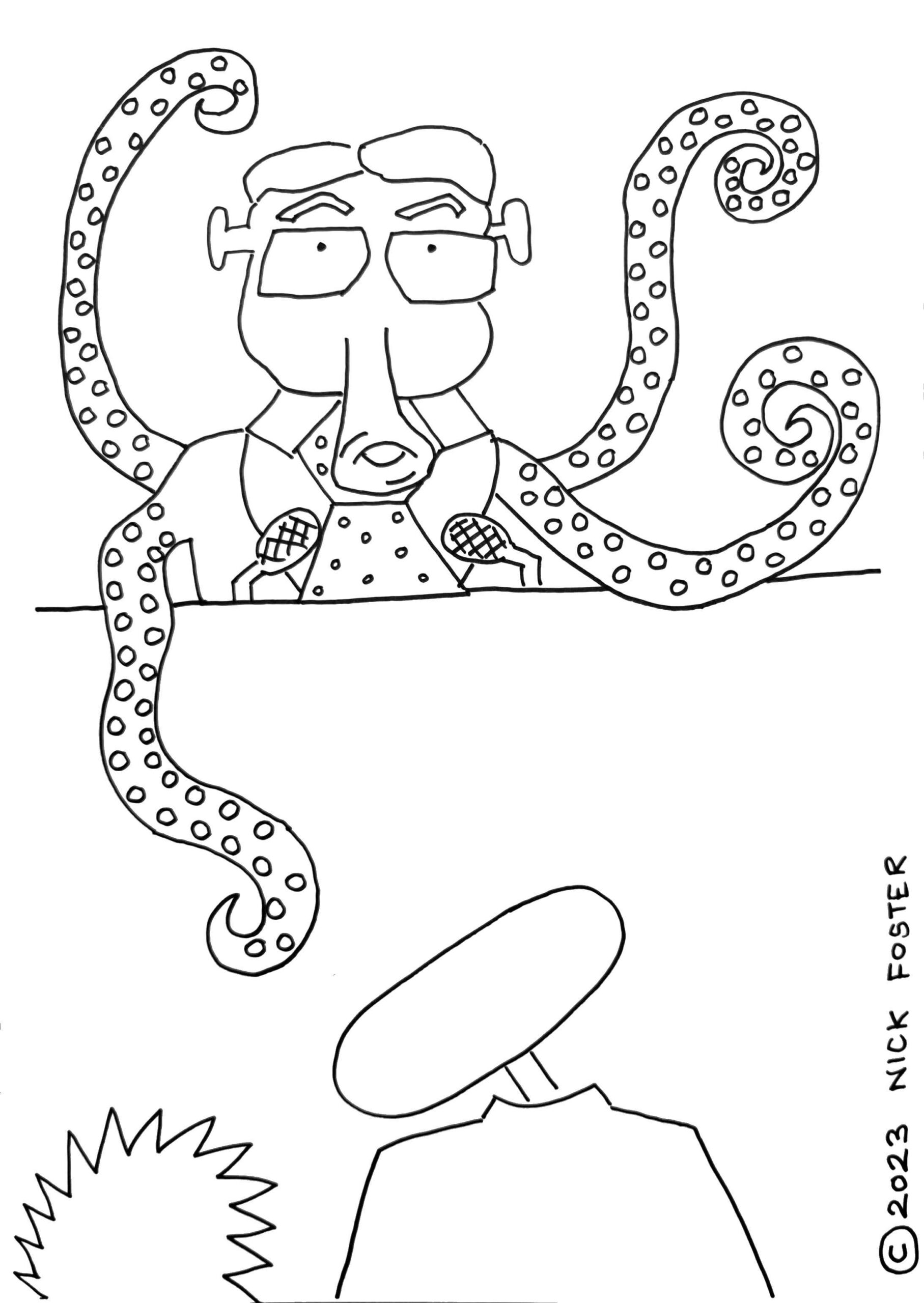
Now first of all, that is clearly not what the Governor of the Bank of England looks like. As readers of this blog already know, he looks like this:
That scene is also notable for including a brief discussion of how the relative value of gold held at the US and British central banks at the time was used “to establish respectively the true value of the dollar and the pound”. In 1964 this would have been via the London Gold Pool, running between 1961 and 1968, by which a group of eight central banks including the United States Fed and the Bank of England agreed to cooperate in maintaining the Bretton Woods System of fixed-rate convertible currencies and defending the gold price. Ian Fleming’s book, written in 1959, predated this arrangement, but the anxieties about the gold market which led to its creation would have been very much around. So we still have the Governor (meeting Bond alone rather than with M) saying (during a lecture which went on for 10 pages):
We can only tell what the true strength of the pound is, and other countries can only tell it, by knowing the amount of valuta we have behind our currency.
Valuta is a rare word, from American English, for the value of one currency in terms of its exchange rate with another, and perhaps an odd one for the Governor of the Bank of England to use. But it is clear that Bond is sent after Goldfinger primarily for economic reasons (finding a way to smuggle large amounts of gold across borders threatens the Bank of England’s cosy little gold club) rather than because (spoiler alert) Goldfinger thinks nothing of murdering people (quite a lot of people in the case of Operation Grand Slam) who get in his way, cheating at golf, employing butlers with lethal bowlers, slicing through things with gold lasers and planting nuclear devices in Fort Knox. Released shortly after Ian Fleming’s death, it was the last Bond movie he saw in production.
It is the same film in which Bond obsesses about getting his favourite champagne (Dom Perignon 1953 – Bond was also someone not afraid to hit his expense account pretty hard from time to time) chilled to 38°F (3.3°C) before he gets bashed on the back of the head and the girl he is with (Goldfinger’s assistant, Jill Masterson, played by Shirley Eaton) gets sprayed from head to toe with gold paint. Perhaps more than any other brand, Bond linked luxury and high octane liquids of various kinds.
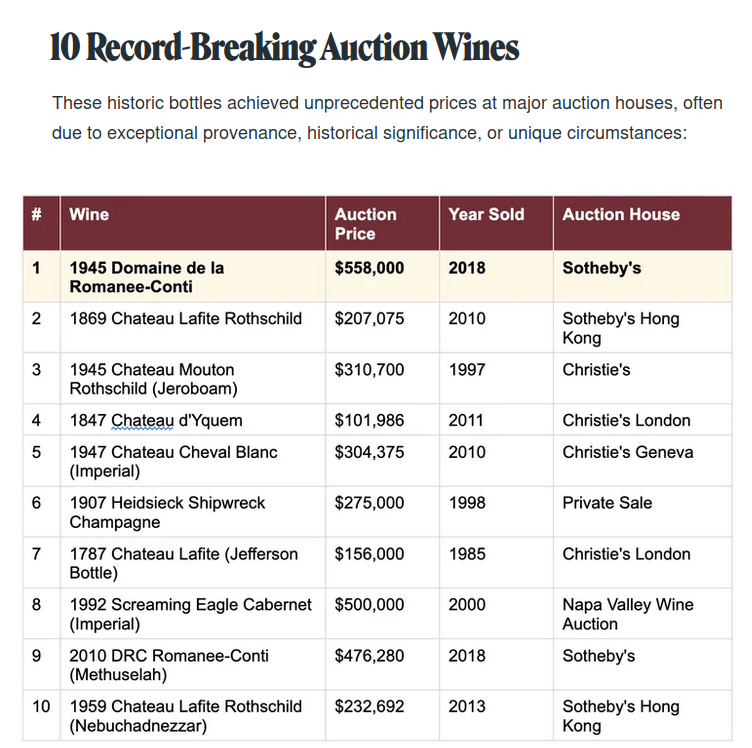
Skip forward a few decades and some of it has clearly stopped being something to drink at all, but instead a, very fragile, status asset for the very rich to demonstrate their status to each other. Here are the top prices achieved by wine at auction from one website, 8 of the 10 of them pre-dating both me and Goldfinger:
Contrast this with the way we have treated fossil fuels. As Luke Kemp points out in Goliath’s Curse:
We tend to forget that fossil fuels come primarily from long-dead plants and animals. These organisms died between 360 and 286 million years ago during the Carboniferous period, after capturing sunlight through photosynthesis or other means. It is that fossilised energy that we are consuming. According to one estimate, it would take 400 years of global photosynthesis to power the modern world for one year. It takes ninety-eight tons of organic matter buried during the Carboniferous to become just five litres of petrol. We are now a high-energy Goliath, powered by dead matter.
According to a petrol price checker from earlier this week, the garage closest to me currently sells unleaded petrol for £1.29 a litre. So 98 tones of organic matter curated for 300 million years retails for £6.45. That’s less than half the price of a sausage bap and a coffee from Costa via UberEats:
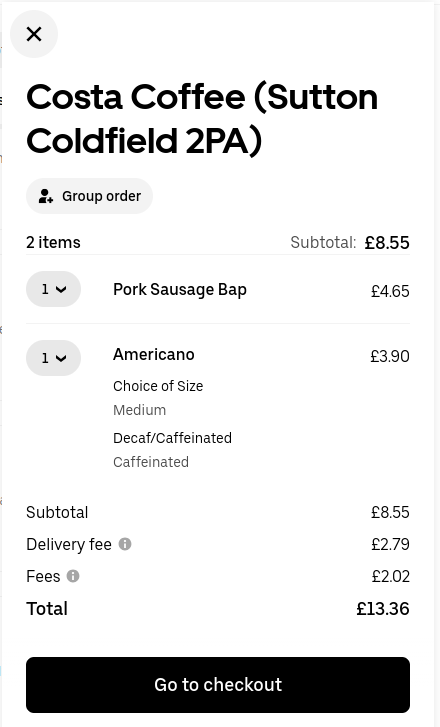
But apparently it’s still not cheap enough.
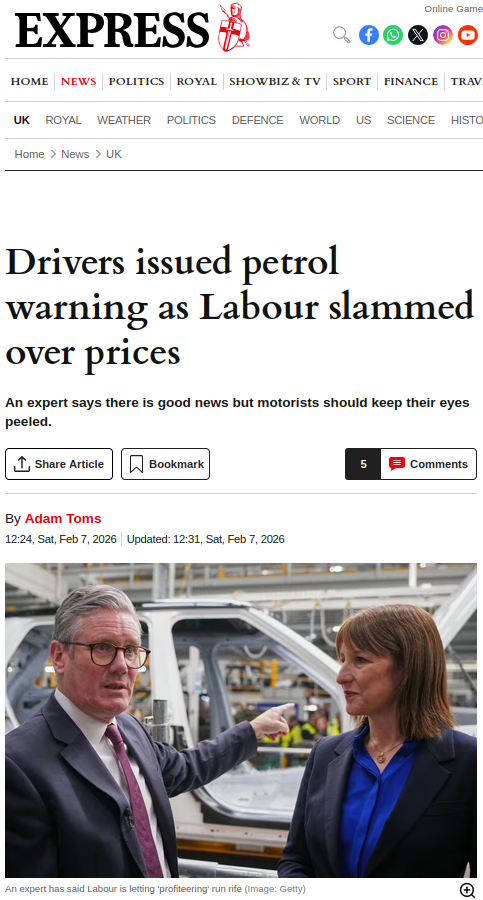
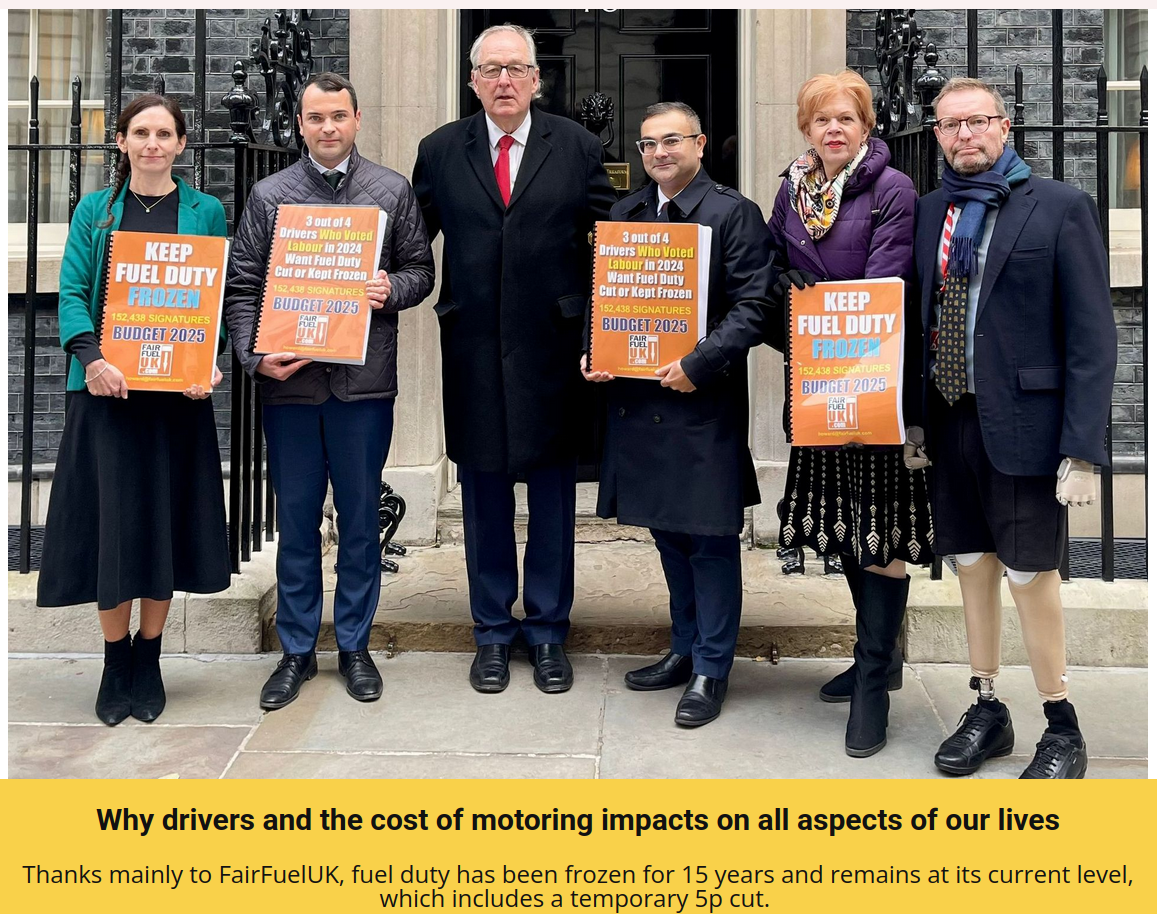
Most of the content from this article recommending eternal vigilance despite the cheapest prices for 5 years and the claims that “petrol is still 6p too high at the pumps” comes from Howard Cox, founder of FairFuelUK. Whose website includes this picture with a not-too-presumptious-claim-at-all below it:
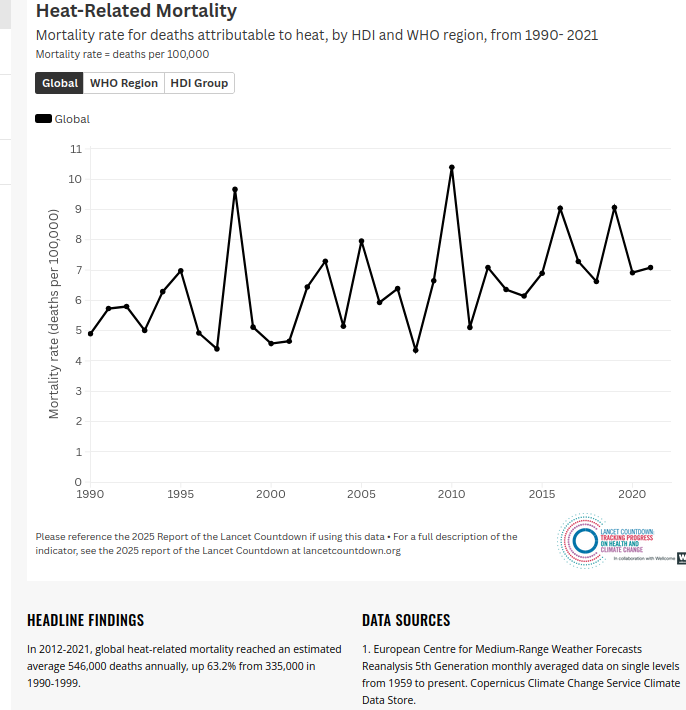
Even if you weren’t concerned with climate change or the health effects of petrol fumes in the air, this seems like a strange hill for anyone to be dying on. And dying we are. According to the 2025 Global Report of the Lancet Countdown average global heat-related mortality has now reached 546,000 pa, up 63% in just over 20 years:
And that’s just heat. A recent report from the Royal College of Physicians: A Breath of Fresh Air estimated 30,000 deaths from air pollution each year, of which car emissions form an important component.
By the time even the Bond franchise had started worrying about environmental concerns in 2008 with Quantum of Solace, a Somerset Maughamish short story converted into an attempt by a sinister organisation to become the water monopoly in Bolivia through underhand means, the iconic shot of the woman covered in gold had become a female consular employee (Strawberry Fields, played by Gemma Arterton) drowned in oil:
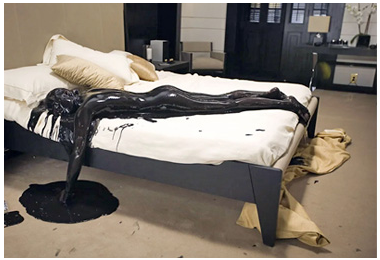
We currently pay between £3.12 and £7.09 per litre in duty on wine, depending on strength, and £0.53 per litre in duty on petrol.
Our attitude to different types of high octane liquids has clearly been nuts in all kinds of ways for a long time. But it is just part of our political frostbite at the moment: we allow our living organisations and institutions to remain frozen in time because we have always done things that way, regardless of the living tissue we are killing in the process. From the endless cycle of public inquiries and ignored recommendations to our use of economics to rationalise things we have already decided to do to batting on with traditional exams: it seems we are just going to do what we are going to do. And freezing fuel duty now looks like it needs to be added to that list.
We can laugh at Trump for accepting an award of “undisputed champion of beautiful clean coal” by the Washington Coal Club and legislating that black is now white by revoking the Environmental Protection Agency’s scientific ruling from 2009 about the harms of climate change. But Trump does at least think he needs a reason to support the fossil fuel industry, even if he needs to make one up. We are just doing it because our politics has gangrene.