

We shall not cease from exploration
And the end of all our exploring
Will be to arrive where we started
And know the place for the first time.
T.S. Eliot – Four Quartets
I feel like I am having a bit of a T.S. Eliot week. I have been writing about the OBR since the beginning of this blog in 2013, with their repeated failures as a forecaster forming the banner for the blog for many years.
What has brought me back to the OBR, as if for the first time, is recalling during the recent Funding the Future conference the words of the very good and wise friend of mine who was there with me. I had invited him to talk to one of my undergraduate groups at the University of Leicester during a professional skills session a few years ago. We were looking at past disciplinary cases of the Institute and Faculty of Actuaries and discussing what the actuaries involved could have done better.
In one of the case studies we considered, an actuary had produced a quarterly reserving report for a company, estimating the reserves on a ‘high’ basis of £74.5 million, a ‘low’ basis of £36.9 million and a ‘best’ basis of £52.1 million. The company then produced financial statements for the year, approved by the board of which he was a part, containing a reserve figure of £15.5 million. My friend told the students that the way to challenge in a situation like this is not to focus on the numbers, but instead see that each different number reflects a different story being told. So you need to look at what the story would need to be for the £15.5 million to be an appropriate figure and take issue with the things that don’t make sense within that story.
It was great advice then and still is, and it is definitely the way to look at the OBR I think. We find a story unsatisfactory if the characters are shallow, do not behave in a credible way, and the plot oversimplifies a much richer situation (something which every story must do to some extent to be manageable to the reader) in a deeply unsatisfying way.
Several other commentators have talked about the inability of the OBR to forecast anything (including me) – this is the equivalent of insufficiently fleshed out characters behaving in unbelievable ways. Richard Murphy, for instance, pointed out how ridiculous the proposed character plotline for inflation was at the last budget:
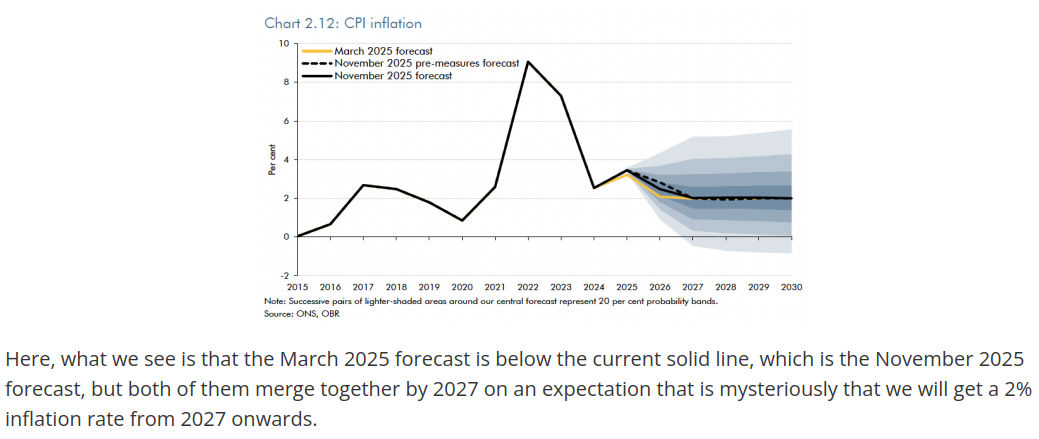
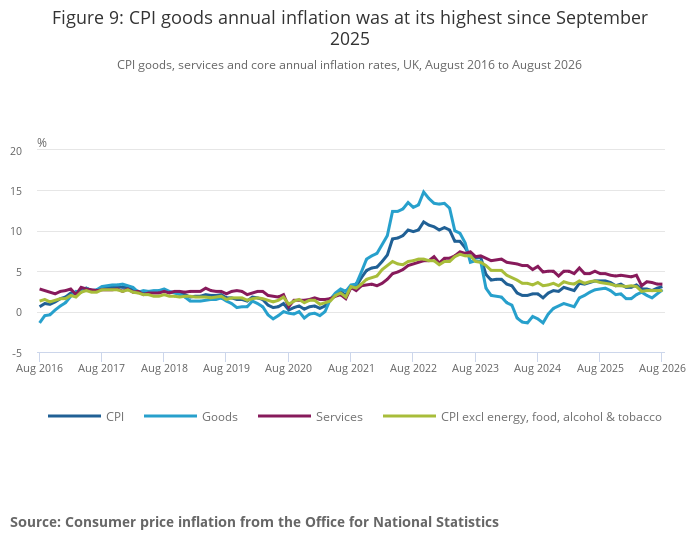
Whereas in fact of course the downward trajectory predicted at the last budget didn’t look remotely likely even then. The Consumer Prices Index (CPI) rose by 3.1% in the 12 months to August 2026, up from 2.9% the previous month.
However it is Dan Davies’ recent couple of Substack posts (one and two) which get to the heart of the problem in my view. Dan Davies’ contention is that it is the plot oversimplification which is the main problem here. As he says:
The system we have set up only seems to be able to communicate two states though – the signal is either “COMPLIANT – WAR CHEST” or “NONCOMPLIANT – BLACK HOLE”. It would be a significant improvement even for the OBR to add some measure of urgency or non-urgency to its press release – a sentence like “this surplus is well within the forecast error, however, so it should not be used to justify a change in policy”.
But, in his view, it is even worse than that:
In general, most things which a government spends money on will tend to have effects on the economy which go well beyond the five year forecast. The OBR uses an information set which contains only a small and quite arbitrary subset of government decisions – it is, literally, not capable of representing the system it is meant to control at an acceptable level of accuracy.
The justification for ignoring the future consequences of current spending seems to be no more sophisticated than what we pejoratively call “Treasury Brain” – the belief that a) spending departments always claim that their budget should be seen as an investment, b) that they systematically overestimate the long term benefits of current costs and c) that the best solution to a) and b) is to completely ignore any future benefits from investment or future costs caused by noninvestment. It’s just not good enough.
It is this dog’s breakfast that apparently tells us whether we are on track to meet the plotline the government has set for itself. Its three fiscal rules:
Rule 1. The current budget should be on course to be in balance or surplus by 2029/30 (‘stability rule’);
Rule 2. Net financial debt should fall as a share of the economy in 2029/30 (‘investment rule’); and
Rule 3. Some types of welfare spending must remain below a pre-specified level (the ‘welfare cap’).
And if that gruesome threesome doesn’t set your heart racing about the country’s future story, you are not alone. Because the people banging on about fiscal space will always push for governments to spend less, regardless of the circumstances. For instance, at the height of the pandemic in December 2020, Moody’s were saying this (with excess deaths already estimated at over 30,000 in the UK by Public Health England at that point):
However, compared to the government’s March budget (that was quickly overtaken by events), there are some initial signs that fiscal policy outside of investment is likely to be less expansive than previously announced. What remains unclear is whether this ambition will be able to withstand the political pressures that seem to be inevitable given the government’s previous commitments. Even before the Spending Review, longer-term spending commitments for health, education, and defence had already been announced. Together, these three areas account for around 60% of total expenditure.
One of the themes from the Funding the Future conference was, to quote from Educating Rita:
“There must be better songs to sing than this”.
I agree. One possibility is proposed by the New Economics Foundation, who suggest categorising policies by their level of multiplier effect (ie how much economic activity is increased by an increase in spending) and replacing fiscal rules with a “fiscal referee” who can make a more holistic judgement addressing many of the omissions Dan Davies complains about. This would then lead to a discussion rather than the compliant/non-compliant cliff edge we currently have, and allow the government to make its case. And it would not automatically incentivise cuts like the current system does.
Other possibilities exist. As Dan Davies describes it:
any accounting system is a mental prison of some kind, and one which needs to be periodically escaped from
In my view, a jailbreak is long overdue.