
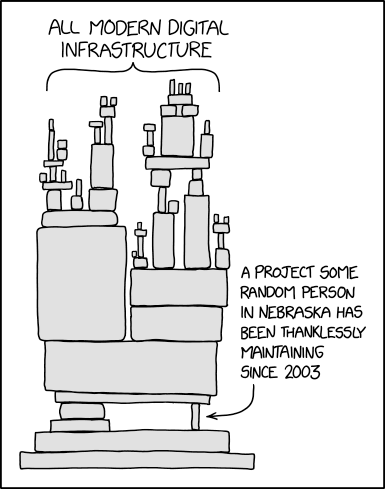
Last week I suggested that the period of disruption we have entered would be likely to impact the relationship between society and its institutions and professions, and likened those institutions and professions to the models behind the models we normally focus on. I suggested that this has serious implications for actuarial education, amongst much else.
This week I want to expand a little on what I meant by that.
First, the impact of AI. My view of AI is that I don’t believe most of the claims coming out of OpenAI and Anthropic when noone else gets to see the data and they clearly have a vested interest in playing up the capabilities of their systems. And I certainly don’t believe the fantasy economics the Magnificent 7 are currently indulging in is sustainable (see Ed Zitron’s Hater’s Guide to Circular Financing for more on this). But I do believe that there is a lot of political power with an increasingly out of control stake in it continuing, which makes the quote often attributed to Keynes (“Markets can remain irrational longer than you can remain solvent”, although it may have been A. Garry Shilling in 1999) even more relevant here.
However, what cannot be denied is that the existence of AI is accelerating conversations which we should have been having a long time ago. Last month, MIT issued a report called AI and Education, which turns out to be more a philosophical musing about what we should be trying to achieve in universities, and what expectations we should have of both staff and students. It’s not a long report, but for the time poor amongst you there are two passages from this that I’d like to highlight here.
First, on the expectations we should have of students:
Leaning into learning means creating a new “social contract” between teachers and students. All of us who teach at MIT will need to be prepared to help students understand both that the process of education is necessarily a productive struggle, and that the most important product of their education is not a GPA or a diploma but themselves: their personal growth and intellectual maturity and the development of their own imagination, insight, and judgment.
Instilling these attitudes needs to become a central task for every educator, so that our students know not only what they should learn, but also how they should learn and why learning matters. We need to help them develop metacognitive abilities to think about thinking, to engage in reflective practices, and to enhance their sense of personal agency. This will require both dedication and fresh preparation on the part of instructors.
Remember that social contract idea, because it will be coming up again.
Second, on what kinds of assessments we need to move to in anything we still want to be able to refer to as education:
Rather than simply “AI-proof” current methods of assessment, instructors need to revisit what they really want students to know and devise assessments that foster, or even include, the kind of productive struggle that builds durable understanding and mastery.
We urge instructors to consider forms of assessment that are less vulnerable to AI, and more valuable for learning, such as oral exams, semester portfolios, and out-of-class assignments paired with in-class conversations. This likely means resources such as TAs and class time will become more central to evaluation.
and this:
To match the shift towards assessment methods that aren’t vulnerable to AI, instructors need to increase the role of experiential and project-based learning. To encourage this kind of creative teaching, MIT should support the development of teaching skills and practices for all instructors, and recognize contributions in this domain.
As someone who has already spent some time advocating just such a move in higher education, I feel quite vindicated. But back to that social contract point. I am in a WhatsApp group called Actuarial Change in Education (A C E), where we have been discussing this point for a while, but couldn’t agree what to call it. Culture was one proposal, but I think we all agreed on the MIT point that it should be aiming to ensure:
our students know not only what they should learn, but also how they should learn and why learning matters
And then, like buses, a third take on this point came from, of all people, Seth Godin in Two schools of thought about school:
One kind of school is about culture, compliance and community. We indoctrinate kids, for better or worse, in what it means to be in this world we’ve built, and how to do it together. We teach them how to be kids, how to be citizens and hopefully, how to be adults.
And the other kind of school is about the content. All the ‘R’s. The software that goes with the operating system we taught in the other school.
The first paragraph is what MIT and my WhatsApp group are referring to. It is the bit which has been assumed we shared in common for too long, but is the most important bit. A shared culture or social contract would allow us to meet and discuss things within a shared set of assumptions about how we can get agreement and take action. It is what has been holding back COPs and peace talks and politics more generally for my whole lifetime. It is also how we decide what we put in the second paragraph, which is necessarily stuff which will be being tweaked constantly and be much more short-term in focus..
The second paragraph is what the Institute and Faculty of Actuaries respond with when you ask them about education (I am only picking on them as this is the one I am most familiar with). Curriculum. Syllabus items. Suggested number of hours study. Past papers to practise for the traditional written exam.
Seth Godin calls this software. It is content. It is largely ephemeral, as the needs of the model we operate in and the tools we are given to do so change all the time. Little of it will survive a decade let alone a career. It does not encourage looking up and wondering if there is a better way. It is full of short-term deadlines and urgency and immediacy. Which tends to get confused with importance.
But the software will never surprise you or deal with situations noone has ever met before. If it is not in the underlying model, it will not turn up in the software. The important education is in the operating system. That is what needs to be reformed.
As I said, there is a WhatsApp group discussing such questions regularly. We are a small group currently, but would welcome new members interested in these questions. If you are, then respond to me in the comments section below or via a LinkedIn message if you are reading it there.
A little more information about A C E is set out below:
What is A C E?
Actuarial Change in Education. A place to discuss where change is needed in how actuarial students learn and the changing landscape they are preparing themselves for. A place to argue about how we teach, and how we get students to care about why they are in education and question the assumptions underlying it. A place to share thoughts and ideas you have had or seen about education, actuarial or otherwise. A place to collaborate with others equally concerned about the future of actuarial education. A place to plan and deliver communications with the wider actuarial community.
What are A C E’s aims?
To have an impact on actuarial education by providing a place for developing actionable ideas about education more generally and how they can be applied to actuarial studies in particular. The hope is that these will then be a useful resource for when the need for alternatives gains a wider acceptance.
Who can join A C E?
Anyone interested in the development of actuarial students.