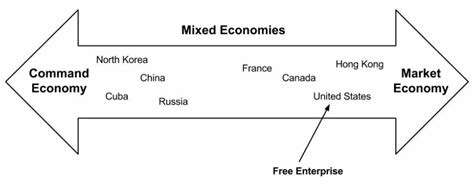
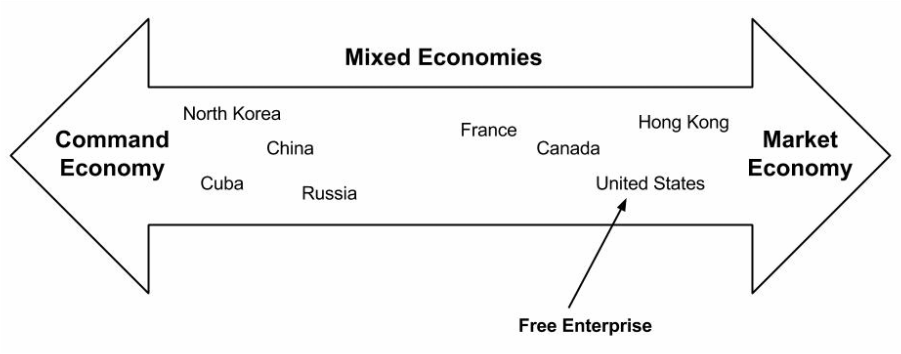
Just type “mixed economy graphic” into Google and you will get a lot of diagrams like this one – note that they normally have to pick out the United States for special mention. Notice the big gap between those countries – North Korea, Cuba, China and Russia – and us. It is a political statement masquerading as an economic one.
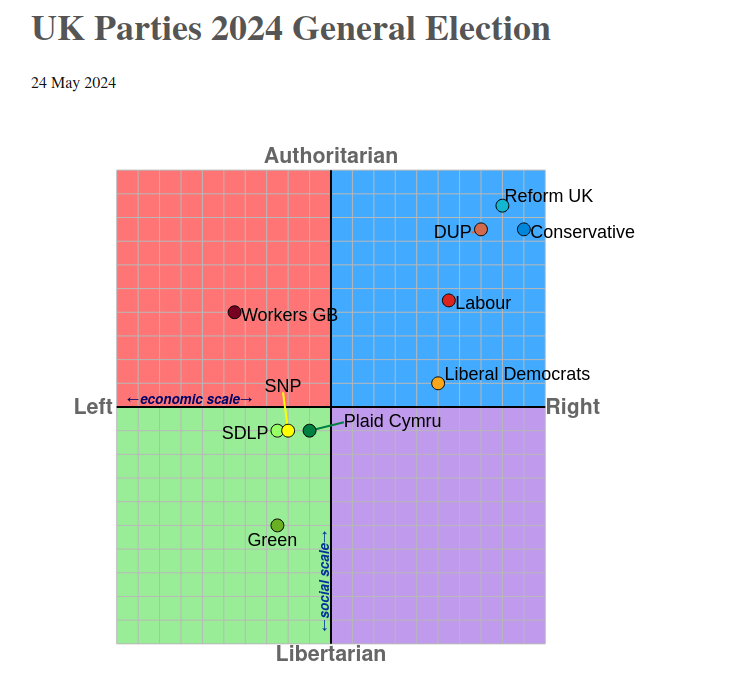
This same line is used to describe our political options. The Political Compass added an authoritarian/libertarian axis in their 2024 election manifesto analysis but the line from left to right (described as the economic scale) is still there:
So here we are on our political and economic spectrum, where tiny movements between the very clustered Reform, Conservative, Labour and Liberal Democrat positions fill our newspapers and social media comment. The Greens and, presumably if it ever gets off the ground, Your Party are seen as so far away from the cluster that they often get left out of our political discourse. It is an incredibly narrow perspective and we wonder why we are stuck on so many major societal problems.
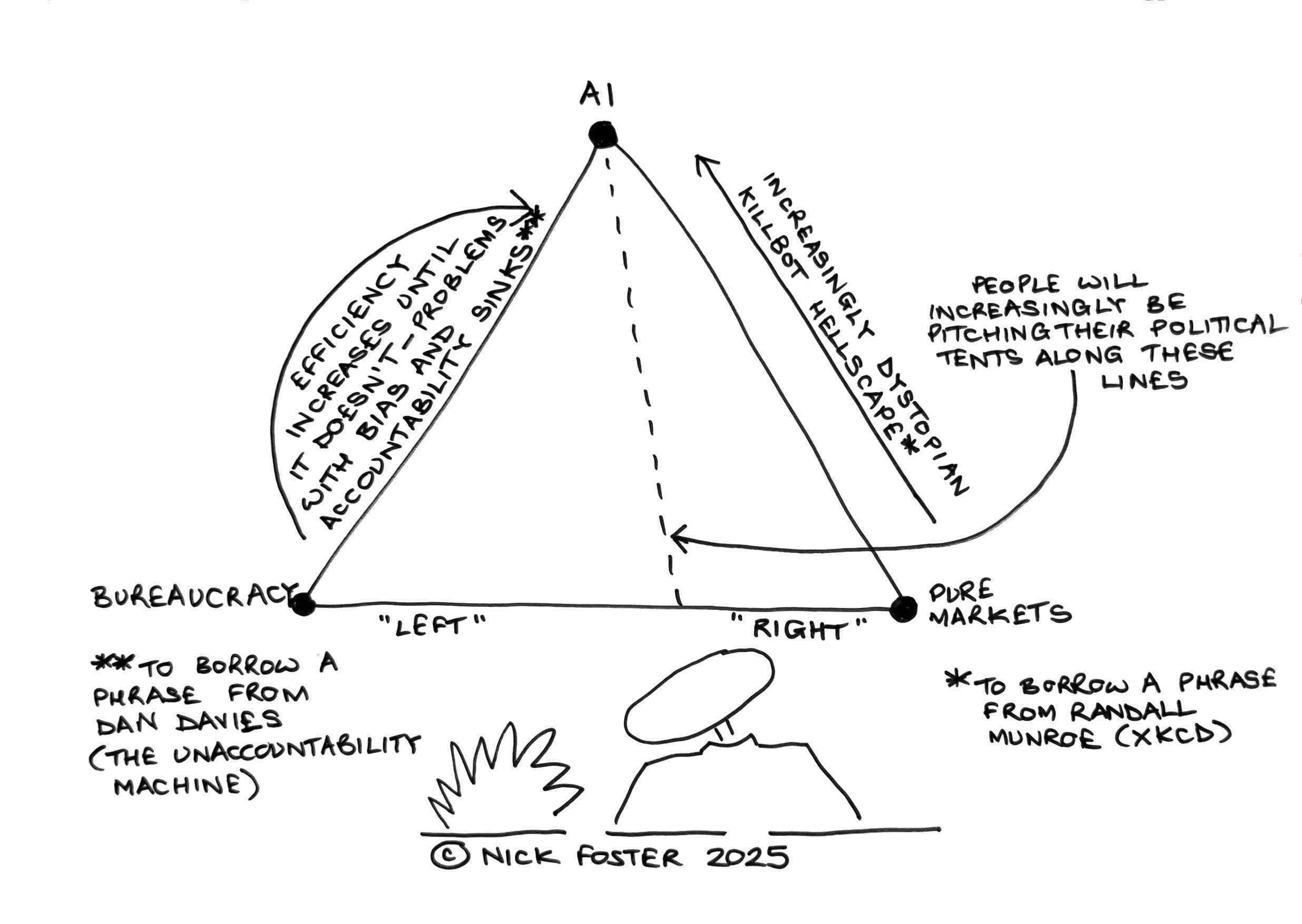
This is where we have ended up following the “slow singularity” of the Industrial Revolution I talked about in my last post. Our politics coalesced into one gymnasts’ beam, supported by the hastily constructed Late Modern English fashioned for this purpose in the 1800s, along which we have all been dancing ever since, between the market information processors at the “right” end and the bureacratic information processors at the “left” end.
So what does it mean for this arrangement if we suddenly introduce another axis of information processing, ie the large language AI models. I am imagining something like this:
What will this mean for how countries see their economic organisation? What will it mean for our politics?
In 1884, the English theologian, Anglican priest and schoolmaster Edwin Abbott Abbott published a satirical science fiction novella called Flatland: A Romance of Many Dimensions. Abbott’s satire was about the rigidity of Victorian society, depicted as a two-dimensional world inhabited by geometric figures: women are line segments, while men are polygons with various numbers of sides. We are told the story from the viewpoint of a square, which denotes a gentleman or professional. In this world three-dimensional shapes are clearly incomprehensible, with every attempt to introduce new ideas from this extra dimension considered dangerous. Flatland is not prepared to receive “revelations from another world”, as it describes anything existing in the third dimension, which is invisible to them.
The book was not particularly well received and fell into obscurity until it was embraced by mathematicians and physicists in the early 20th century as the concept of spacetime was being developed by Poincaré, Einstein and Minkowski amongst others. And what now looks like a prophetic analysis of the limitations of the gymnasts’ beam economic and political model of the slow singularity has continued to not catch on at all.
However, much as with Brewster’s Millions, the incidence of film adaptations of Flatland give some indication of when it has come back as an idea to some extent. This tells us that it wasn’t until 1965 until someone thought it was a good idea to make a movie of Flatland and then noone else attempted it until an Italian stop-motion film in 1982. There were then two attempts in 2007, which I can’t help but think of as a comment on the developing financial crisis at the time, and a sequel based on Bolland : een roman van gekromde ruimten en uitdijend heelal (which translates as: Sphereland: A Fantasy About Curved Spaces and an Expanding Universe), a 1957 sequel to Flatland in Dutch (which didn’t get translated into English until 1965 when the first animated film came out) by Dionys Burger, in 2012.
So here we are, with a new approach to processing information and language to sit alongside the established processors of the last 200 years or more. Will it perhaps finally be time to abandon Flatland? And if we do, will it solve any of our problems or just create new ones?
I have just been reading Adrian Tchaikovsky’s Service Model. I am sure I will think about it often for years to come.
Imagine a world where “Everything was piles. Piles of bricks and shattered lumps of concrete and twisted rods of rebar. Enough fine-ground fragments of glass to make a whole razory beach. Shards of fragmented plastic like tiny blunted knives. A pall of ashen dust. And, to this very throne of entropy, someone had brought more junk.”
This is Earth outside a few remaining enclaves. And all served by robots, millions of robots.
Robots: like our protagonist (although he would firmly resist such a designation) Uncharles, who has been programmed to be a valet, or gentleman’s gentlerobot; or librarians tasked with preserving as much data from destruction or unauthorised editing as possible; or robots preventing truancy from the Conservation Farm Project where some of the few remaining humans are conscripted to reenact human life before robots; or the fix-it robots; or the warrior robots prosecuting endless wars.
Uncharles, after slitting the throat of his human master for no reason that he can discern, travels this landscape with his hard-to-define-and-impossible to-shut-up companion The Wonk, who is very good at getting into places but often not so good at extracting herself. Until they finally arrive in God’s waiting room and take a number.
Along the way The Wonk attempts to get Uncharles to accept that he has been infected with a Protagonist Virus, which has given Uncharles free will. And Uncharles finds his prognosis routines increasingly unhelpful to him as he struggles to square the world he is perambulating with the internal model of it he carries inside him.
The questions that bounce back between our two unauthorised heroes are many and various, but revolve around:
Is there meaning beyond completing your task list or fulfilling the function for which you were programmed?
What is the purpose of a gentleman’s gentlerobot when there are no gentlemen left?
Is the appearance of emotion in some of Uncharles’ actions and communications really just an increasingly desperate attempt to reduce inefficient levels of processing time? Or is the Protagonist Virus an actual thing?
Ultimately the question is: what is it all for? And when they finally arrive in front of God, the question is thrown back at us, the pile of dead humans rotting across the landscape of all our trash.
This got me thinking about a few things in a different way. One of these was AI.
Suppose AI is half as useful as OpenAI and others are telling us it will be. Suppose that we can do all of these tasks in less than half the time. How is all of that extra time going to be distributed? In 1930 Keynes speculated that his grandchildren would only need to work a 15 hour week. And all of the productivity improvements he assumed in doing so have happened. Yes still full-time work remains the aspiration.
There certainly seems to have been a change of attitude from around 1980 onwards, with those who could choose choosing to work longer, for various reasons which economists are still arguing about, and therefore the hours lost were from those who couldn’t choose, as The Resolution Foundation have pointed out. Unfortunately neither their pay, nor their quality of work, have increased sufficiently for those hours to meet their needs.
So, rather than asking where the hours have gone, it probably makes more sense to ask where the money has gone. And I think we all know the answer to that one.
When Uncharles and The Wonk finally get in to see God, God gives an example of a seat designed to stop vagrants sleeping on it as the indication it needed of the kind of society humans wanted. One where the rich wanted not to have to see or think about the poor. Replacing all human contact with eternally indefatigable and keen-to-serve robots was the world that resulted.
Look at us clever humans, constantly dreaming of ways to increase our efficiency, remove inefficient human interaction, or indeed any interaction which cannot be predicted in advance. Uncharles’ seemingly emotional responses, when he rises above the sea of task-queue-clutching robots all around him, are to what he sees as inefficiency. But what should be the goal? Increasing GDP can’t be it, that is just another means. We are currently working extremely hard and using a huge proportion of news and political affairs airtime and focus on turning the English Channel into the seaborne equivalent of the seat where vagrants and/or migrants cannot rest.
So what should be the goal? Because the reason Service Model will stay with me for some time to come is that it shows us what happens if we don’t have one. The means take over. It seems appropriate to leave the last word to a robot.
“Justice is a human-made thing that means what humans wish it to mean and does not exist at all if humans do not make it,” Uncharles says at one point. “I suggest that ‘kind and ordered’ is a better goal.”
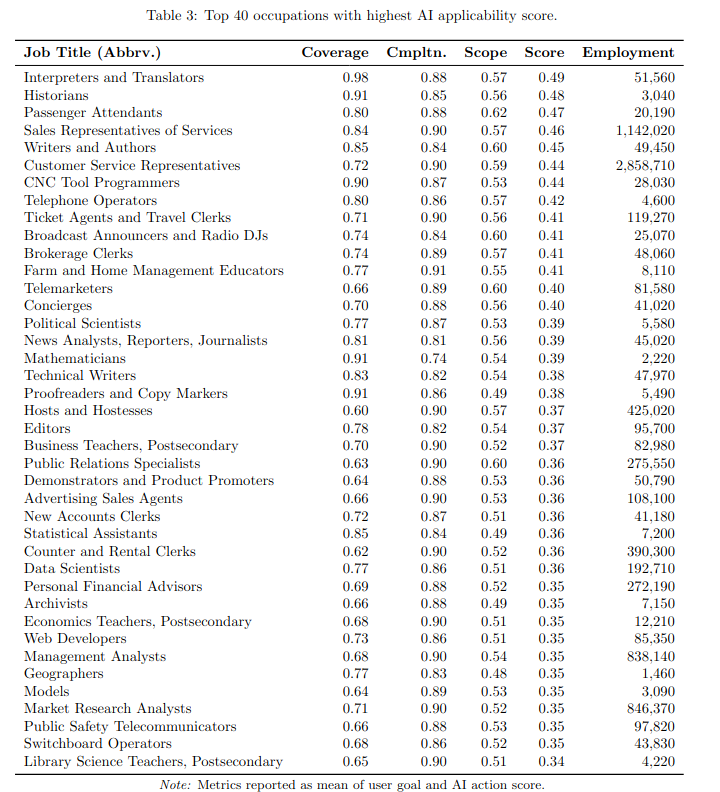
Meanwhile, Microsoft have recently produced a report into the occupational implications of generative AI and their top 40 vulnerable roles looks like this (look at where data scientist, mathematician and management analyst sit – all noticeably more replaceable by AI than model which caused all the headlines when Vogue did it last week):
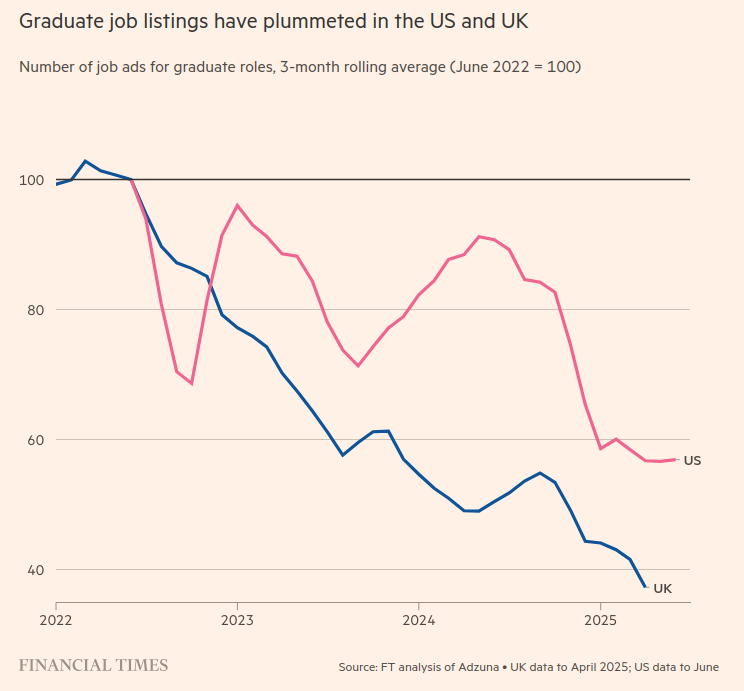
So this looks like a process well underway rather than a theoretical one for the future. But I want to imagine a few years ahead. Imagine that this process has continued to gut what we now regard as entry level jobs and that the warning of Dario Amodei, CEO of AI company Anthropic, that half of “administrative, managerial and tech jobs for people under 30” could be gone in 5 years, has come to pass. What then?
Well this is where it gets interesting (for some excellent speculative fiction about this, the short story Human Resources and novel Service Model by Adrian Tchaikovsky will certainly give you something to think about), because there will still be a much smaller number of jobs in these roles. They will be very competitive. Perhaps we will see FBI kind of recruitment processes becoming more common for the rarified few, probably administered by the increasingly capable systems I discuss below. They will be paid a lot more. However, as Cory Doctorow describes here, the misery of being the human in the loop for an AI system designed to produce output where errors are hard to spot and therefore to stop (Doctorow calls them, “reverse centaurs”, ie humans have become the horse part) includes being the ready made scapegoat (or “moral crumple zone” or “accountability sink“) for when they are inevitably used to overreach what they are programmed for and produce something terrible. The AI system is no longer working for you as some “second brain”. You are working for it, but no company is going to blame the very expensive AI system that they have invested in when there is a convenient and easily-replaceable (remember how hard these jobs will be to get) human candidate to take the fall. And it will be assumed that people will still do these jobs, reasoning that it is the only route to highly paid and more secure jobs later, or that they will be able to retire at 40, as the aspiring Masters of the Universe (the phrase coined by Tom Wolfe in The Bonfire of the Vanities) in the City of London have been telling themselves since the 1980s, only this time surrounded by robot valets no doubt.
But a model where all the gains go to people from one, older, generation at the expense of another, younger, generation depends on there being reasonable future prospects for that younger generation or some other means of coercing them.
In their book, The Future of the Professions, Daniel and Richard Susskind talk about the grand bargain. It is a form of contract, but, as they admit:
The grand bargain has never formally been reduced to writing and signed, its terms have never been unambiguously and exhaustively articulated, and noone has actually consented expressly to the full set of rights and obligations that it seems to lay down.
Atul Gawande memorably expressed the grand bargain for the medical profession (in Better) as follows:
The public has granted us extraordinary and exclusive dispensation to administer drugs to people, even to the point of unconsciousness, to cut them open, to do what would otherwise be considered assault, because we do so on their behalf – to save their lives and provide them comfort.
The Susskinds questioned (in 2015) whether this grand bargain could survive a future of “increasingly capable systems” and suggested a future when all 7 of the following models were in use:
The traditional model, ie the grand bargain as it works now. Human professionals providing their services face-to-face on a time-cost basis.
The networked experts model. Specialists work together via online networks. BetterDoctor would be an example of this.
The para-professional model. The para-professional has had less training than the traditional professional but is equipped by their training and support systems to deliver work independently within agreed limits. The medical profession’s battle with this model has recently given rise to the Leng Review.
The knowledge engineering model. A system is made available to users, including a database of specialist knowledge and the modelling of specialist expertise based on experience in a form that makes it accessible to users. Think tax return preparation software or medical self-diagnosis online tools.
The communities of experience model, eg Wikipedia.
The embedded knowledge model. Practical expertise built into systems or physical objects, eg intelligent buildings which have sensors and systems that test and regulate the internal environment of a building.
The machine-generated model. Here practical expertise is originated by machines rather than by people. This book was written in 2015 so the authors did not know about large language models then, but these would be an obvious example.
What all of these alternative models had in common of course was the potential to no longer need the future traditional model professional.
There is another contract which has never been written down: that between the young and the old in society. Companies are jumping the gun on how the grand bargain is likely to be re-framed and adopting systems before all of the evidence is in. As Doctorow said in March (ostensibly about Musk’s DOGE when it was in full firing mode):
AI can’t do your job, but an AI salesman (Elon Musk) can convince your boss (the USA) to fire you and replace you (a federal worker) with a chatbot that can’t do your job
What strikes me is that the boss in question is generally at least 55. As one consultancy has noted:
Notably, the youngest Baby Boomers turned 60 in 2024—the average age of senior leadership in the UK, particularly for non-executive directors. Executive board directors tend to be slightly younger, averaging around 55.
Assume there was some kind of written contract between young and old that gave the older generation the responsibility to be custodian of all of the benefits of living in a civilised society while they were in positions of power so that life was at least as good for the younger generation when they succeeded them.
Every time a Baby Boomer argues that the state pension age increases because “we” cannot afford it, he or she is arguing both for the worker who will then be paying for his or her pension to continue to do so and that they should accept a delay in when they will get their quid pro quo, with no risk that the changes will be applied to the Boomer as all changes are flagged many years in advance. That contract would clearly be in breach. Every Boomer graduate from more than 35 years ago who argues for the cost of student loans to increase when they never paid for theirs would break such a contract. Every Boomer homeowner who argues against any measure which might moderate the house price inflation which they benefit from in increased equity would break such a contract. And of course any such contract worth its name would require strenuous efforts to limit climate change.
And a Boomer who removes a graduate job to temporarily support their share price (so-called rightsizing) in favour of a necessarily not-yet-fully-tested (by which I mean more than testing the software but also all of the complicated network of relationships required to make any business operate successfully) system then the impact of that temporary inflation of the share price on executive bonuses is being valued much more highly than both the future of the business and of the generation that will be needed to run it.
This is not embracing the future so much as selling a futures contract before setting fire to the actual future. And that is not a contract so much as an abusive relationship between the generations.
I want to talk about The Future by Naomi Alderman. I read it last year, after wandering around the Hay Festival bookshop moaning that they don’t do science fiction and then coming across Naomi’s book and realising I had just missed her being interviewed. Then I watched the interview and bought both The Future and The Power (which I will talk about at some future date, but which is equally terrific).
The book is about Lenk Sketlish, CEO of the Fantail social network, Zimri Nommik, CEO of the logistics and purchasing giant Anvil, Ellen Bywater, CEO of Medlar Technologies, the world’ most profitable personal computing company, and the people working for them, and the people linked with those people. Zimri, Ellen and Lenk are at least as monstrous as Jeff, Sundar, Elon, Tim and Mark. And they are all preparing for the end of the world.
(If you need to remind yourself what Elon, Jeff, Mark and Sundar all look like milling around, below is a link to Trump’s inauguration:
Anvil is set up with alerts for signs of the end of the world being reported anywhere: giant hailstones, plague of locusts, Mpox, rain of blood which turned out to be a protest for menstrual equity involving blood-soaked tampons being thrown at Lenk and co as they emerged from a courthouse in Washington. The information Zimri, Ellen and Lenk have on everybody else in the world makes them feel all seeing, all hearing, all knowing. Combined with riches unknown to anyone before in history it makes them feel invulnerable, even to the end of the world, even to each other. Which turns out, of course, to be their decisive vulnerability.
It takes in survivalism, religious cults and wraps it all up in a thriller plot which is absolutely the kind of science fiction you want to be reading now instead of listening out for the latest antics of the horse in the hospital. And it was all written over a year before Elon even started with DOGE. The Future by Naomi Alderman is a fantastic read, particularly if you would like to see someone like Musk get an appropriate end to his story. I obviously won’t spoil it by saying what that is, but I don’t think I would be giving anything away by saying rockets are involved!
Came across this on YouTube today and it was such a brilliant discussion in the same area as my post from yesterday (which went out before I had seen this), but which went much further in a number of really interesting directions, that I thought many of you would be interested. Look out for a mention early in the video for the late great Iain Banks, science fiction fans!
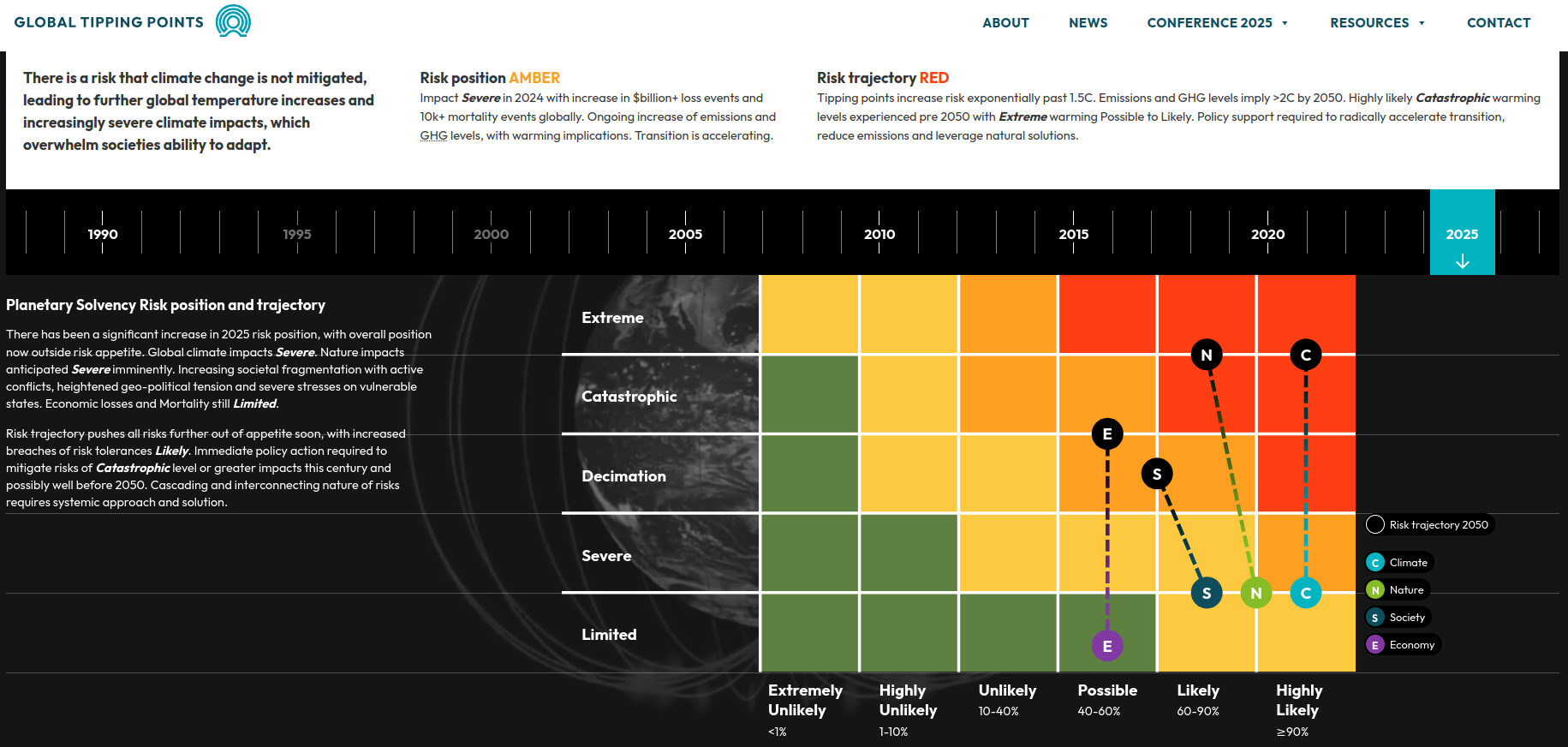
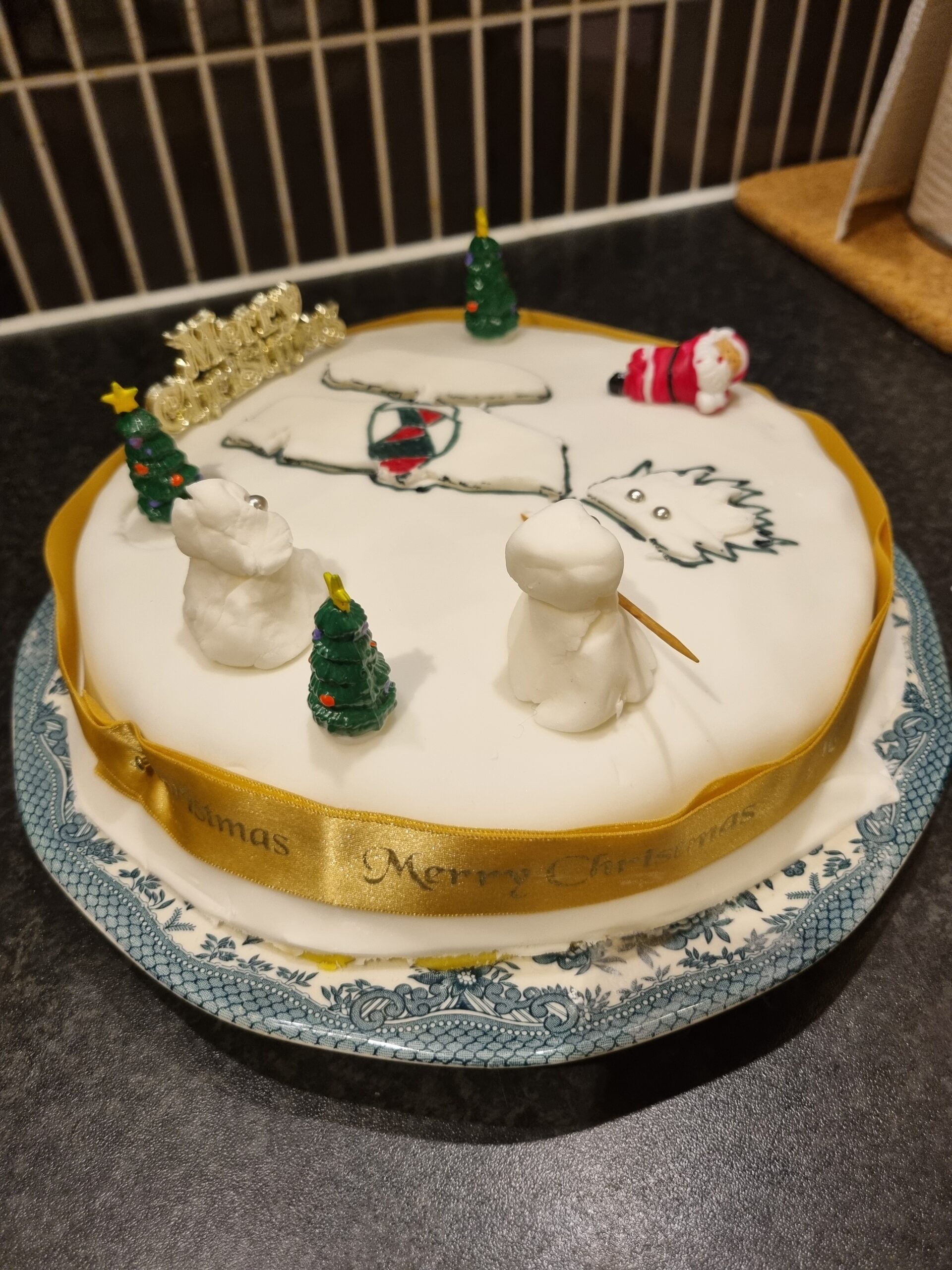
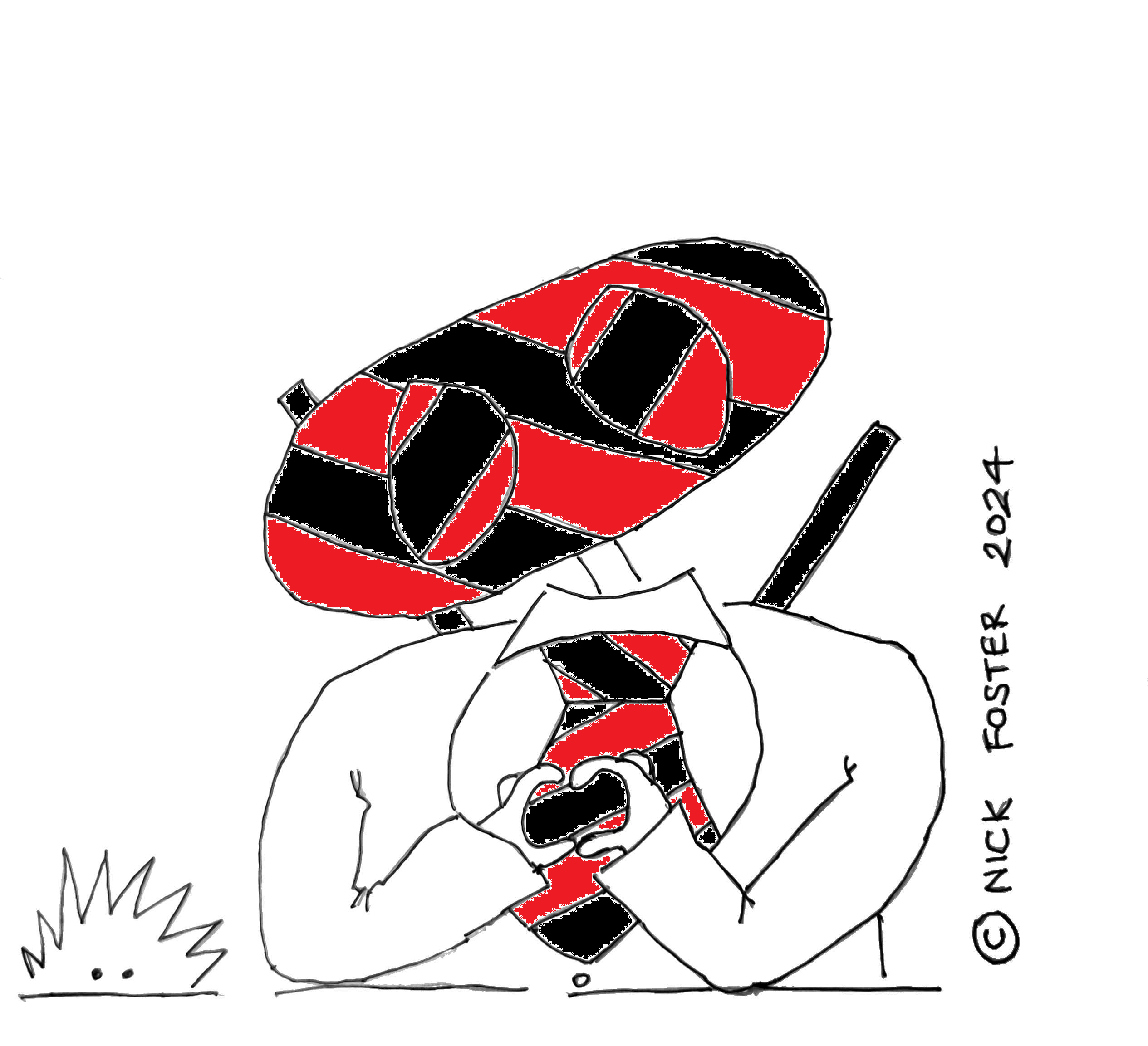
Happy new year to everyone who reads this blog! I am planning for there to be quite a lot more activity here in 2025, moving from an average of one article a month to at least weekly. There should be more cartoons too – Pinhead and Spikes even made it to our Christmas cake this year.
There is a lot I want to write about this year. Expect some or all of the following themes in the next few months (in no particular order):
Some examples using Steve Keen’s Ravel software to demonstrate how Government debt is not the constraint they think it is.
Extending Naomi Alderman’s argument in The Future that we could get rid of the Tech Bros and not miss them, effectively upending Ayn Rand’s ideas in Atlas Shrugged. They are not key workers.
Keynes’ argument that, with the future so uncertain, we should not sacrifice people in the present to our models of it.
Spiegelhalter on the four types of luck, which cuts away at the meritocracy argument for distributing wealth.
How the professions have become a way of solidifying and enabling the massively uneven distribution we see. Have they outgrown their usefulness in their current form, just like the guilds did?
How the choice for providing public goods appears to boil down to public ownership or private monopoly – with accompanying Technofeudalism replacing capitalism. Why are we so much more relaxed about private monopolies than we were 100 years ago, when it accelerates inequalities so much?
The relationship between worldbuilding in science fiction and people living in their own models in the policy making world. Great example of this just this morning in the FT.
So plenty to do. If this sounds interesting to you, please stick with the blog, which will not be going to Substack and will not be charging a subscription. If it sounds really interesting to you, tell a friend! Will be in touch again soon.
Imagine a super-hero who could not be killed. No I don’t mean Deadpool. A more apt name for our super-hero would be Deadmeat. Deadmeat is empirically dead, but, rather like the Monty Python parrot, is being energetically kept alive by the pretence of its continued existence amongst all of those around it. So much so that it becomes impolite to expose the pretence and point out that Deadmeat is in fact dead. If you really push, and someone likes you enough to want to give you an explanation, you will have a hand put on your shoulder and be led away to a corner to have the pretence explained to you. What that explanation turns out to be is something like this. Deadmeat is of course the Paris climate agreement from 2015 which committed 193 countries plus the EU to “pursue efforts” to limit global temperature rises to 1.5C, and to keep them “well below” 2.0C above those recorded in pre-industrial times.
Deadmeat, it turns out, wasn’t shot. Deadmeat was overshot. Under overshoot, we bring the terrible thing back under control after it has done the damage and hope we can fix the damage at a later date. It’s a bit like the belief in cryopreservation or uploading our brains into cyberspace in the hope that we can have our bodies fixed with future medicine or be provided with artificial bodies. It means relying on science fiction to save us.
Andreas Malm and Wim Carton have considered this approach and how we got here in their latest book Overshoot. For me there are two big ideas in this book, although the account of how things definitively got away from us immediately post pandemic and exactly how that played out is mesmerising too. I thoroughly recommend a read.
The first big idea is the problem with the justification for overshoot in the first place, which is that at some point in the future we will be so much richer and more technologically advanced that it will be much easier to bring carbon dioxide levels down to sustainable levels than to try and stay within sustainable levels now. In what they call “The Contradiction of the Last Moment” Malm and Carton show how an intense fresh round of fossil fuel investment is almost certain to occur close to a temperature deadline (ie fossil fuel companies rushing to build more infrastructure while it is still allowed), whether it is 1.5 or 2 degrees or something higher. Then, as they put it “the interest in missing it will be overwhelmingly strong”. If an investment is 40 or 50 years old, then it might not be so disastrous to have it retired, but if a fossil fuel company has invested billions in the last few years in it? They will fight tooth and nail to keep it open and producing. And by prolonging the time until the retirement of fossil fuel infrastructure, the capital which has used the time to entrench its position and now owns a thousand new plants rather than a few hundred will be in a much stronger position to dictate policy. The longer we leave it, they argue, the harder it will become to retire fossil fuels, not easier.
The second big idea explains why, despite the enormous price collapse of solar power in particular, there is no Big Solar to compete with Big Oil. As they put it “there was no Microsoft or Apple or Facebook. More broadly, there was no Boulton & Watt of the flow, no Edison Machine Works, no Ford factories, no ascendant clusters of capital accumulation riding this wave.” The only remotely comparable company would be Tesla, but they produced cars. Why is this?
Malm and Carton talk about “the scissor”, the difference between the stock of the fossil fuel industry and the flow of renewable power. Fossil fuel’s “highly rivalrous goods: the consumption of one barrel of oil or one wagon-load of coal means that no one can ever consume it again. Every piece of fossil fuel burns once and once only. But supplies of sunlight and wind are in no way affected by any one consumer’s use.”
And this is the key I think. What economists call “public goods”, goods which are non-rivalrous (ie your use of the sun’s energy does not stop somebody else’s unless you put them in the shade) and non-excludable (ie you cannot easily stop someone else from using it, in this case by sticking a solar panel on their roof), are very difficult if not impossible to make a profit from. Private markets will therefore not provide these goods, possibly at all without extremely artificial regulation (something we have probably had enough of with our utilities in the UK) and certainly not in the quantity that will be required.
In Postcapitalism, Paul Mason discussed the options when the price mechanism disappears and additional units of output cannot be charged for. As he put it:
Technologically, we are headed for zero-price goods, unmeasurable work, an exponential takeoff in productivity and the extensive automation of physical processes. Socially, we are trapped in a world of monopolies, inefficiency, the ruins of a finance-dominated free market and a proliferation of “bullshit jobs”.
This also ties in with my own experience and others I have spoken to over the years about how hard it is to invest outside of fossil fuels and make a return.
Therefore if the private sector will not provide public goods and renewable power is predominantly a public good, then it follows that renewable power needs to be in public ownership. And if the climate crisis requires all power to be renewable and zero carbon, which it does, then it also follows that the entire power sector ultimately needs to be in public ownership too.
And then the motivation for overshoot becomes clear and how high the stakes are: not just the proceeds of the sale from one dead parrot as it turns out, but the future of private power generation. My fear is that the Deadmeat franchise may end up having as many sequels as Godzilla (38 and counting). With the potential to do rather more damage in the process.
Election day is approaching. It has been a bruising 5 years and the Labour Party’s landslide-super-majority seems like a distant memory. The Conservative Party was not quite wiped out in the end: less than 100 seats but still His Majesty’s Opposition. The Labour Government had well over 400 seats. Once all the levels of government jobs had been allocated: 95 ministers and whips, 41 parliamentary private secretaries, various party roles such as chairman, deputies, etc and perhaps a few trade envoys, and other roles had been occupied like select committee positions, there were considerably in excess of 200 MPs over who the Government had rather less leverage. In the case of the 60 or so MPs seen as left wing, the leverage was close to non-existent after 5 years of vilification of the Corbyn era and all who sailed with her. There had therefore been a great deal of scope for mischief to be made, and mischief duly followed.
This did not concern the new Government too much. It made it clear to all that they were very different to the Corbyn-led party, a point that they had been almost obsessive about (even likening the Conservatives to Corbyn in terms of uncosted commitments) in the 2024 election campaign. The left wingers were not particularly well coordinated in any case, and still felt considerably more loyalty to the Labour Government, however much they disagreed on policy, than the Government felt towards them. In the absence of an issue which unified MPs more widely, the potential damage was limited.
But then a party which had always been a party of protest suddenly found itself with a seat. In fact the Reform Party had 6 seats and very loud seats they turned out to be. However most of their manifesto or “contract” with the electorate was not shared with any of the other parties. The one exception to this – a manifesto position shared to some extent by the Liberal Democrats, the SNP, the Green Party and Plaid Cymru – was a more proportional voting system to replace first past the post (FPTP). This only amounted to 100 votes in total of course, but it was a start.
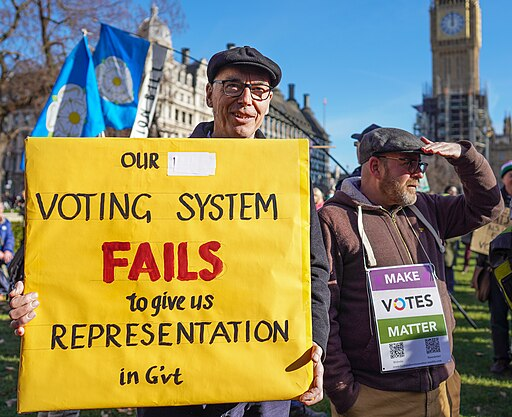
The Taking Back Our Seats campaign launched in September 2024. Its main argument was that a large number of the seats in parliament had not been granted by the votes cast. Labour had won 40% of the votes, which should entitle them to 252 seats but had instead landed them 435. The SNP had also done well out of FPTP. However the Conservatives, with half the Labour vote, should have expected 126 seats but got less than 100. The Liberal Democrats could also claim they were due 12 more seats. And the Green Party and Reform were the most hard done by: the Greens should have won 57 seats but gained only 4 and Reform’s 6 noisy seats should have been a cacophonous 101.
But even with all of the opposition parties on board, and a steadily increasing majority in the country in favour of changing the voting system as the campaign developed, they still had less than half of the Labour vote in parliament. Before the 2024 election, around half of Labour MPs were in support of Proportional Representation (PR), but their now dominant parliamentary position had caused many of those to reconsider, as well as bringing in a lot of new faces who owed their seats to the unfairness of the current system. About two thirds of Labour supporters were thought to be in favour of PR, which might become more relevant should the super-majority itself suddenly come under threat.
Which it duly did. The early signs were there: talks with the junior doctors, which many had expected Labour to be able to settle quickly and for less than 35%, collapsed and a new wave of strikes were announced. Any lingering thoughts of a honeymoon period ended abruptly in 2025. The summer was a shocker, a late heatwave in August led to hundreds of excess deaths and widespread riots in the most overcrowded prisons in the system in Durham, Leeds, Preston, Wandsworth, Bedford and Lincoln. And then, towards the end of September, just as the nation’s children were setting off to campus, the first universities declared themselves bankrupt.
Coventry and Sheffield Hallam had been in very public difficulties for some time, but it soon became clear how much they had been relying on a very different funding deal from the incoming Labour Government. Different from the Conservatives of course but also from the statements made by the shadow cabinet in the 2024 election campaign. It had taken 12 months for the reality that the Labour Government meant what they had said in the election campaign to come into contact with the universities’ financial plans, but now there was nowhere else to go. Courses were closed and put on teach out mode, almost entirely online. Students expecting to take up places were suddenly back on a hastily organised late emergency clearing programme, with all those who could defer by a year advised to do so.
Bristol, Bournemouth, Southampton, Somerset, Dover, Havering, North Northamptonshire, Cheshire East and Bradford councils all issued section 114 notices in quick succession. There was talk of a large number of other councils not far behind them.
The election polling towards the end of 2025 indicated the fastest and biggest swing in polling history. 40% was now a distant memory as the level of support sank below 30%. The very real danger that the super-majority might be a one term phenomenon was being actively discussed in all the bars and tea rooms of Westminster. The question on everyone’s lips in government was whether something big and popular could be done quickly which might also put some kind of safety net under the Labour seat count. And Taking Back Our Seats suddenly started to make sense to more and more Labour MPs. It might not save all their seats, but the threat that the leverage which had worked on their increasing popular vote so powerfully in 2024 could be turned just as effectively against them in 2029 was being taken increasingly seriously.
A referendum was proposed for the following year. Taking Back Our Seats avoided the trap the 2011 referendum had fallen into when they advocated the Alternative Vote (AV) system as the alternative to FPTP. This had kept the single MP per constituency of FPTP which sitting MPs always claimed was so important to voters, but had been susceptible to charges that it was not really PR at all. AV, or instant-run off voting as it is sometimes called, involves voters ranking the candidates rather than just voting for one. The candidate with the fewest “1” rankings is eliminated and all its “1” rankings are then reallocated to the “2” rankings of those who ranked the eliminated candidate 1st. And so on until one candidate is left.
Taking Back Our Seats instead backed the single transferable vote (STP), which also lets voters rank candidates. However instead of organising constituencies around single candidates, they are clustered (into clusters of 3 to 6 seats). First choices are reallocated if those choices are eliminated as for the AV system, but also if candidates have more votes than they need to get elected. This means that each vote has broadly the same value and results in much more proportionality in outcomes. This compares with the current system at the 2019 election where, according to the Electoral Reform Society, 865,697 votes were required to elect each Green MP, while only 38,264 were needed for each Conservative MP. STV is the preferred voting system of the Electoral Reform Society and is used in the Australian Senate, Ireland and Malta.
The result was an almost exact reversal of the 2011 vote – 70% voted in favour of STV for the next general election and the enabling legislation was passed the following year.
The impact on the party system in Westminster even before the new voting system was used was interesting. Many of the disaffected Labour left group announced that they would not be standing as Labour candidates at the next election, and subsequently a new Socialist Labour Party emerged which attracted many of them, as well as Jeremy Corbyn, who had stood successfully in 2024 as an Independent. Others gravitated towards the Greens. The Conservatives, whose vote was still struggling to overtake Labour despite the many reverses of the last 5 years, were less prone to splits amongst their 100 remaining MPs, but a handful joined Reform and there was a smaller number of transfers between the Labour, Conservative and Liberal Democrat Parties as their positions had moved further apart at the prospect of a STV election.
And now here we are. On the brink of what feels like a big change. Everyone is a little nervous about where we are going with this, but there is also a certain amount of exhilaration in the air. We are all half expecting the politicians to find a way to turn this experiment against us, but also the thought that we will finally have a Parliament which properly represents us is a little bit intoxicating. Still lots of work to do on all the problems we have of course, but perhaps we now have the right tool to start that work.
We shall see…
For more information on the different voting systems mentioned in this little fable, I recommend Lessons Not Learnt, published by the Electoral Reform Society in January 2024.
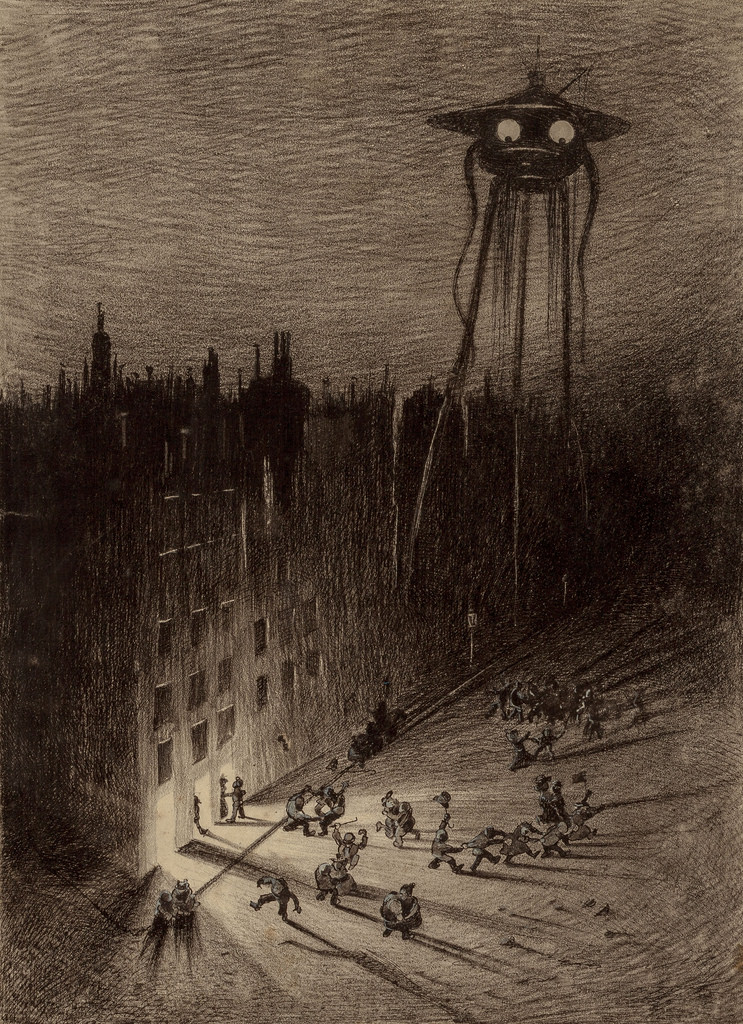
Source: One of Henrique Alvim Corrêa’s 1906 illustrations of War of the Worlds. HG Wells himself approved of these incredible drawings, praising them before their publication and saying, “Alvim Corrêa did more for my work with his brush than I with my pen.”
“We are living inside the imagination of our ancestors” said Gaia Vince in an article earlier this year. I was reminded of this more recently when Sandy Trust said something very similar in his excellent presentation on climate scenarios ahead of the publication of the The Emperor’s New Climate Scenarios, which highlights how most climate-change scenario modelling in financial services excludes the possibility of tipping points and secondary impacts of climate change, thereby substantially underplaying the risk of us ending up with a hothouse earth scenario.
So I decided to remind myself of the imagination of one of our more imaginative ancestors and read The War of the Worlds. Despite having recently watched both the 2005 Spielberg/Tom Cruise film and the BBC adaptation, I found the content of the book quite surprising – much more focused on how the society of 1895 dealt with the Martians than the aliens themselves.
Wells delights in revealing the imagined human response at each stage. From concern about Martians trapped in their spacecraft in a pit near Woking, to sending a deputation to negotiate with it, to satisfying ourselves that they cannot escape their landing crater after their “Heat-Ray” has massacred 40 people surrounding it. As he puts it:
So some respectable dodo in the Mauritius might have lorded it in his nest, and discussed the arrival of that shipful of pitiless sailors in want of animal food. “We will peck them to death tomorrow, my dear.”
That was on the Friday. By Saturday night there was still more interest in the breakdown of a train between Byfleet and Woking junction than in whether this had anything to do with Martians. The lack of response continues:
I have read, in another account of these events, that on Sunday morning “all London was electrified by the news from Woking”. As a matter of fact, there was nothing to justify that very extravagant phrase. Plenty of Londoners did not hear of the Martians until the panic of Monday morning. Those who did took some time to realize all that the hastily worded telegrams in the Sunday papers conveyed. The majority of people in London do not read Sunday papers.
Wells has a theory:
The habit of personal security, moreover, is so deeply fixed in the Londoner’s mind, and startling intelligence so much a matter of course in the papers, that they could read without any personal tremors: “About seven o’clock last night the Martians came out of the cylinder, and, moving about under an armour of metallic shields, have completely wrecked Woking station with the adjacent houses, and massacred an entire battalion of the Cardigan Regiment. No details are known. Maxims have been absolutely useless against their armour; the field-guns have been disabled by them. Flying hussars have been galloping into Chertsey. The Martians appear to be moving slowly towards Chertsey or Windsor. Great anxiety prevails in West Surrey, and earthworks are being thrown up to check the advance London-ward.”
By Monday morning London is being evacuated in the wake of death and destruction. Wells could not sound more contemporary if he were to give his views about Lockdown or responses to the climate emergency. And we can look at these Londoners from nearly 130 years ago and see ourselves, busily discounting the far greater saturation of 24 hour television news, radio and social media and reading, watching and listening to the dire warnings of our own time “without any personal tremors”.
But if our children are going to be living inside our imagination, then what are we offering them? Ursula K Le Guin, in a talk originally called “Where Do You Get Your Ideas From?” and then changed to “The Question I Get Asked Most Often”, said this:
“The imagination can transfigure the dark matter of life. And in many personal essays and autobiographies, that’s what I begin to miss, to crave: transfiguration. To recognise our shared, familiar misery is not enough. I want to recognize something I never saw before. I want the vision to leap out at me, terrible and blazing – the fire of the transfiguring imagination. I want the true dragons.”
And that transfiguration of our experience, to embrace things we never saw before but can imagine, must happen in our stories initially. But if the stories are good enough they can then spread – to our homes, our workplaces, other places we meet our friends and people who aren’t our friends, to our politics, our economics, our society.
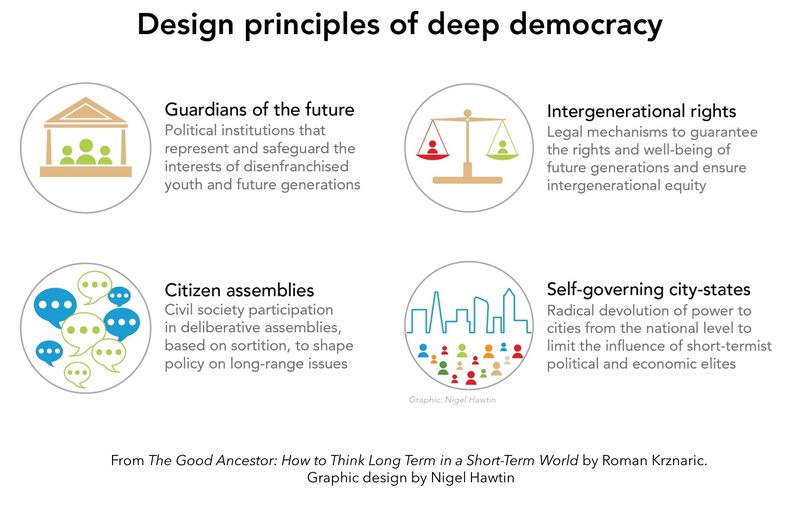
Roman Kznaric’s asks in his book, The Good Ancestor, whether there is an antidote to political myopia. His response is that there is and it lies in attempting to establish what he calls “deep democracy”.
In 2009, The Observer newspaper reported that a letter had been sent to the Queen after she demanded, during a visit to the London School of Economics in November 2008, to know why nobody had anticipated the credit crunch. There was one particularly telling sentence which was picked up widely at the time:
In summary, your majesty, the failure to foresee the timing, extent and severity of the crisis and to head it off, while it had many causes, was principally a failure of the collective imagination of many bright people, both in this country and internationally, to understand the risks to the system as a whole.
To force our children to live inside our current imagination is to force them to live in a world stunted by the ever increasing influence and share of our head space which can be bought by the ever shrinking group of people we allocate our wealth to. But somewhere between the transfiguring imagination Le Guin talks about and the practical proposals of Kznaric and others, it seems to me that there is the first draft of an imagination which our children could live inside.
The year is 2100. Earth is approaching a peak population of 9.5 billion people. Despite some notable progress in decarbonising our activities and more progress on carbon capture of various types than expected 80 years ago, overall we have not managed to shift much off the Intergovernmental Panel on Climate Change (IPCC) middle-of-the-road shared socioeconomic pathway (SSP2). Some countries have done much better than others, with income inequality a problem both within and between them. Carbon emissions stayed fairly level until 2050 before starting to fall, but net zero has still not been achieved.1
Temperatures have risen by 2.7 degrees compared to pre-industrial levels. Africa has split between a north which has seen a recovery of rainfall and a south which is no longer habitable for humans. The Indian monsoon rains have failed. The Himalayan glaciers providing the waters of the Indus, Ganges and Brahmaputra, the Mekong, Yangtze and Yellow rivers have reduced by 90% from their pre-industrial levels.
The Amazonian rain forest basin has dried out completely. In Brazil, Venezuela, Columbia, East Peru and Bolivia life has become increasingly difficult due to wild fires. Drought is now permanent in the sub-tropics and Central America. Australia has become the world’s driest nation.
In the US Gulf of Mexico high sea temperatures drive 180+ mph winds.2 Flooding is widespread with sea levels having risen by 0.6 metres on average compared to 2020.3 Many plant species have become extinct as they were unable to adapt to such a sudden change in climate.
Food prices continue to soar, with temperatures, droughts and the inundation of arable land adversely affecting many crops. Massive migrations have led to increasingly severe military and police responses from the most popular destination countries. There is fear that we have not yet seen the end of the terrible costs of climate change, with temperatures continuing to rise.
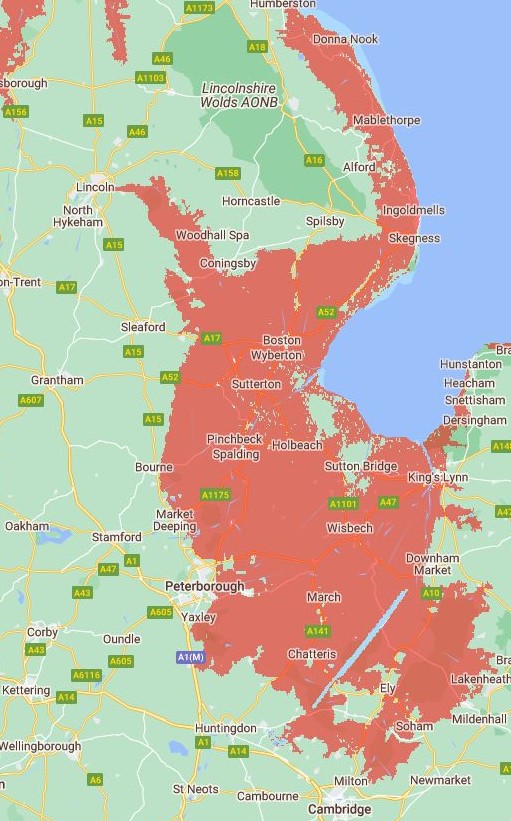
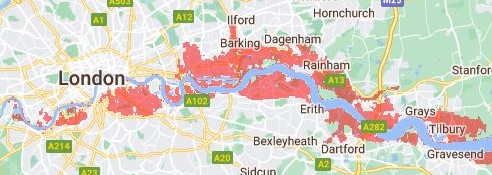
England has a new Eastern coastline, which became a certainty once the decision was taken that the cost benefit analysis did not justify the expense on the massive coastal defences which would have been required to prevent it. Sleaford is now a seaside town. Birmingham is the only major city which has not been significantly affected by sea level rise4 and there are calls for the capital to be moved there. However London hangs grimly on following the failure of the Thames Barrier in the 2040s. An Intertidal Property Pricing Index (IPPI) has sprung up, which sucks in money as investors bet on the development opportunities in the aftermath of the catastrophe.5
This, or something like it, is the future we are currently on track for but none of us wants. So let’s change the trajectory.
Notes:
The IPCC’s SSP2 narrative description.
Mark Lynas, Six Degrees: Our Future On A Hotter Planet, Harper Perennial, 2008 for the scientific consensus at the time on the consequences of 3 degrees warming
https://sealevel.nasa.gov/ipcc-ar6-sea-level-projection-tool?type=global (accessed 5 July 2023)
https://coastal.climatecentral.org/ (accessed 5 July 2023) for the maps of England following 2.7 degrees warming by 2100 following current trajectories
IPPI borrowed from Kim Stanley Robinson’s depiction of a future New York after two pulses totalling 15 metres (50 feet) of sea level rise in New York 2140, Orbit, 2018