Whatever you think about the risk of extremism being incubated in Birmingham schools or the political battles going on at the top of the Conservative Party, the contrast between the two Ofsted reports into Park View is startling to say the least. Just look at the key findings from the report issued today and compare them with comments from the 2012 report:

Park view Ofsteds

Are these really the same schools? The only summary findings which do not have a direct and emphatic rebuttal from the report two years earlier are those from a section of the current staff who appear to be concerned about leadership, feel the governors are involved inappropriately, and complain about unfair recruitment practices and feeling intimidated against speaking out. So are these courageous whistle-blowers, who were still summoning up that courage two years ago, or merely resentful staff?

What has changed? The new report refers to “considerable staff changes since the academy opened almost two years ago”. It then continues as follows:

The substantive principal, who was appointed in Spring 2012, is currently seconded to Golden Hillock School as acting principal. A Park View vice principal is currently the acting principal. The former academy principal is now the executive principal of the trust, she is due to retire at the end of the Spring Term 2014. She is being replaced by the substantive principal of Park View, who will continue in this capacity in addition to the post of executive principal of the trust. Other leaders have transferred to, or work part of their time in, the other two trust academy schools. A new vice principal and a new assistant principal have been appointed to start in April 2014.

One thing that has definitely changed is that in 2012 the school, Park View Business and Enterprise School as it was then, was a school. It then converted to academy status in April 2012, Park View School Academy of Mathematics and Science, the trust being managed by Park View Educational Trust, which then expanded into a multi-academy trust that includes Nansen Primary School and Golden Hillock School. All three have now been put into special measures.

So is it the academy programme which is the problem here rather than anything to do with extremism? A school subject to special measures can be subjected to further Ofsted inspections at very short-notice (although now we hear that no-notice inspections for all schools are being considered) to monitor its improvement. The senior managers and teaching staff can be dismissed and the school governors replaced by an appointed executive committee. This sounds very much like Park View’s recent history. It is unclear what benefit more short-notice inspections are likely to have, when their findings can differ as radically as this.

It seems fairly clear that something has gone wrong in the governance of these schools during the process of moving to a multi-academy trust, and that at least some of the school community feel that they have not had their views properly taken into account during that process. Raising the bogey of hardline Muslim extremism stalking the city’s schools, as Michael Wilshaw has done today, does not help anybody tackle this.

What also seems fairly clear is that the Ofsted inspection regime is considerably less objective than it would have us believe. Whatever changes may have occurred at this school over a two year period, at least some of the vertiginous decline from outstanding with no concerns to inadequate with few redeeming features (they came up with three in their summary) can ultimately only be explained by the last team liking the school and the new team (admittedly working in a very different climate) disliking the school. Those “likes” and “dislikes” appear to be what passes for a regulatory framework for the education of our young people. It is not nearly good enough.


A recent piece of research into how the way people spend their money changes as they age got me thinking about how age might currently influence a particular household’s own Consumer Price Inflation (CPI).

The Office of National Statistics (ONS) produces a monthly inflation report for each major sector of expenditure, alongside the updates for CPI. The latest of these, out yesterday, showed CPI falling to 1.6%, finally less than wage inflation in the UK. However CPI is based on an average basket of goods to determine how people’s cost of living is increasing and this of course differs from person to person. In particular, the spending habits of the population, when split by the age of the household reference person (the ONS term for what used to be known as the “head of household”, when it was always the man of the house even when that house was owned by the woman: this was changed in the 90s), differ markedly.

CPI by age

The graph is based on the latest splits available of spending by the 12 categories used by the ONS to determine CPI (these are from 2012, although the overall averages these figures provide give CPI figures of 0.1% or less different from the actual figures so I think they will do for illustrative purposes).

What we can see straight away is that the gap between CPI for under 30 year old households and the 65-74 year old households has shrunk from around 0.8% pa to around 0.5% pa. However, under 30 year olds are still experiencing consistently higher inflation than the rest of the population. In fact this section of the working population are still experiencing inflation well in excess of the average wage inflation of 1.7% announced today.

The big winners since July have been the 30-44 year olds, with their households down to 1.5% pa inflation from 2.7% pa at the start of the period. And if your head of household is between 50 and 74 you are now experiencing average inflation year on year of only 1.4% pa.

The people who have not won quite so much (other than the under 30s) have been the over 75s, with their households at 2.6% pa at the start of the period and at 1.6% pa (ie bang on the average) at the end. Interestingly, the under 30s and over 75s have an average inflation above the headline rate, and everyone in between is coming in below it.

Why the differences? Well the change in the inflation rate has varied hugely amongst the 12 categories of spending.

CPI constituents

Food and non-alcoholic drink inflation has fallen from 3.9% to 1.7%, Clothing and footwear from 2.5% to 0.2% and Transport from 1.5% to -1.0%, so any sector with spending habits weighted towards these areas is going to have done better than average. The 30-64 year old households spend between 5.9% and 6.1% on Clothing and between 15.9% and 16.7% on Transport compared to the averages of 5.6% and 15.2% respectively. However the over 75s spend 18.8% of their income on Housing, fuel and power, which has seen inflation remain stubbornly high at 3.1% pa, and have higher than average spending on Health (4.6% against 1.5% average) and Household goods and services (8.3% against 6.8% average), both of which saw an increase in inflation over the period. Education appears to be in a world of its own, with inflation falling from 19.7% at the start of the period to 10.3% at the end. Perhaps fortunately for those placing a lot of faith in the headline rate, Education does not account for more than 3% of spending in any group (it’s 3% for the under 30s) and only 1.6% overall.

So, as always, the picture is more complicated than the headline rate. And, when it comes to inflation, age matters.

DA optionsThe Defined Ambition consultation ended on 19 December but the lobbying has continued. Camps have now formed around the various options.

Steve Webb, the Pensions Minister, and Alan Rubinstein, Chief Executive of the Pension Protection Fund, have been enthusiastic supporters of something called the pension income builder, which increases the guaranteed pension accrued each year with part of the annual contribution, with the remaining contributions invested in a collective defined contribution (DC) arrangement.

The Collective DC more generally, where returns are smoothed between members in an attempt to reduce the volatility of returns on individual DC, has also had some very vocal proponents. Considering it was originally ruled out as an option by the Department of Work and Pensions (DWP), has had 10 objections to it raised by the Association of British Insurers (ABI) and has been accused of not reducing risk so much as moving it around between members by Lord Hutton, this is a little bit of a surprise.

Lord Hutton, former Secretary of State for Work and Pensions and chair of the Commission on Public Service Pensions Commission, is dismissive of the whole defined ambition idea. Recently he said that the Government should stop “banging on” about defined ambition and let the pensions industry focus on applying defined benefit (DB) investment strategies to DC schemes. He is a particular fan of the Liability Driven Investment (LDI) approach, common in DB schemes protecting their funding position, being applied more consistently to DC. Hutton has recently joined Redington, an investment consultancy, so I imagine we can expect to hear a lot more from him on this subject.

Much has been made of the Dutch system, which has a “second pillar” of large industry-wide pension schemes. This has suffered from the same economic pressures which have dogged the UK system since the turn of the century, but has arguably retreated from straight final salary benefits – first to career average retirement earnings (CARE), then to risk sharing via variable contributions for employers balanced by variable benefits for employees, and currently renegotiating again  in the wake of the 2008 crash – in a more orderly manner. I tend to feel that the main reason the Dutch system is better than ours is the same reason that their flood defence system is better: they put a lot more money into it. Nine times as much in the case of flood defences, and contributions into their second pillar average 20% of salary compared to the current average into DC schemes in the UK of under 8%. They also make you buy an annuity, make you join and don’t let you opt out. Despite this it remains remarkably popular with the public.

As you can see, there are a lot of acronyms flying around, and relatively little discussion with the people who these schemes are likely to end up getting foisted on. The Association of Consulting Actuaries (ACA) carried out a survey of smaller firms which revealed that what they wanted was:

  • Members to receive more from their savings;
  • Increased transparency and trust in the companies who provided pensions;
  • No collective schemes; and
  • More tax concessions.

This last point is unlikely to be conceded, with the Institute of Fiscal Studies joining the increasing clamour this week to limit the generous tax exemptions to employers and members with occupational pension arrangements.

But has anyone asked members of pension schemes? Very few, as far as I can see. The most notable being the Pension Regulator’s survey of DC pension members in 2012. When those still actively contributing to these schemes were asked which of a long list of things would encourage them to take more interest in their pension, the three things they wanted overwhelmingly most of all were:

  • Someone making clear to them how much they needed to save;
  • Being able to talk to someone to understand their pensions better; and
  • Clear communication from their employer and their pension provider.

Notice how concerns about guaranteed benefits did not feature here. When asked, 85% had some understanding that their pension income was not guaranteed, and even more (94%) had an understanding that contribution levels were a key factor in determining that income. While 78% thought their company or personal pension would be one of their main sources of income in retirement (the next highest was the state pension with 22%), only 24% were confident that their current level of contributions was going to provide an adequate income. So they know they have a problem.

What they are asking for is a step change in financial education so that they can begin to tackle that problem. So could it be that all of the groups we have heard from above are trying to solve the wrong thing entirely?

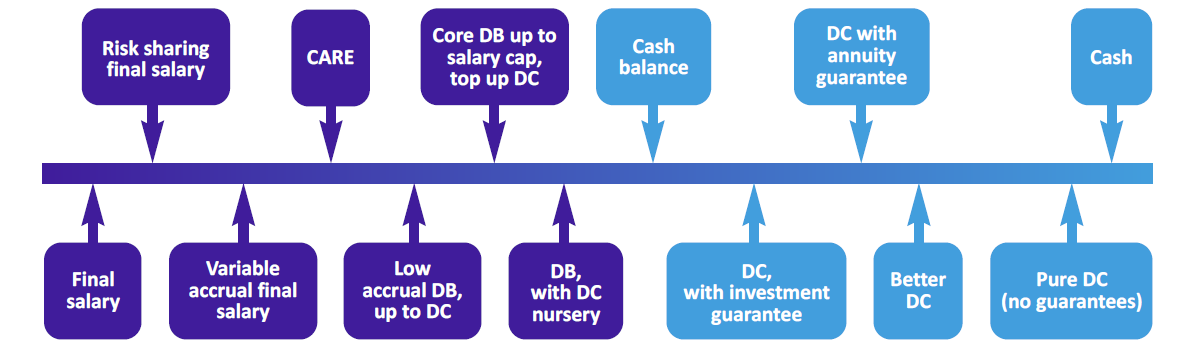
As far as the regulatory environment is concerned, I think the document Defining Ambition produced by the National Association of Pension Funds (NAPF) before the consultation probably summarised the situation best. Joanne Segars stopped short of supporting any particular solution and instead laid out some of the main options and where they sat on the scale of risk (which I have reproduced above) to the member.

Segars suggested that we shouldn’t “sweat the small stuff”, and should instead concentrate on providing a flexible continuum of regulation to cover the whole scale of risk, otherwise any new approaches would be snuffed out by HMRC’s and TPR’s lack of flexibility and overly complex approach before they even got going, much as cash balance schemes have been over the last 20 years. I felt that this was just fence-sitting at the time, but have since realised that she was right. We have all been “banging on” for too long about things about which prospective members simply don’t care.

Assuming a relaxation of the regulations which doesn’t yet exist, we actuaries have piled enthusiastically into debating slight differences between our different pet schemes, standing toe to toe and swapping model results like punches, while seemingly forgetting all about the member.

Suddenly the most important contribution in Defining Ambitions seems clear to me: that of Morrisons’ HR Director about how they introduced a three year financial education and advice programme (called Save Your Dough) throughout their workforce ahead of their auto-enrolment date. They realised that they needed to help their employees understand their finances first before they would understand that they could make a difference to their long-term finances by saving into a pension. They involved Alvin Hall to add some celebrity glitter to the process, but also involved their main union USDAW. And they used a lot of different communication tools, from booklets to podcasts to online modellers to short films and video diaries in addition to the more traditional information sources and face to face sessions. They trusted that they had good people who would make reasonable decisions given sufficient accessible information.

I am sure there are other examples of such good practice out there, but we have not encouraged them with our endless debates about DC plus v CDC v DB minus and everything in between. The small stuff has been sweated quite enough. Let’s help firms talk to their members better instead.

Pirates colourImagine a ship tossed around in a rough sea. The waves throw the vessel in all directions, before the sea level plummets sharply. Whirlpools have formed to the south of them and there are fears these will spread north and swallow the ship. The only means of escape is a rope ladder dangled above the ship, from an airship desperately being inflated above their heads. However the only place on the ship where this can be reached is the ship’s bridge, which is reserved for the ship’s officers.

Strangely the crew do not attempt to storm the bridge but seem resigned to their fate. Instead the captain orders the airship to dump several tons of ballast into the ship, pulling it even further down into the water. To all pleas for mercy from the crew his reply is the same: row harder. The captain has had the sail removed and passed up to the airship crew, on the understanding that the material will be made into a tow rope that will pull the ship to safety. But that seems like a long time ago. The crew have been left with no choice but to row, their daily rations gradually dwindling.

Question: if the sea level rises again, as of course it will eventually, so that the rope ladder moves into reach for everyone on the ship not too weak to take advantage of it, despite everything the ship’s officers have done to make the crew’s lives more hopeless, should we congratulate the ship’s captain on his stewardship? I and many others think not.

Meanwhile the head of a pin is drawing perilously close to the fabric of the airship as the crew pile heedlessly up the rope ladder…..

mobile pics Nov 2013 010Now that the Great and Good of the actuarial profession and pensions industry have launched their joint consultation with the DWP on defined ambition (DA) options, it is interesting to look at the initial response in the print media.

The first thing to note is how little of it there is. The Daily Mail, Daily Express and Daily Telegraph have it on the front page. The Financial Times, Guardian and Times do not. Nor do the red tops. All three headlines sit alongside photographs of the Duchess of Cambridge.

And the response varies. The Express have written what looks like a positive piece (“Bigger Better Pensions For All”) until you discover it has decided to present the launch of the consultation as an “industry shake-up” which will “spell the end of annuities”. I was a little puzzled about this at first, as the consultation is not really about annuities at all, until I realised that Steve Webb had made a speech the previous day and mentioned the FCA review of annuities. This clearly fed into the default Express editorial line better than the actual topic of the consultation. This became clearer on page 4, with the headline “’Poor value’ annuity payouts are axed in pensions shake-up” next to a big picture of a smiling Ros Altmann. There appears to be only one story possible in the Express on pensions, whatever the actual news event.

The Mail does at least focus on things that are in the consultation, concentrating on the proposals to allow final salary pensions to drop some currently guaranteed elements of benefits such as indexation and spouses’ pensions. “The Death Knell for Widows’ Pensions” is their headline, but the article beneath is fairly balanced on flexible defined benefit (DB), quoting both those highlighting the reductions to benefits the proposal would allow on the one hand, and the danger that all the remaining horses would bolt from the DB stable if changes were not made on the other.

Finally, the Telegraph. “Pensions face new blow from ministers” is their headline. The article is similarly balanced, and is the only one to make the important point that benefits already accrued would be unaffected.

The coverage of the alternatives put up for consultation is patchy. Strangely the Express does best here, despite its desperation to make it a story about the death of the annuity, it does mention in passing collective defined contribution (DC) and guaranteed DC. Otherwise the focus is exclusively on flexible DB in both the Mail and Telegraph, and what members currently accruing non-flexible DB might lose as a result. The comparison with public sector pensions is made several times, with the Telegraph pointing out that the recent settlement on public sector pensions, which would not be removing the requirement to provide indexation and spouses’ pensions, was promised by ministers to be the last for 25 years.

So what kind of start does this represent for engaging the UK public in the debate on the future on pension provision? Mixed, I think. There will clearly be much more scrutiny on any legislative easing to current benefit guarantees than there will be to any addition of guarantees on pensions which currently have none. Perhaps this is to be expected. I do worry that cash balance may get squashed out as an option between the two camps of flexible DB and guaranteed DC – it is barely mentioned in the consultation, and can work well when coupled with a strong commitment to employee education like Morrisons have attempted.

But these are early days and the first thing everybody needs to do is respond to the consultation. Most pensions actuaries and many others will have strong views on many elements of it. So don’t leave it to your firm to do it on your behalf. The deadline is 19 December.