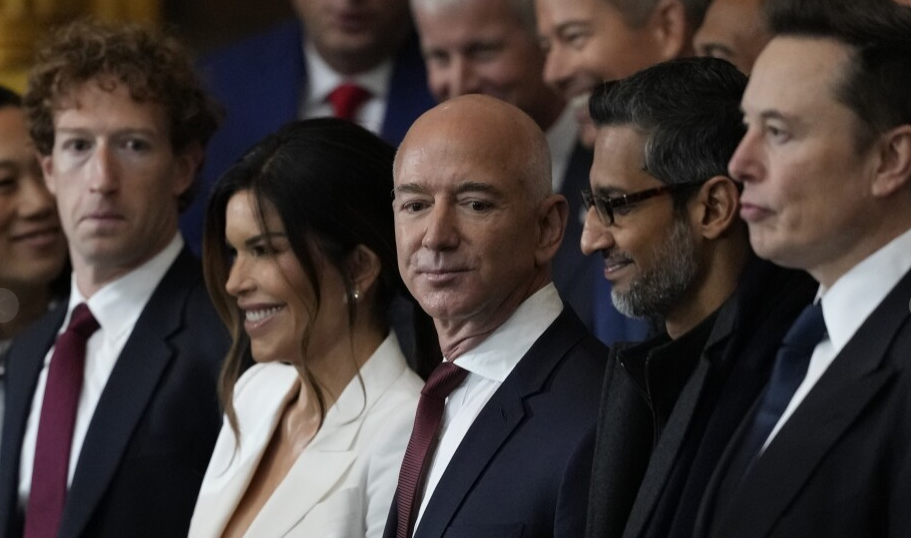
The 1960s version of The Magnificent Seven (itself a remake of Kurosawa’s Seven Samurai) before most of them were shot dead

In my last post, I suggested that there appeared to be a campaign to impugn the character of the younger generation as cover for reducing graduate recruitment, partly because of the desire to make AI systems of various sorts handle a wider and wider range of tasks. However there are other reasons why the value of AI needs to be promoted to the point where if your toaster or fridge is not using a chip they absolutely should be. It is all about the dependence of the US stock market on the so-called Magnificent 7 companies: Alphabet (Google), Apple, Meta (Facebook), Tesla, Amazon, Microsoft and Nvidia whose combined market capitalisation as at 22 July was 31% of the S&P500.

Nvidia? Who are they? They produce silicon chips. As Laura Bratton wrote in May:

As of Nvidia’s 2025 fiscal fourth quarter (the three months ending on Jan. 26 of this year), Bloomberg estimates that Microsoft spends roughly 47% of its capital expenditures directly on Nvidia’s chips and accounts for nearly 19% of Nvidia’s revenue on an annualized basis.

Meanwhile, 25% of Meta’s capital expenditures go to Nvidia and the company accounts for just over 9% of Nvidia’s annual revenue.

Amazon, Alphabet and Tesla are also big customers.

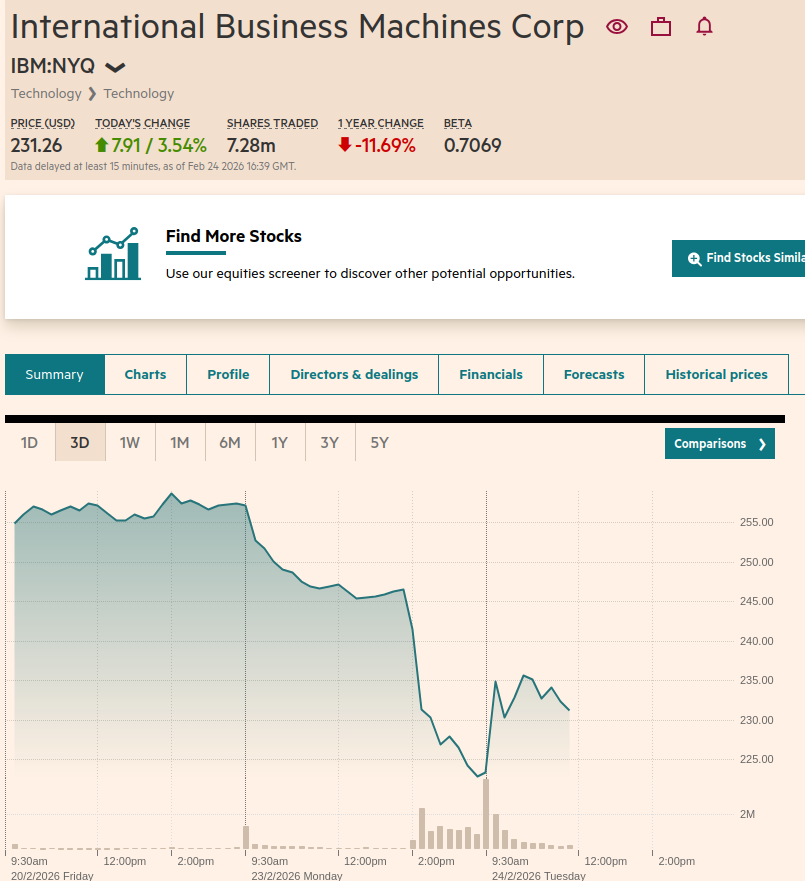
Nvidia is a growth stock, which means that it needs continued growth to support its share price. Once it ceases to be a growth stock then the kind of price earnings ratio it currently enjoys (nudging up to 60, by comparison the price earnings ratio of, say, HSBC is around 17.5) will no longer be acceptable to investors and a large correction in the share price will happen. So a growth slowdown in the Magnificent 7 is big news.

What would prevent a growth slowdown? Well a lot of processing-heavy sales for Facebook, Amazon, Apple and Google primarily. That is why there is now an AI overview of your Google search, why Rufus sits at the bottom of your Amazon search and everything appears to have a voice activated capability which can be accessed via Alexa or Siri these days.

Of course I am not arguing that there are not uses for large language models (LLMs) and other technologies currently wrapped up in the term AI. Seth Godin, usually a first mover in this space, has produced a set of cards with prompts for your LLM that you can tailor for various uses. Many people are seeing how AI applications can cut down the time they spend on everything from diary management to constructing PowerPoint presentations. There is no doubt that use of AI will have changed the way we do some things in a few years’ time. It will not, however, have replaced all of the jobs in Microsoft’s list, from mathematician to geographer to historian to writer. If you want a (much) fuller critique of what is misguided about the AI bubble, I refer you to The Hater’s Guide To The AI Bubble.

There is a lot of rough surrounding a few diamonds and the conditions for a bubble are all there. We know this because we have been here before. On 10 March 2000, the dotcom bubble burst. As Goldman Sachs puts it:

The Nasdaq index rose 86% in 1999 alone, and peaked on March 10, 2000, at 5,048 units. The mega-merger of AOL with TimeWarner seemed to validate investors’ expectations about the “new economy”. Then the bubble imploded. As the value of tech stocks plummeted, cash-strapped internet startups became worthless in months and collapsed. The market for new IPOs froze. On October 4, 2002, the Nasdaq index fell to 1,139.90 units, a fall of 77% from its peak.

Fortune are now claiming that the current AI boom is bigger than the dotcom bubble. And even leading figures in the AI industry admit that it is already a bubble.

This is where it gets interesting. The FT, in its reflection on these parallels, appears to be comforted by the big names involved this time:

To be sure, the parallels are not exact. They never are. While most of the dotcom companies were ephemeral newcomers, the Mag 7 include some of the world’s most profitable and impressive groups including Apple, Amazon and Microsoft, as well as the main supplier to the AI economy, Nvidia.

But of course this is the reason why it’s worse this time. We were able to manage without the “ephemeral newcomers”, although Amazon‘s share price fell by 90% over 2 years and Microsoft lost 60%, so the comparison is not quite true. However these companies were not the foundations of the economy then that they are now.

If Nvidia is the essential supply chain for all the other 6 of the Magnificent 7, then its own supply chain is equally precarious. As Ed Conway’s excellent Material World points out, Nvidia is “fabless” (ie without its own fabrication plant) and relies on Taiwan Semiconductor Manufacturing Company (TSMC) for the manufacture of its processors. They in turn are completely dependent on the company which makes the machines essential to their manufacturing units, ASML. As Conway says:

As of this moment, ASML is the only company in the world capable of making these machines, and TSMC is, alongside Samsung, the only company capable of putting such technology into mass production.

And then there are the raw materials required in these industries. Much has been made, by Diane Coyle and others, of the “weightless” nature of our global economy. Conway demolishes this fairly comprehensively:

In 2019, the latest year of data at the time of writing, we mined, dug and blasted more materials from the earth’s surface than the sum total of everything we extracted from the dawn of humanity all the way through to 1950.

There is a place in North Carolina called Spruce Pines where they mine the purest quartz in the world. As one person Conway interviewed said:

“If you flew over the two mines in Spruce Pine with a crop duster loaded with a very particular powder, you could end the world’s production of semiconductors and solar panels within six months.”

Whereas China controls the solar panel market it is reliant on imports for its semiconductors. In 2017 this cost China more than Saudi Arabia exported in oil or the entire global trade in aircraft.

Conway muses on whether China would invade Taiwan because of this and concludes probably not.

“Even if China invaded Taiwan and even if TSMC’s fabs survived the assault…that would not resolve its issue. Fab 18 [TSMC’s plant] might be where the world’s most advanced chips are made, but they are mostly designed elsewhere”.

However it would certainly be hugely disruptive if that were your goal. So even if the share prices of the Magnificent 7 don’t plummet of their own accord, they might be eviscerated by a crop duster or an assault on Taiwan.

There are so many needles poised to prick this particular bubble it would seem prudent to be cautious as a company in how dependent you should make yourselves to AI technology over the next few years.

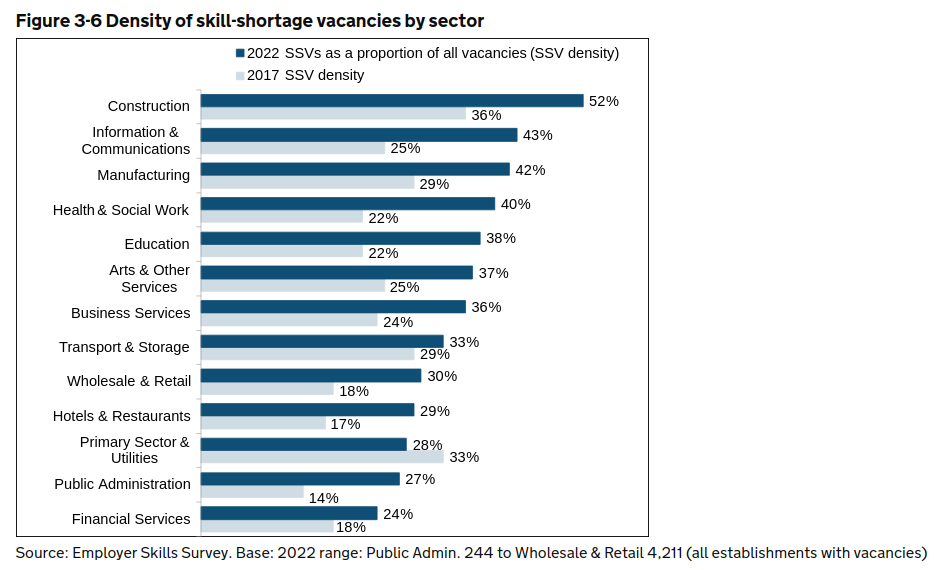
In a previous post, I mentioned the “diamond model” that accountancy firms are reportedly starting to talk about. The impact so far looks pretty devastating for graduates seeking work:

And then by industry:

Meanwhile, Microsoft have recently produced a report into the occupational implications of generative AI and their top 40 vulnerable roles looks like this (look at where data scientist, mathematician and management analyst sit – all noticeably more replaceable by AI than model which caused all the headlines when Vogue did it last week):

So this looks like a process well underway rather than a theoretical one for the future. But I want to imagine a few years ahead. Imagine that this process has continued to gut what we now regard as entry level jobs and that the warning of Dario Amodei, CEO of AI company Anthropic, that half of “administrative, managerial and tech jobs for people under 30” could be gone in 5 years, has come to pass. What then?

Well this is where it gets interesting (for some excellent speculative fiction about this, the short story Human Resources and novel Service Model by Adrian Tchaikovsky will certainly give you something to think about), because there will still be a much smaller number of jobs in these roles. They will be very competitive. Perhaps we will see FBI kind of recruitment processes becoming more common for the rarified few, probably administered by the increasingly capable systems I discuss below. They will be paid a lot more. However, as Cory Doctorow describes here, the misery of being the human in the loop for an AI system designed to produce output where errors are hard to spot and therefore to stop (Doctorow calls them, “reverse centaurs”, ie humans have become the horse part) includes being the ready made scapegoat (or “moral crumple zone” or “accountability sink“) for when they are inevitably used to overreach what they are programmed for and produce something terrible. The AI system is no longer working for you as some “second brain”. You are working for it, but no company is going to blame the very expensive AI system that they have invested in when there is a convenient and easily-replaceable (remember how hard these jobs will be to get) human candidate to take the fall. And it will be assumed that people will still do these jobs, reasoning that it is the only route to highly paid and more secure jobs later, or that they will be able to retire at 40, as the aspiring Masters of the Universe (the phrase coined by Tom Wolfe in The Bonfire of the Vanities) in the City of London have been telling themselves since the 1980s, only this time surrounded by robot valets no doubt.

But a model where all the gains go to people from one, older, generation at the expense of another, younger, generation depends on there being reasonable future prospects for that younger generation or some other means of coercing them.

In their book, The Future of the Professions, Daniel and Richard Susskind talk about the grand bargain. It is a form of contract, but, as they admit:

The grand bargain has never formally been reduced to writing and signed, its terms have never been unambiguously and exhaustively articulated, and noone has actually consented expressly to the full set of rights and obligations that it seems to lay down.

Atul Gawande memorably expressed the grand bargain for the medical profession (in Better) as follows:

The public has granted us extraordinary and exclusive dispensation to administer drugs to people, even to the point of unconsciousness, to cut them open, to do what would otherwise be considered assault, because we do so on their behalf – to save their lives and provide them comfort.

The Susskinds questioned (in 2015) whether this grand bargain could survive a future of “increasingly capable systems” and suggested a future when all 7 of the following models were in use:

  1. The traditional model, ie the grand bargain as it works now. Human professionals providing their services face-to-face on a time-cost basis.
  2. The networked experts model. Specialists work together via online networks. BetterDoctor would be an example of this.
  3. The para-professional model. The para-professional has had less training than the traditional professional but is equipped by their training and support systems to deliver work independently within agreed limits. The medical profession’s battle with this model has recently given rise to the Leng Review.
  4. The knowledge engineering model. A system is made available to users, including a database of specialist knowledge and the modelling of specialist expertise based on experience in a form that makes it accessible to users. Think tax return preparation software or medical self-diagnosis online tools.
  5. The communities of experience model, eg Wikipedia.
  6. The embedded knowledge model. Practical expertise built into systems or physical objects, eg intelligent buildings which have sensors and systems that test and regulate the internal environment of a building.
  7. The machine-generated model. Here practical expertise is originated by machines rather than by people. This book was written in 2015 so the authors did not know about large language models then, but these would be an obvious example.

What all of these alternative models had in common of course was the potential to no longer need the future traditional model professional.

There is another contract which has never been written down: that between the young and the old in society. Companies are jumping the gun on how the grand bargain is likely to be re-framed and adopting systems before all of the evidence is in. As Doctorow said in March (ostensibly about Musk’s DOGE when it was in full firing mode):

AI can’t do your job, but an AI salesman (Elon Musk) can convince your boss (the USA) to fire you and replace you (a federal worker) with a chatbot that can’t do your job

What strikes me is that the boss in question is generally at least 55. As one consultancy has noted:

Notably, the youngest Baby Boomers turned 60 in 2024—the average age of senior leadership in the UK, particularly for non-executive directors. Executive board directors tend to be slightly younger, averaging around 55.

Assume there was some kind of written contract between young and old that gave the older generation the responsibility to be custodian of all of the benefits of living in a civilised society while they were in positions of power so that life was at least as good for the younger generation when they succeeded them.

Every time a Baby Boomer argues that the state pension age increases because “we” cannot afford it, he or she is arguing both for the worker who will then be paying for his or her pension to continue to do so and that they should accept a delay in when they will get their quid pro quo, with no risk that the changes will be applied to the Boomer as all changes are flagged many years in advance. That contract would clearly be in breach. Every Boomer graduate from more than 35 years ago who argues for the cost of student loans to increase when they never paid for theirs would break such a contract. Every Boomer homeowner who argues against any measure which might moderate the house price inflation which they benefit from in increased equity would break such a contract. And of course any such contract worth its name would require strenuous efforts to limit climate change.

And a Boomer who removes a graduate job to temporarily support their share price (so-called rightsizing) in favour of a necessarily not-yet-fully-tested (by which I mean more than testing the software but also all of the complicated network of relationships required to make any business operate successfully) system then the impact of that temporary inflation of the share price on executive bonuses is being valued much more highly than both the future of the business and of the generation that will be needed to run it.

This is not embracing the future so much as selling a futures contract before setting fire to the actual future. And that is not a contract so much as an abusive relationship between the generations.

Trump mentions in BBC News US & Canada top feed around 4.30pm today. Out of 12 stories, 8 mention Trump by name in the headline https://www.bbc.co.uk/news/world/us_and_canada

You will have all seen the work mug staple: “The Difficult We Do Immediately. The Impossible Takes a Little Longer”. The original quotation in the title, originally attributed to Charles Alexandre de Calonne, the Finance Minister for Louis XVI, in response to a request for money from his Queen, Marie Antoinette, appeared in a collection from 1794, this was a year after Louis and Marie Antoinette (but not Charles, who survived another nine years) died on the guillotine and five since George Washington had been inaugurated as the first President of the United States. It seems as if the seemingly impossible may need to be attempted once again.

So let’s start by expanding on the problem which I brought up in my last post. The problem goes much wider than Donald Trump. He is assembling a court of loyalists around him, in the style of a mob boss, which as has been observed by others, has been the prelude to fascism in the past. As Jason Stanley, Professor of Philosophy at Yale and author of Erasing History: how fascists rewrite the past to control the future, puts it: “the United States is your enemy”. There is also considerable circumstantial evidence to suggest that Trump is considered an agent of influence by Putin’s regime in Russia.

The difficulty of what I am about to suggest is also the reason why it is so urgent: our relationship with the United States (the one we keep needing reassurance by successive US Presidents of its special nature) is positively symbiotic. George Monbiot lists some of our vulnerabilities here:

  1. Through the “Five Eyes” partnership, the UK automatically shares signals intelligence, human intelligence and defence intelligence with the US government. The two governments, with other western nations, run a wide range of joint intelligence programmes, such as Prism, Echelon, Tempora and XKeyscore. The US National Security Agency (NSA) uses the UK agency GCHQ as a subcontractor.
  2. Depending on whose definitions you accept, the US has either 11 or 13 military bases and listening stations in the UK. They include RAF Lakenheath in Suffolk, from which it deploys F-35 jets; RAF Menwith Hill in North Yorkshire, which carries out military espionage and operational support for the NSA in the US; RAF Croughton, part-operated by the CIA, which allegedly used the base to spy on Angela Merkel among many others; and RAF Fylingdales, part of the US Space Surveillance Network. If the US now sides with Russia against the UK and Europe, these could just as well be Russian bases and listening stations.
  3. Then we come to our weapon systems… among the crucial components of our defence are F-35 stealth jets, designed and patented in the US.
  4. Many of our weapons systems might be dependent on US CPUs and other digital technologies, or on US systems such as Starlink, owned by Musk, or GPS, owned by the US Space Force. Which of our weapons systems could achieve battle-readiness without US involvement and consent? Which could be remotely disabled by the US military?
  5. Then there is our independent nuclear deterrent, which is “neither British nor independent” according to Professor Norman Dombey, Emeritus Professor of Physics and Astronomy at the University of Sussex.

Then there is the sheer cost of rearming with Europe to the extent necessary in the absence of the United States’ support, suggesting 3.5% rather than 2.5% of GDP is what will be required, suggesting the UK Government, with its WCAIWCDI approach described here, will need to find something in addition to the foreign aid budget to ransack. I will be talking more about defence spending in a future post.

It is small wonder that some commentators, such as Arthur Snell, former Assistant Director for Counter-Terrorism at the Foreign and Commonwealth Office, conclude that disentangling ourselves from the United States may be impossible. And that is just considering defence and security considerations.

On the economy the symbiosis is just as evident. First of all there is the sizeable proportion of our imports and exports of both goods and services which are with the United States. Only in June 2023, we were trying hard to develop these further with something called the Atlantic Declaration. Although, as a recent speech by Megan Greene of the Bank of England’s Monetary Policy Committee shows, our trade with the US as a proportion has remained remarkably stable since 2000 at least.

Source: ONS and Bank calculations. Trade weights for each trading partner are calculated as the sum of bilateral exports and imports as a share of total UK trade. Data is annual and in current prices. EU refers to the EU27. Latest data point is 2023

Culturally, the United States is embedded in our laptops and mobile phones, our television programmes and movies, and our social media. Its concerns have permeated our language and our politics. A reasonable proportion of our political and financial elite have been to their universities and theirs to ours. Many of our employers have US parents: just in the actuarial world, two of the three biggest consultancies (Aon and Willis Towers Watson) are described as British-American firms, with the other one (Mercer) headquartered in New York. It has Apple. It has Amazon. It has Google. It has Meta and, of course, X.

And perhaps the greatest entanglement of our two countries is political, to the extent that we routinely send our politicians to each other countries to support election campaigns and our media breathlessly report every in and out of the US Presidential elections. We are lucky if a French or German one is mentioned more than a couple of weeks before it takes place. Whether it is the language thing (we are still VERY resistant to learning other languages) or the post imperial thing (feeling like we have a special understanding of the problems the United States face as a self-appointed global police force) or the degree of financialisation of our economy or for some other reason, it is very hard to avoid a sense of being conjoined with the United States of America.

But it is precisely because our relationship is so close in so many important areas that we are particularly vulnerable to US pressure – the harder it will be to disentangle ourselves, the more urgent it is that we do.

As David Allen Green puts it this week, the US is currently undergoing a diplomatic revolution. Originally applied to France’s realignment of all of its alliances away from Prussia and towards Austria, which ultimately led to the work mug motto at the start of this piece, the US appears to be realigning itself towards Russia and away from the UK and the EU. As Green goes on to say:

Other countries would now be prudent to regulate their affairs so as to minimise or eliminate their dependency on the United States – it is no longer a question of waiting out until the next United States elections.

And other political systems would be wise to limit what can be done within their own constitutions by executive order, and to strengthen the roles of the legislature and the judiciary (and also of internal independent legal advice within government).

The last seems key to me. We cannot, particularly now we are outside the EU, afford for our main ally to be capable of being so capricious. This applies whether the US are allowed to and do elect a President in 2028 who is respectful of its institutions and constitution. We always felt Americans were very respectful of their constitution because they never stopped talking about it, but it turns out to have been a thin veneer with little meaning. Much like our discussion of sovereignty in the UK.

The first thing we need to do is to stop obsessing about what John Mulaney memorably referred to as a “horse in a hospital” in 2019. Despite the fact that was five years ago and we have now seen a horse in the hospital before, many have been turned off news coverage altogether by the anxiety caused as a result of the constant media narration of what Trump and Musk have done next each day. The dangers of treating the Trump and Musk chaos as a TV show are potentially existential in the US but grave for us in the UK too.

While we may have deep sympathy for the people in the US and other countries caught up in the chaos, our priority has to be to get our own house in order. Otherwise we won’t be any help to anyone.

My priorities would be the ones I set out in October 2022, only now with much greater urgency.

  1. We can’t have parties with only 20% of the popular vote (34% of a 60% turnout) having an absolute majority of 174 seats. We need proportional representation, so that every vote counts equally and perhaps we might get somewhere near the turnout of Germany’s last election of 82.5%.
  2. Reform media ownership and promote plurality in support of a more democratic and accountable media system. The Media Reform Coalition has produced a manifesto for a people’s media which I support: it includes proposals for an Independent Media Commons – with participatory newsrooms, community radio stations, digital innovators and cultural producers, supported by democratically-controlled public resources to tell the stories of all the UK’s communities. As we know, our social media is controlled by Meta (with Facebook, WhatsApp and Instagram), all of which have more than 2 billion active users and Google with YouTube, also with more than 2 billion active users. X still has over half a billion, despite what Musk has done with it. In newspapers, 90% of daily circulation is controlled by three firms: News UK, Daily Mail Group and Reach plc (which has most of the local titles you’ve ever heard of, including the Birmingham Mail and Birmingham Live, as well as The Daily Express and the Daily Star).
  3. Reform election finance. Recommendations for doing this were provided in the July 2021 report by the Committee on Standards in Public Life. There was an eye-watering amount of money spent in the US Presidential Election this time: The Democrats spent $1.8 billion and the Republicans $1.4 billion, with $2.6 billion and $1.7 billion respectively being spent by the two parties on the Senate and House races. In the UK, paradoxically, the relatively small amount of money donated to parties mean that they are potentially more vulnerable to well organised lobbying operations. This is why the offer of $100 million by Musk to Reform led for calls to restrict foreign political donations to profits generated within the UK.

This way we would be more resilient to the many ways that the current chaotic United States establishment can reach into our own politics and governance, and start to develop policies with broad support which can reduce our dependency on the United States.

Risk trajectory (black circle) shows the anticipated future state for the risk in 2050. Current risk position in grey. Source: https://actuaries.org.uk/planetary-solvency

The excellent report from the Institute and Faculty of Actuaries and the University of Exeter Planetary Solvency – finding our balance with nature splits the risk trajectories into four sections: Climate, Nature, Society and Economy. I have focused on the Society one above as, in my view, this is the reason we are interested in all of the other ones. According to the Planetary Solvency report, we are on track for a society in 2050 described as follows:

Nature and climate risk trajectories will drive further biophysical constraints including stresses on water supply, further food supply impacts, heat stress, increased disease vectors, likely to drive migration and conflict. Possible to Likely risk of Severe to Decimation level societal impacts, with increasingly severe direct and indirect consequences of climate and nature risks driving socio-political fragmentation in exposed and vulnerable regions.

So what are we doing about it? Well the United States has just voted in Donald Trump as President. There was a flurry of executive orders issued in his first week (with the appropriate caveats about how many of these might actually be implemented), the climate-related ones of which are neatly summarised here by Bill McKibben:

The attacks on sensible energy policy have been swift and savage. We exited the Paris climate accords, paused IRA spending, halted wind and solar projects, gutted the effort to help us transition to electric vehicles, lifted the pause on new LNG export projects, canceled the Climate Corps just as it was getting off the ground, and closed the various government agencies dedicated to environmental justice. Oh, and we declared an “energy emergency” to make it easier to do all of the above.

Timothy Snyder has written about how to respond to tyranny in your own country. What is happening currently in the United States is threatening tyranny for many (as Robert Reich lists here):

The government now recognizes only two “immutable” genders, male and female. Migrants (now referred to as “aliens”) are being turned away at the border. Immigration agents are freed to target hospitals, schools, and churches in search of people to deport. Diversity efforts in the federal government have been dismantled and employees turned into snitches. Federal money will be barred from paying for many abortions.

The first thing you should do, according to Timothy Snyder, is to not obey in advance.

Most of the power of authoritarianism is freely given. In times like these, individuals think ahead about what a more repressive government will want, and then offer themselves without being asked. A citizen who adapts in this way is teaching power what it can do.

And how did we respond to all of this in the UK? Well Keir Starmer was keen to tell The Donald that we were deregulating to boost growth in their first phone call. His reward for this was the story that Trump thought he was doing a good job. Supposedly an endorsement from the “Drill Baby Drill” guy is the proper corrective from being told he should be locked up by the Nazi salute guy.

And then there were the actions on the environment. From the talking out of the Climate and Nature Bill which sought to meet new legally binding targets on climate change and protect nature. To a housing policy which will be both hugely environmentally destructive and fail to make houses more affordable. To announcing the intention to overhaul the planning rules, in the upcoming Planning and Infrastructure Bill, to reduce the power of people to object (and, as the Conservatives’ restrictions on protest have not been lifted, subsequently bang them up for years on end if we subsequently demonstrate about it) so that global firms would think that the UK was a “great place to invest” .

And then today we had Rachel Reeves’ big speech. Approval for developing the third runway at Heathrow, as had been extensively trailed, and the creation of “Europe’s Silicon Valley” between Oxford and Cambridge were the main announcements. There was quite a lot of talk about investment in sustainable aviation fuel (which means biofuels, the benefits of which have already been shown to be wiped out by rising demand).

And as for the Silicon Valley idea, I am not sure we want one. First there is the lack of real innovation despite the excellent game they talk. And second, is it going to be the authoritarian nightmare that the Californian one is turning into? The early signs are not good. Just last week Marcus Bokkerink, the Chair of the Competition and Markets Authority (CMA), was replaced by Doug Gurr, until recently Jeff Bezos’ head of Amazon UK. So not exactly standing up to Technofeudalism then.

According to Cory Doctorow:

Marcus Bokkerink, the outgoing head of the CMA, was amazing, and he had charge over the CMA’s Digital Markets Unit, the largest, best-staffed technical body of any competition regulator, anywhere in the world. The DMU uses its investigatory powers to dig deep into complex monopolistic businesses like Amazon, and just last year, the DMU was given new enforcement powers that would let it custom-craft regulations to address tech monopolization (again, like Amazon’s).

But it’s even worse. The CMA and DMU are the headwaters of a global system of super-effective Big Tech regulation. The CMA’s deeply investigated reports on tech monopolists are used as the basis for EU regulations and enforcement actions, and these actions are then re-run by other world governments, like South Korea and Japan.

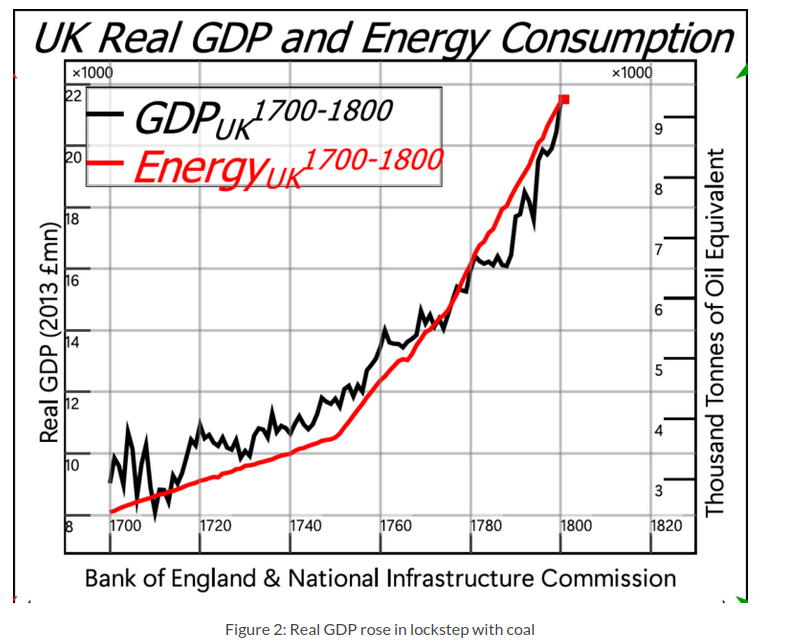
When you see Trump flanked by Bezos and the other Tech Bros at his inauguration, it certainly feels like we are obeying in advance. Rachel Reeves’ speech had an enormous increase in energy demand implicit in pretty much every measure announced, which is expected because, GDP (the thing she is looking to boost) and energy consumption have been in lockstep forever. This is the implication of prioritising GDP growth over everything else.

What were missing were both a compensatory increase in renewable energy capacity and/or a reorganisation of our economy away from energy intensity. The problem for the government is that the latter would not increase GDP, so instead we get into the absurd position of the Business Secretary saying we “cannot afford to not build runways”.

However it seems that when the motivation is big enough (in this case to dispute the assertion that the Russian economy is doing well in wartime despite the official statistics, which the EU really needs to do in order to continue to make the case for sanctions) alternative ways to measure the economy can be found. In section 3.2 we find this:

The general assumption of connecting GDP growth to making people better off is not relevant in this situation, which should be included in any discussion of how the Russian economy is doing.

What is interesting about this analysis is that:

a. It is carried out by the kind of orthodox economists (the Stockholm Institute of Transition Economics) who believe GDP would be a good index to use in normal circumstances; and

b. They are saying this even if the GDP figures published by Russia are technically accurate. As they go on to say:

What this analysis suggests is that if we believe in official Russian statistics, then Russia has economic capacity to sustain current policies in the short run, a conclusion shared with many other observers. We also find, though, that beyond the GDP numbers, the redirection into a war economy is already putting pressure on all sectors not directly involved in the war, causing internal macroeconomic imbalances, increasing risks in the financial sector, and eroding export revenues and existing reserves. Short term growth is kept up by a massive fiscal stimulus, but the impact is mitigated by necessary monetary contraction to deal with inflationary pressures, and structural factors (demographics, weak property rights) limiting the possible economic response to the stimulus.

Some of which sound familiar closer to home – “necessary monetary contraction” (things we cannot afford) and “increasing risks in the financial sector” anyone?

We are currently facilitating a world where the only capacity we are increasing is to fly over the climate-ravaged areas of the globe and their fleeing populations. Fly Baby Fly is not going to get us anywhere we want to go.

Came across this on YouTube today and it was such a brilliant discussion in the same area as my post from yesterday (which went out before I had seen this), but which went much further in a number of really interesting directions, that I thought many of you would be interested. Look out for a mention early in the video for the late great Iain Banks, science fiction fans!